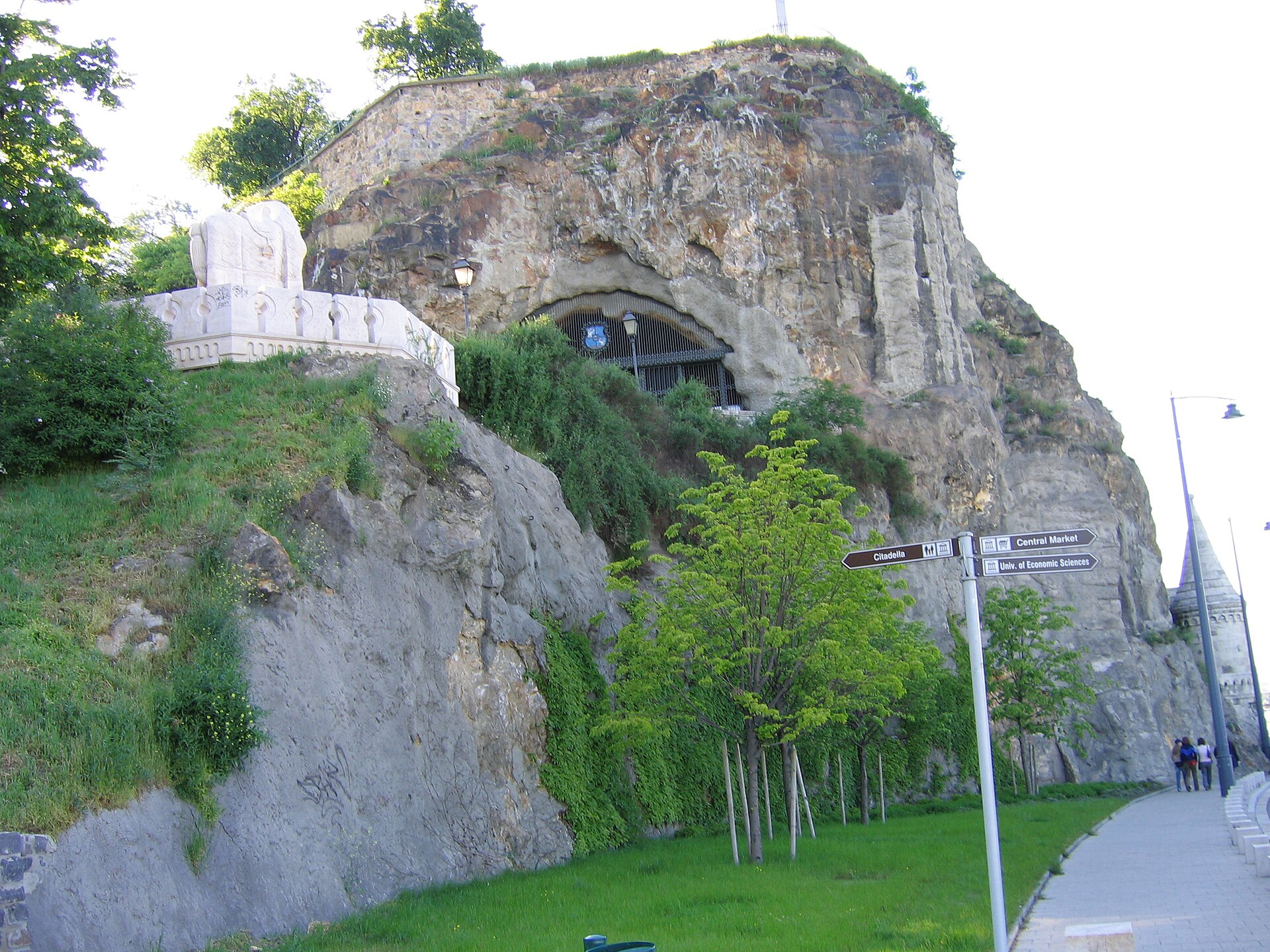
Gellért Hill Cave, also known as the Cave Church, is a natural cave system located within the Gellért Hill in Budapest. The cave was historically associated with Saint Ivan, a hermit who reportedly used the thermal waters of the nearby springs to heal the sick, giving the site a long-standing reputation as a place of spiritual and physical restoration.
In 1926, the cave was formally consecrated as a chapel by a group of Pauline monks who modeled the interior after the sanctuary at Lourdes. During the Communist era, the cave was sealed with a thick concrete wall and the monastery was suppressed, but it was reopened to the public in 1989 following the political transition in Hungary.
Key Facts
- Materials
- Natural limestone, Concrete, Wood
- Civilization
- Hungarian
- Accessibility
- Accessible via paved path; interior contains stairs
- Date(s)
- 1926 (consecration)
- Condition
- Active religious site and tourist attraction
- Original Function
- Hermitage and natural spring site
- Key Figures
- Saint Ivan, Pauline Order
Early History and Legend
MedievalThe cave was inhabited by a hermit known as Saint Ivan, who utilized the natural thermal springs of the area for medicinal purposes. The site became a destination for those seeking healing, cementing its status as a local sacred space.
Consecration as a Chapel
1926A group of Pauline monks returned to the site and established a chapel within the cave. The interior was designed to mirror the sanctuary at Lourdes, France, and it quickly became a significant pilgrimage site for Hungarian Catholics.
Suppression and Sealing
1951During the height of the Communist regime, the monastery was raided and the cave was forcibly closed. A thick concrete wall was constructed to seal the entrance, and the site remained inaccessible for nearly four decades.
Restoration and Reopening
1989-PresentFollowing the fall of the Iron Curtain, the cave was reopened and restored to its religious function. It currently serves as an active place of worship and a notable cultural landmark within the Budapest UNESCO World Heritage area.
Cultural Significance
The cave represents the intersection of natural geological features and religious devotion in Budapest. It serves as a symbol of resilience for the Hungarian Catholic Church, having survived decades of state-mandated closure to reclaim its role as a site of pilgrimage and reflection.
Interpretive Notes
Scholarly debates and areas of uncertainty
There is limited scholarly debate regarding the site, though historians occasionally discuss the extent to which the 'Saint Ivan' legend was embellished during the 19th-century romanticization of Budapest's history.
Visiting Information
Entry Rules
Open daily for visitors. Modest dress is required as it is an active place of worship. Entry is ticketed for tourists, with proceeds supporting the maintenance of the site.
Best Times to Visit
Early morning or late afternoon to avoid peak tourist crowds. The site is particularly atmospheric during the winter months.
Photography
Photography is permitted, but flash and tripods are prohibited inside the chapel to maintain the sanctity of the space.
Preservation Notes
The cave environment is sensitive to humidity and temperature changes. Visitors are requested to remain on designated paths and refrain from touching the cave walls.
Nearby POIs
11 shownSources & Further Reading
- [1]The Pauline Order in Hungary — László, P.. Budapest Historical Press (2010)
- [2]Budapest: A History of the City — Molnár, M.. Palgrave Macmillan (2001)
Key Facts
- Materials
- Natural limestone, Concrete, Wood
- Civilization
- Hungarian
- Accessibility
- Accessible via paved path; interior contains stairs
- Date(s)
- 1926 (consecration)
- Condition
- Active religious site and tourist attraction
- Original Function
- Hermitage and natural spring site
- Key Figures
- Saint Ivan, Pauline Order