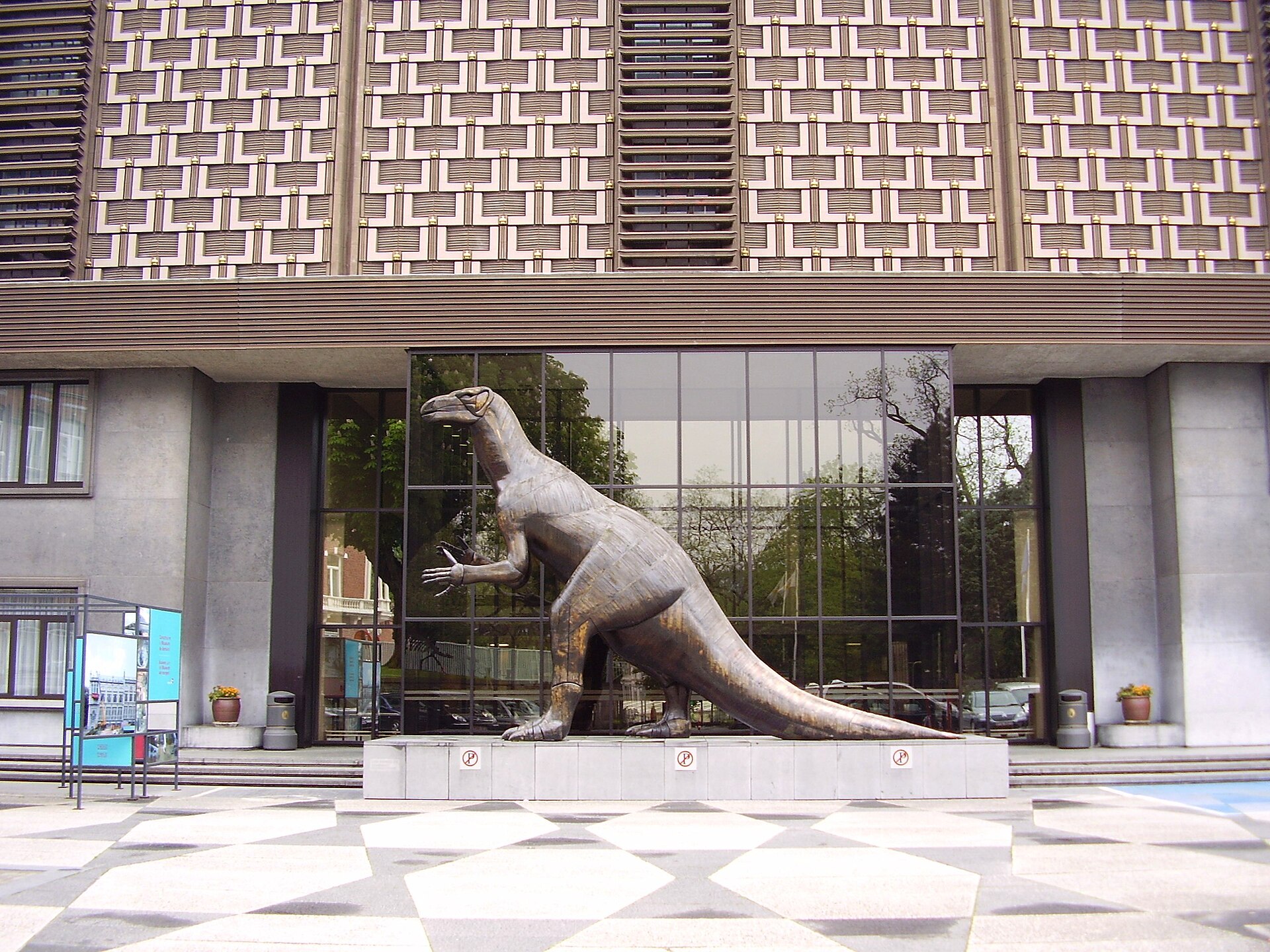
The Museum of Natural Sciences in Brussels is a premier research institution and public museum dedicated to the study of natural history. It is part of the Royal Belgian Institute of Natural Sciences and is internationally renowned for its extensive collection, which includes over 37 million specimens spanning geology, paleontology, and zoology.
The museum is most famous for its Gallery of Dinosaurs, which houses the world's largest collection of Iguanodon skeletons discovered in a coal mine in Bernissart in 1878. Beyond paleontology, the institution holds significant artifacts such as the Ishango bone, a 20,000-year-old tool fragment that provides evidence of early mathematical understanding in human history.
Key Facts
- Materials
- Brick, Stone, Glass, Steel
- Civilization
- Belgian
- Accessibility
- Fully wheelchair accessible with elevators and ramps
- Date(s)
- 1846
- Condition
- Active, well-maintained, and continuously updated
- Original Function
- Natural history research and exhibition
- Key Figures
- Louis Dollo, Jean de Heinzelin de Braucourt
Founding and Early Years
1846The museum was established as the Royal Museum of Natural History of Belgium, evolving from the earlier collections of the Royal Society of Brussels.
The Bernissart Discovery
1878The discovery of 30 nearly complete Iguanodon skeletons in a coal mine in Bernissart transformed the museum's collection, establishing it as a global center for dinosaur research.
Modern Expansion
20th-21st centuryThe museum underwent significant architectural expansions, including the construction of the modern wing to house the dinosaur gallery and the development of specialized research laboratories.
Cultural Significance
The museum serves as a cornerstone of Belgian scientific heritage, bridging the gap between academic research and public education. It plays a vital role in the national identity by preserving the country's paleontological discoveries and fostering public engagement with evolutionary biology and environmental science.
Interpretive Notes
Scholarly debates and areas of uncertainty
The interpretation of the Ishango bone remains a subject of academic discussion, particularly regarding whether the markings represent a tally system, a lunar calendar, or a more complex mathematical tool.
Visiting Information
Entry Rules
Open Tuesday to Sunday. Tickets can be purchased online or at the entrance. No food or drink allowed in the galleries.
Best Times to Visit
Weekday mornings are generally quieter, avoiding the peak school group visits that occur during the school year.
Photography
Personal photography is permitted without flash or tripods. Commercial photography requires prior authorization.
Preservation Notes
Do not touch the specimens or display cases. Maintain a respectful distance from the fossil mounts to ensure their long-term stability.
Nearby POIs
11 shown- Royal Palace of Brussels1.2 km
- Autoworld1.2 km
- Palace of Justice of Brussels1.3 km
- BELvue Museum1.3 km
- Royal Museums of Fine Arts of Belgium1.4 km
- Musical Instruments Museum1.4 km
- Church of Our Lady of Victories at the Sablon1.5 km
- Mont des Arts1.6 km
- Cathedral of St. Michael and St. Gudula1.7 km
- Belgian Comic Strip Center2 km
- Brussels City Museum2 km
Sources & Further Reading
- [1]Royal Belgian Institute of Natural Sciences: History — RBINS. Official Institutional Archive (2023)View
- [2]The Bernissart Iguanodons — Pascal Godefroit. Royal Belgian Institute of Natural Sciences Press (2012)
Key Facts
- Materials
- Brick, Stone, Glass, Steel
- Civilization
- Belgian
- Accessibility
- Fully wheelchair accessible with elevators and ramps
- Date(s)
- 1846
- Condition
- Active, well-maintained, and continuously updated
- Original Function
- Natural history research and exhibition
- Key Figures
- Louis Dollo, Jean de Heinzelin de Braucourt
Nearby POIs
11 shown- Royal Palace of Brussels1.2 km
- Autoworld1.2 km
- Palace of Justice of Brussels1.3 km
- BELvue Museum1.3 km
- Royal Museums of Fine Arts of Belgium1.4 km
- Musical Instruments Museum1.4 km
- Church of Our Lady of Victories at the Sablon1.5 km
- Mont des Arts1.6 km
- Cathedral of St. Michael and St. Gudula1.7 km
- Belgian Comic Strip Center2 km
- Brussels City Museum2 km