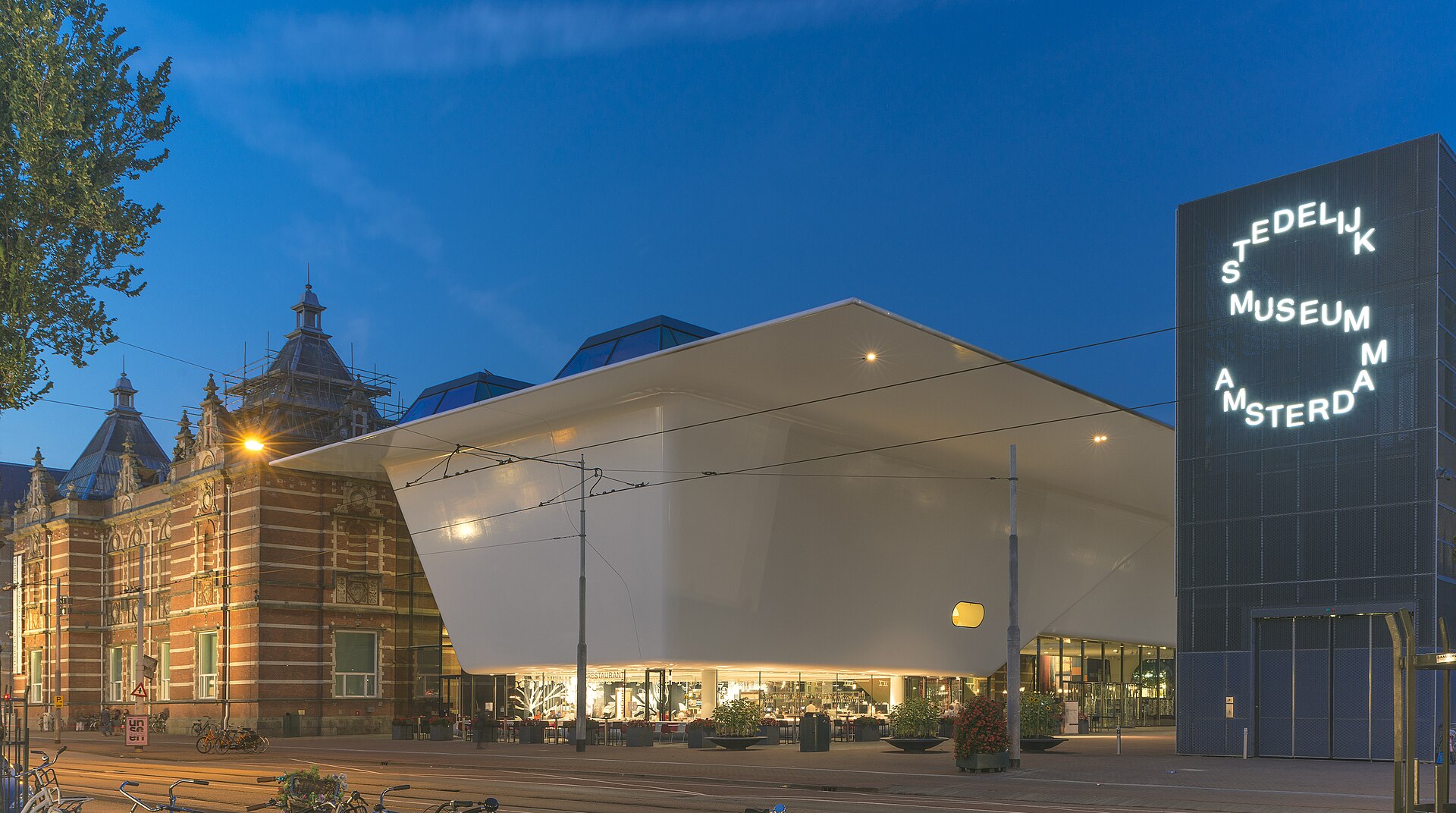
The Stedelijk Museum Amsterdam is the city's primary institution for modern and contemporary art and design. Founded in 1874, the museum houses a vast collection spanning the 20th and 21st centuries, featuring significant works by artists such as Henri Matisse, Pablo Picasso, Piet Mondrian, and Kazimir Malevich. The collection is particularly noted for its extensive holdings of De Stijl, CoBrA, and Abstract Expressionist movements.
The museum's physical identity is defined by the contrast between its original 1895 Neo-Renaissance building, designed by A.W. Weissman, and the controversial 2012 expansion by Benthem Crouwel Architects. Known colloquially as the 'bathtub' due to its distinctive white, floating form, the new wing provides a modern entrance and expanded exhibition space, bridging the historic Museumplein with contemporary architectural standards.
Key Facts
- Materials
- Brick, Stone, Composite fiber (bathtub wing)
- Civilization
- Dutch
- Accessibility
- Fully wheelchair accessible with elevators and ramps
- Date(s)
- 1895 (original), 2012 (expansion)
- Condition
- Active, fully restored and expanded
- Original Function
- Municipal museum for art and history
- Key Figures
- A.W. Weissman, Willem Sandberg, Benthem Crouwel Architects
Founding and Early Years
1874-1895The museum was established through private initiative and opened its doors in 1895. Initially, it housed a diverse collection including historical artifacts and the city's civic guard portraits, which were later transferred to the Rijksmuseum.
Modernist Transformation
1945-1963Under the directorship of Willem Sandberg, the museum shifted its focus exclusively to modern art. Sandberg introduced a radical, minimalist aesthetic and championed avant-garde movements, establishing the museum's international reputation.
Expansion and Modernization
2003-2012To accommodate a growing collection and modern visitor needs, the museum underwent a major renovation and expansion. The project culminated in the opening of the new wing, which significantly increased exhibition capacity and modernized the museum's infrastructure.
Cultural Significance
The Stedelijk Museum serves as the cultural anchor for modernism in the Netherlands. Its collection provides a comprehensive narrative of the evolution of visual arts, from the early 20th-century avant-garde to contemporary digital and installation art. It plays a critical role in the Dutch cultural landscape by fostering dialogue between historical movements and current artistic practice.
Beyond its collection, the museum is a central component of Amsterdam's Museumplein, a cultural hub that attracts millions of visitors annually. Its architectural evolution reflects the city's broader tension between preserving historic urban fabric and embracing bold, contemporary design.
Interpretive Notes
Scholarly debates and areas of uncertainty
The 2012 'bathtub' expansion sparked significant public and architectural debate regarding the preservation of historic urban landscapes. Critics argued the modern structure overwhelmed the 19th-century Neo-Renaissance building, while proponents praised the bold juxtaposition as a necessary evolution for a contemporary institution.
Visiting Information
Entry Rules
Open daily. Tickets can be purchased online or at the museum. Visitors are encouraged to book time slots in advance. Large bags and backpacks are not permitted in the galleries and must be stored in lockers.
Best Times to Visit
Weekday mornings or late Thursday evenings are generally less crowded than weekends. The museum is a popular destination, so booking in advance is recommended for peak tourist seasons.
Photography
Personal photography is permitted for non-commercial use without flash or tripods. Some temporary exhibitions may prohibit photography due to copyright restrictions.
Preservation Notes
Do not touch artworks or display cases. Maintain a respectful distance from exhibits. The museum maintains strict climate control to preserve sensitive modern materials.
Nearby POIs
11 shownSources & Further Reading
- [1]
- [2]The Architecture of the Museumplein — Hans Ibelings. NAi Publishers (2013)
Key Facts
- Materials
- Brick, Stone, Composite fiber (bathtub wing)
- Civilization
- Dutch
- Accessibility
- Fully wheelchair accessible with elevators and ramps
- Date(s)
- 1895 (original), 2012 (expansion)
- Condition
- Active, fully restored and expanded
- Original Function
- Municipal museum for art and history
- Key Figures
- A.W. Weissman, Willem Sandberg, Benthem Crouwel Architects