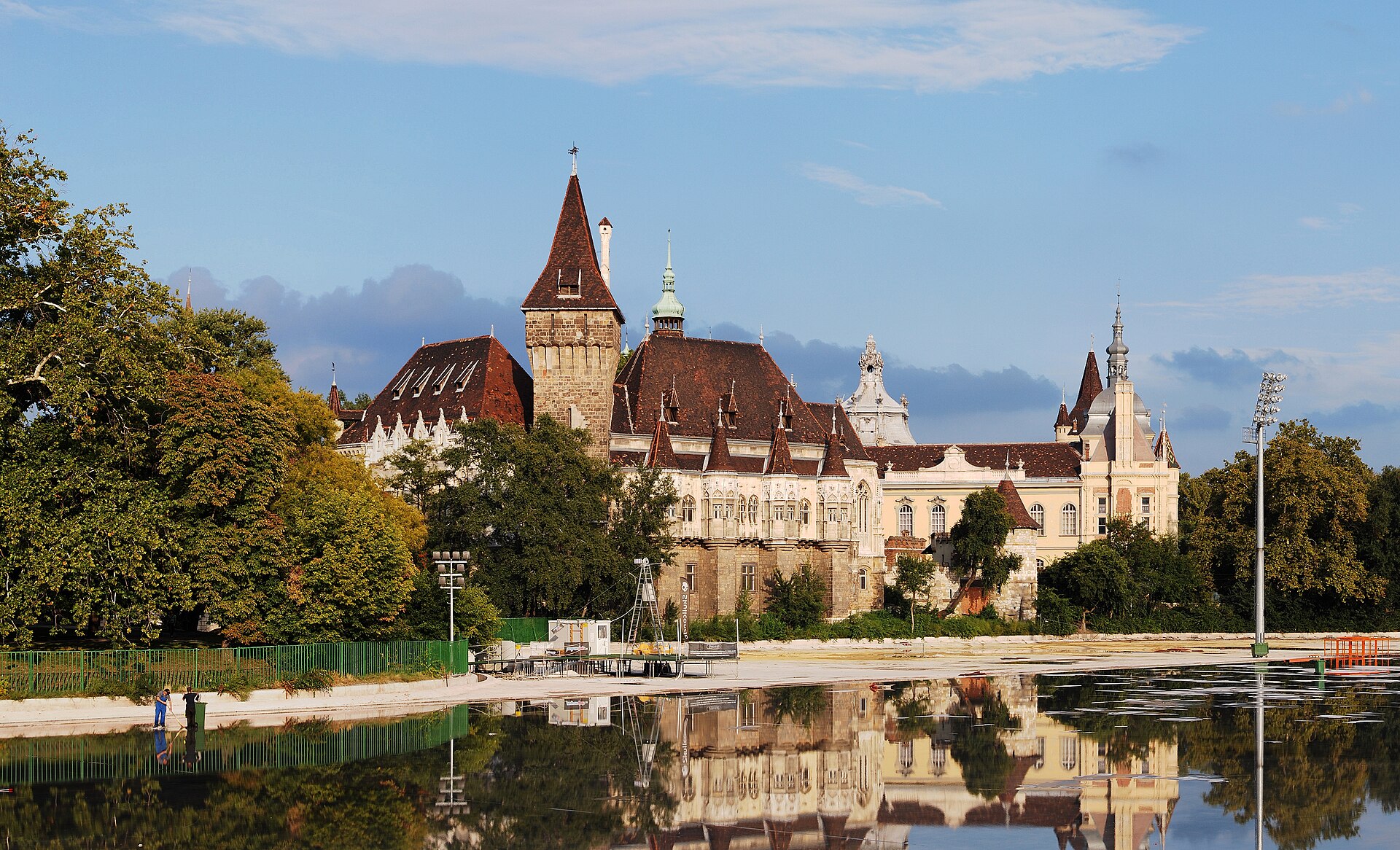
Vajdahunyad Castle is located in the City Park of Budapest, Hungary. Originally constructed as a temporary structure for the 1896 Millennial Exhibition, the castle was designed by Ignác Alpár to showcase the architectural evolution of Hungary over a thousand years. It features a diverse array of styles, including Romanesque, Gothic, Renaissance, and Baroque, inspired by various historical buildings across the Kingdom of Hungary.
Due to its immense popularity, the castle was rebuilt using permanent materials between 1904 and 1908. Today, it houses the Museum of Hungarian Agriculture, the largest agricultural museum in Europe. The complex is surrounded by a moat and is connected to the mainland by several stone bridges, serving as a prominent landmark within the Városliget park area.
Key Facts
- Materials
- Stone, Brick, Wrought iron
- Civilization
- Hungarian
- Accessibility
- Grounds are accessible; museum interior has limited accessibility
- Date(s)
- 1896 (temporary), 1904-1908 (permanent)
- Condition
- Well-preserved, active museum
- Original Function
- Exhibition pavilion
- Key Figures
- Ignác Alpár
Millennial Exhibition
1896The castle was commissioned as part of the celebrations marking the 1000th anniversary of the Hungarian Conquest. Architect Ignác Alpár designed the complex to incorporate copies of famous Hungarian structures, most notably the Hunyad Castle in Transylvania.
Permanent Reconstruction
1904-1908Following the success of the exhibition, the public demanded the preservation of the castle. The temporary wooden and plaster structures were replaced with permanent stone and brick, maintaining the original eclectic design.
Museum Establishment
20th CenturyThe castle became the permanent home of the Museum of Hungarian Agriculture, which focuses on the history of farming, viticulture, and forestry in the Carpathian Basin.
Cultural Significance
Vajdahunyad Castle serves as a physical timeline of Hungarian architectural history. By synthesizing disparate styles into a single complex, it reflects the 19th-century nationalist desire to consolidate and celebrate Hungarian identity and historical continuity.
It remains a central cultural hub in Budapest, frequently hosting festivals, concerts, and public events. The castle's romanticized appearance has made it a significant site for local tourism and a symbol of the City Park's historical landscape.
Interpretive Notes
Scholarly debates and areas of uncertainty
Debates often center on the castle's status as a 'pastiche' or 'copy' architecture. While some critics historically dismissed the structure as an imitation, modern architectural historians increasingly view it as a significant example of Historicism and a deliberate effort to create a national architectural narrative.
Visiting Information
Entry Rules
The castle grounds are open to the public at all times. The Museum of Hungarian Agriculture requires an entry ticket and operates on standard museum hours, typically Tuesday through Sunday.
Best Times to Visit
Spring and autumn are ideal for walking the castle grounds. The area is particularly popular during the winter months when the adjacent City Park lake is converted into an ice rink.
Photography
Personal photography is permitted in the courtyard and public grounds. Commercial photography requires prior authorization from the museum administration.
Preservation Notes
The structure is maintained by the City of Budapest. Visitors are advised to respect the historic masonry and avoid climbing on the exterior decorative elements.
Nearby POIs
11 shown- Budapest Hall of Art0.3 km
- Heroes' Square0.3 km
- Budapest Museum of Fine Arts0.4 km
- House of Terror Museum1.6 km
- St. Stephen's Basilica2.7 km
- Liberty Square2.7 km
- Hungarian Parliament Building2.9 km
- Margaret Island2.9 km
- Hungarian National Museum3 km
- Hungarian Railway Museum3.2 km
- Hungarian Natural History Museum3.7 km
Sources & Further Reading
- [1]The Millennial Exhibition of 1896 — József Sisa. Budapest History Museum (2002)
- [2]Architecture in Hungary: A Guide — László Gerő. Corvina Press (1985)
Key Facts
- Materials
- Stone, Brick, Wrought iron
- Civilization
- Hungarian
- Accessibility
- Grounds are accessible; museum interior has limited accessibility
- Date(s)
- 1896 (temporary), 1904-1908 (permanent)
- Condition
- Well-preserved, active museum
- Original Function
- Exhibition pavilion
- Key Figures
- Ignác Alpár
Nearby POIs
11 shown- Budapest Hall of Art0.3 km
- Heroes' Square0.3 km
- Budapest Museum of Fine Arts0.4 km
- House of Terror Museum1.6 km
- St. Stephen's Basilica2.7 km
- Liberty Square2.7 km
- Hungarian Parliament Building2.9 km
- Margaret Island2.9 km
- Hungarian National Museum3 km
- Hungarian Railway Museum3.2 km
- Hungarian Natural History Museum3.7 km