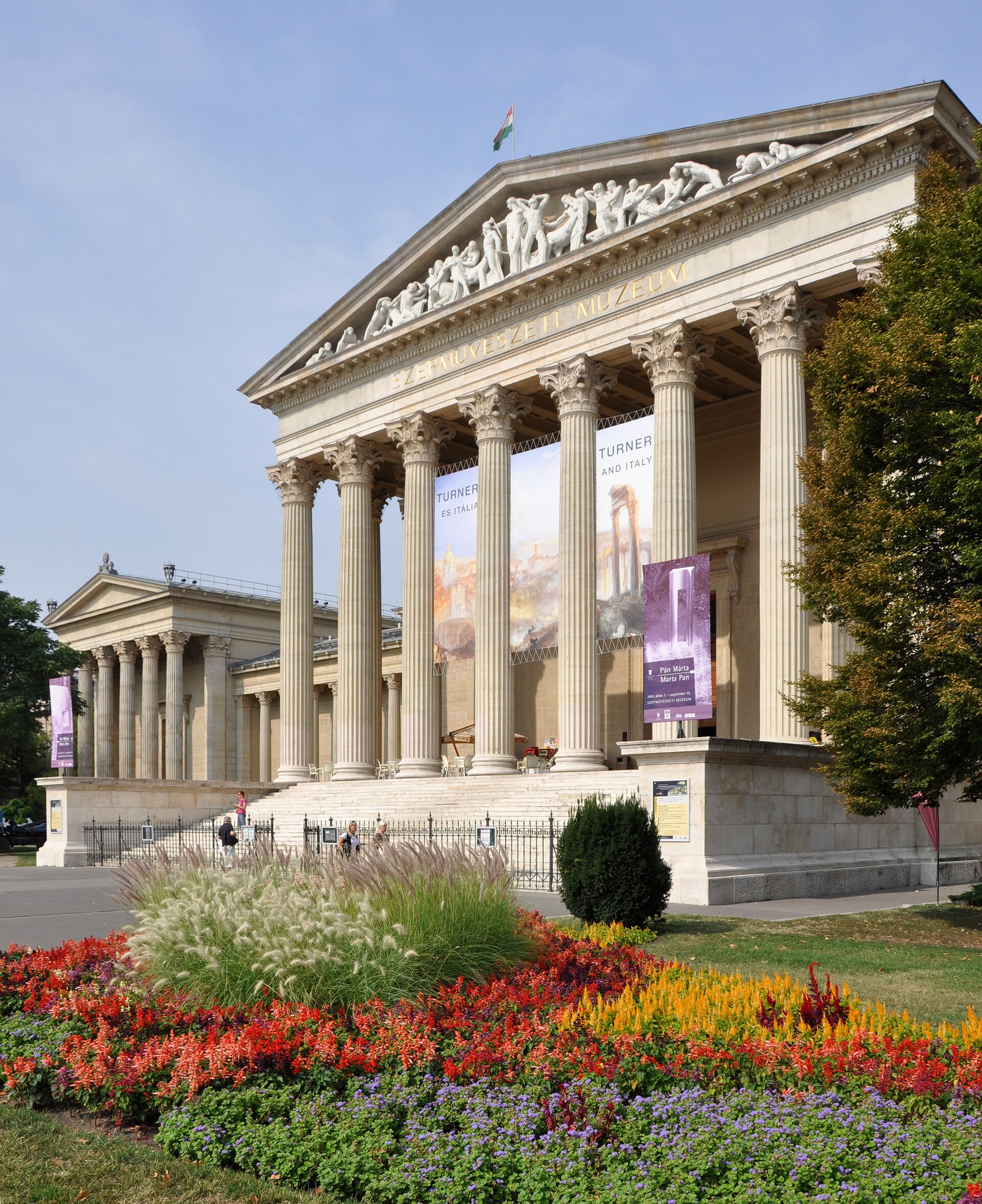
The Museum of Fine Arts in Budapest is a major cultural institution located on Heroes' Square, facing the Palace of Art. Designed by architects Albert Schickedanz and Fülöp Herzog in an eclectic-neoclassical style, the building was constructed between 1900 and 1906 to house the national collection of international art.
The museum's extensive holdings comprise over 100,000 pieces, spanning from antiquity to the contemporary era. Its collections are organized into six primary departments: Egyptian, Antique, Old Master Paintings, Sculpture, Modern Art, and the Graphics Collection, featuring significant works by artists such as El Greco, Goya, and Raphael.
Key Facts
- Materials
- Stone, Brick, Stucco
- Civilization
- Hungarian
- Accessibility
- Wheelchair accessible with elevator access to all floors
- Date(s)
- 1900-1906
- Condition
- Fully restored and active
- Original Function
- National art museum
- Key Figures
- Albert Schickedanz, Fülöp Herzog, Károly Pulszky
Founding and Construction
1896-1906The museum was established following the 1896 Millennium celebrations of Hungary. The government commissioned a purpose-built structure on the newly developed Heroes' Square to consolidate various royal and private art collections.
Expansion of Collections
1906-1945During the early 20th century, the museum significantly expanded its holdings through major acquisitions, including the Zichy collection and various private donations, establishing it as one of the most important art repositories in Central Europe.
Post-War and Modernization
1945-2018Following World War II, the museum underwent several reorganizations. In 2015, it closed for a major multi-year renovation project, which included the restoration of the Romanesque Hall and the modernization of climate control systems, reopening to the public in 2018.
Cultural Significance
The Museum of Fine Arts serves as the primary repository for international art in Hungary, playing a crucial role in the country's cultural diplomacy and education. Its location on Heroes' Square, a UNESCO World Heritage site, underscores its status as a cornerstone of Budapest's architectural and historical landscape.
Beyond its role as a gallery, the museum acts as a center for art historical research and conservation in Central Europe. It remains a vital institution for the preservation of European artistic heritage, bridging the gap between Eastern and Western art traditions.
Interpretive Notes
Scholarly debates and areas of uncertainty
Debates have historically centered on the provenance of certain works acquired during the mid-20th century, particularly regarding the restitution of art looted or displaced during the Second World War. The museum has engaged in ongoing research and transparency initiatives to address these historical claims.
Visiting Information
Entry Rules
Open Tuesday through Sunday. Tickets can at the entrance. Large bags and backpacks must be stored in lockers. Photography is permitted for personal use without flash.
Best Times to Visit
Weekday mornings are recommended to avoid weekend crowds. The museum is particularly popular during temporary international exhibitions.
Photography
Personal photography allowed without flash or tripods. Professional photography requires prior written permission from the museum administration.
Preservation Notes
Do not touch the artworks or display cases. Maintain a respectful distance from paintings and sculptures. Food and drink are strictly prohibited within the galleries.
Nearby POIs
11 shownSources & Further Reading
- [1]
- [2]Art and Architecture in Hungary — Géza Galavics. Corvina Books (2010)
Key Facts
- Materials
- Stone, Brick, Stucco
- Civilization
- Hungarian
- Accessibility
- Wheelchair accessible with elevator access to all floors
- Date(s)
- 1900-1906
- Condition
- Fully restored and active
- Original Function
- National art museum
- Key Figures
- Albert Schickedanz, Fülöp Herzog, Károly Pulszky