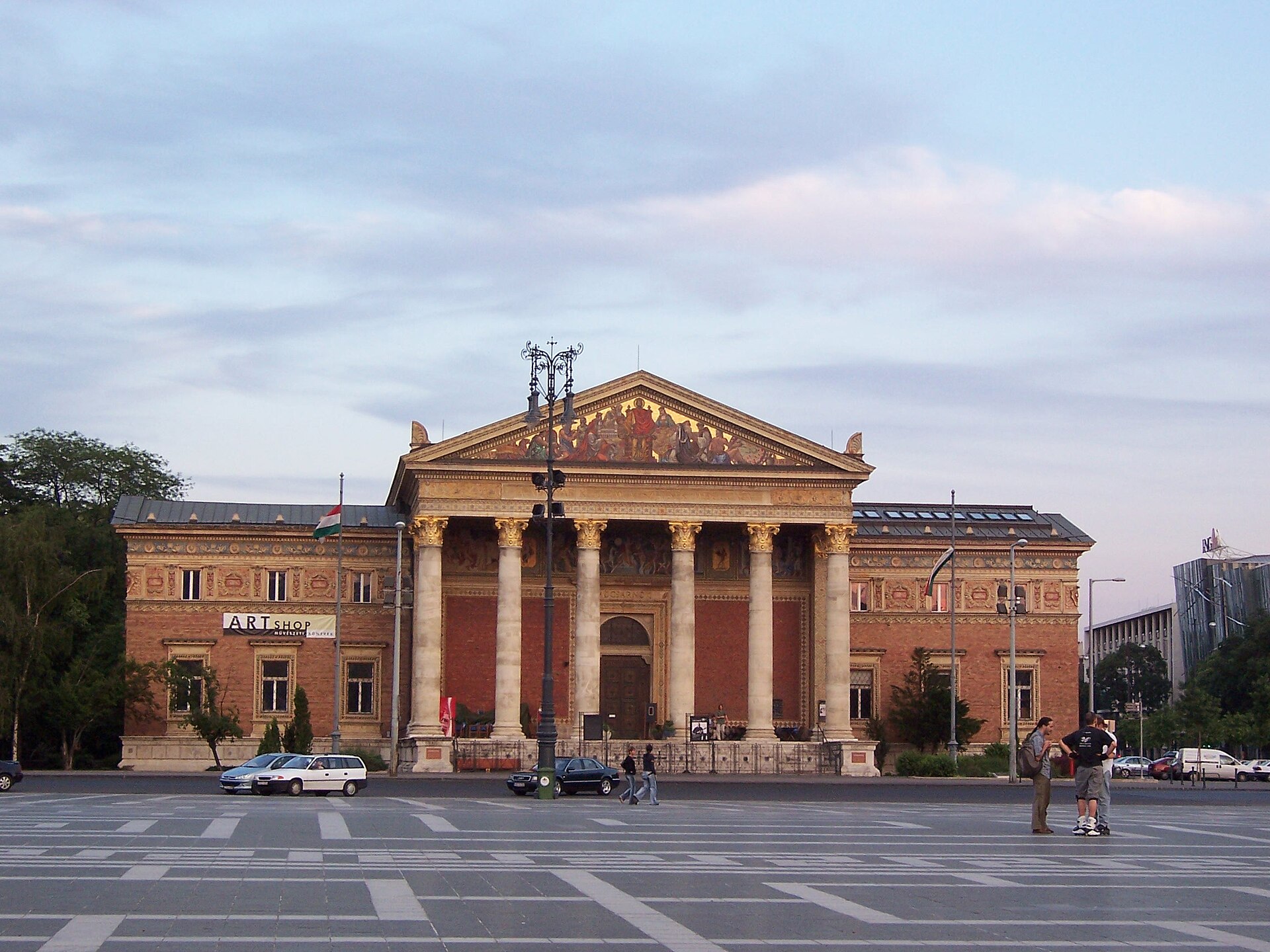
The Budapest Hall of Art, known locally as Műcsarnok, is a prominent exhibition hall located on Heroes' Square in Budapest. Designed by architects Albert Schickedanz and Fülöp Herzog, the building was completed in 1896 to commemorate the millennium of the Hungarian state. Its grand Neoclassical facade, featuring a prominent portico with six Corinthian columns, serves as a focal point of the city's monumental architecture.
Unlike many traditional museums, the Hall of Art does not maintain a permanent collection. Instead, it functions as a dynamic space for rotating exhibitions, primarily focusing on contemporary Hungarian and international fine art. The institution plays a central role in the country's cultural life, hosting large-scale thematic shows and retrospectives that bridge historical artistic traditions with modern creative practices.
Key Facts
- Materials
- Stone, Brick, Mosaic
- Civilization
- Hungarian
- Accessibility
- Wheelchair accessible
- Date(s)
- 1895-1896
- Condition
- Well-preserved, active exhibition space
- Original Function
- Exhibition hall for the Millennium Exhibition
- Key Figures
- Albert Schickedanz, Fülöp Herzog
Millennial Origins
1896The building was constructed as part of the massive urban development project for the 1896 Millennium Exhibition, which celebrated 1,000 years of Hungarian history. It was designed to provide a prestigious venue for contemporary art displays.
Architectural Evolution
1896-1945The structure was designed in a historicist style, heavily influenced by Neoclassical and Renaissance forms. It survived the turbulence of the early 20th century, including the two World Wars, largely intact, maintaining its function as a primary exhibition venue.
Modern Institutional Role
1945-PresentFollowing the Second World War, the institution shifted its focus toward contemporary art. It has undergone several renovations to modernize its interior gallery spaces while preserving the integrity of its historic exterior facade.
Cultural Significance
The Hall of Art is a cornerstone of Budapest's cultural identity, situated within the UNESCO World Heritage site of Andrássy Avenue and its surroundings. It serves as the primary national institution for contemporary fine arts, acting as a bridge between the historical legacy of the Millennium Exhibition and the evolving landscape of modern European art.
Interpretive Notes
Scholarly debates and areas of uncertainty
Discussions often center on the institution's role in balancing state-funded cultural programming with the need for independent contemporary artistic expression. Additionally, the architectural debate persists regarding the preservation of the building's historicist facade versus the requirements for modern, flexible gallery environments.
Visiting Information
Entry Rules
Open Tuesday through Sunday. Tickets can be purchased on-site or online. Visitors are expected to follow standard museum conduct; large bags must be left in lockers.
Best Times to Visit
Weekday mornings are generally quieter. The building is particularly notable during the evening when the facade is illuminated.
Photography
Non-commercial photography is permitted in most areas without flash. Specific exhibitions may have restrictions; please check signage at the entrance.
Preservation Notes
The building is a protected historical monument. Visitors are requested to refrain from touching the walls or architectural elements and to remain within designated exhibition areas.
Nearby POIs
11 shown- Heroes' Square0.1 km
- Vajdahunyad Castle0.3 km
- Budapest Museum of Fine Arts0.3 km
- House of Terror Museum1.3 km
- St. Stephen's Basilica2.4 km
- Liberty Square2.4 km
- Hungarian Parliament Building2.6 km
- Margaret Island2.8 km
- Hungarian National Museum2.8 km
- Hungarian Railway Museum3.4 km
- Hungarian Natural History Museum3.5 km
Sources & Further Reading
- [1]
- [2]The Millennium Exhibition of 1896 — Gábor Gyáni. Hungarian Historical Review (2010)
Key Facts
- Materials
- Stone, Brick, Mosaic
- Civilization
- Hungarian
- Accessibility
- Wheelchair accessible
- Date(s)
- 1895-1896
- Condition
- Well-preserved, active exhibition space
- Original Function
- Exhibition hall for the Millennium Exhibition
- Key Figures
- Albert Schickedanz, Fülöp Herzog
Nearby POIs
11 shown- Heroes' Square0.1 km
- Vajdahunyad Castle0.3 km
- Budapest Museum of Fine Arts0.3 km
- House of Terror Museum1.3 km
- St. Stephen's Basilica2.4 km
- Liberty Square2.4 km
- Hungarian Parliament Building2.6 km
- Margaret Island2.8 km
- Hungarian National Museum2.8 km
- Hungarian Railway Museum3.4 km
- Hungarian Natural History Museum3.5 km