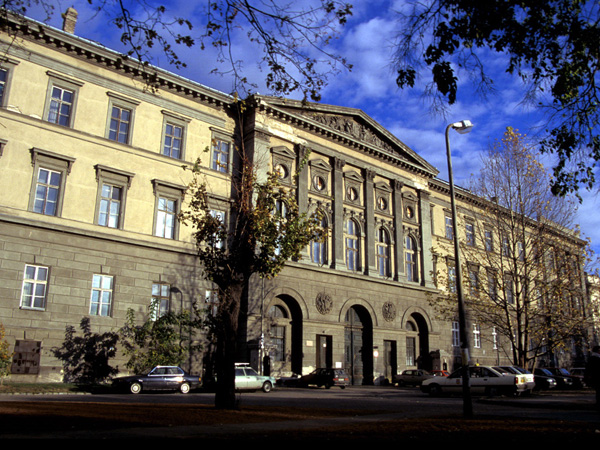
The Hungarian Natural History Museum, located in Budapest, houses the largest collection of natural history specimens in Hungary and the surrounding region. Established in 1802 as part of the Hungarian National Museum, it became an independent institution in the 20th century. The museum's extensive holdings include millions of items spanning zoology, botany, anthropology, mineralogy, and paleontology.
Currently housed in the Ludovika campus, the museum features permanent exhibitions that highlight the Carpathian Basin's biodiversity, geological history, and prehistoric life. Notable displays include a 20-meter fin whale skeleton, comprehensive dinosaur reconstructions, and detailed exhibits on coral reefs and mineralogy, serving as both a public educational center and a significant hub for scientific research.
Key Facts
- Materials
- Brick, Glass, Steel
- Civilization
- Hungarian
- Accessibility
- Fully wheelchair accessible
- Date(s)
- 1802 (founding)
- Condition
- Active museum and research facility
- Original Function
- Natural history collection and research
- Key Figures
- Count Ferenc Széchényi
Foundation and Early Years
1802The museum originated from the donation of Count Ferenc Széchényi's private collection to the Hungarian National Museum, forming the core of the nation's natural history archives.
Institutional Independence
20th CenturyFollowing decades of growth and reorganization, the natural history departments were separated from the National Museum to form an independent institution dedicated to biological and geological research.
Relocation to Ludovika
1990sThe museum moved to its current location in the historic Ludovika building complex in Budapest, which underwent extensive renovation to accommodate the vast collections and modern exhibition spaces.
Cultural Significance
The museum serves as the primary repository for Hungary's natural heritage, playing a critical role in the documentation of the Carpathian Basin's flora and fauna. It acts as a bridge between academic research and public education, fostering a deeper understanding of environmental conservation and evolutionary history within the region.
Interpretive Notes
Scholarly debates and areas of uncertainty
Ongoing discussions within the institution focus on the digitization of its massive biological collections to ensure long-term preservation and accessibility for international researchers, as well as the ethical curation of historical anthropological remains.
Visiting Information
Entry Rules
Open Tuesday to Sunday. Tickets can be purchased at the entrance or online. Photography for personal use is permitted without flash.
Best Times to Visit
Weekday mornings are generally quieter. The museum is a popular destination for school groups, so visiting during the academic off-season or late afternoons can provide a more relaxed experience.
Photography
Personal photography is allowed without flash or tripods. Professional or commercial photography requires prior authorization.
Preservation Notes
Do not touch specimens or display cases. Maintain a quiet environment to respect ongoing research activities within the building.
Nearby POIs
11 shownSources & Further Reading
- [1]Hungarian Natural History Museum Official Website — Hungarian Natural History Museum. nhmus.hu (2023)View
- [2]The History of the Hungarian Natural History Museum — Máté, Z.. Journal of Hungarian Science (2015)
Key Facts
- Materials
- Brick, Glass, Steel
- Civilization
- Hungarian
- Accessibility
- Fully wheelchair accessible
- Date(s)
- 1802 (founding)
- Condition
- Active museum and research facility
- Original Function
- Natural history collection and research
- Key Figures
- Count Ferenc Széchényi