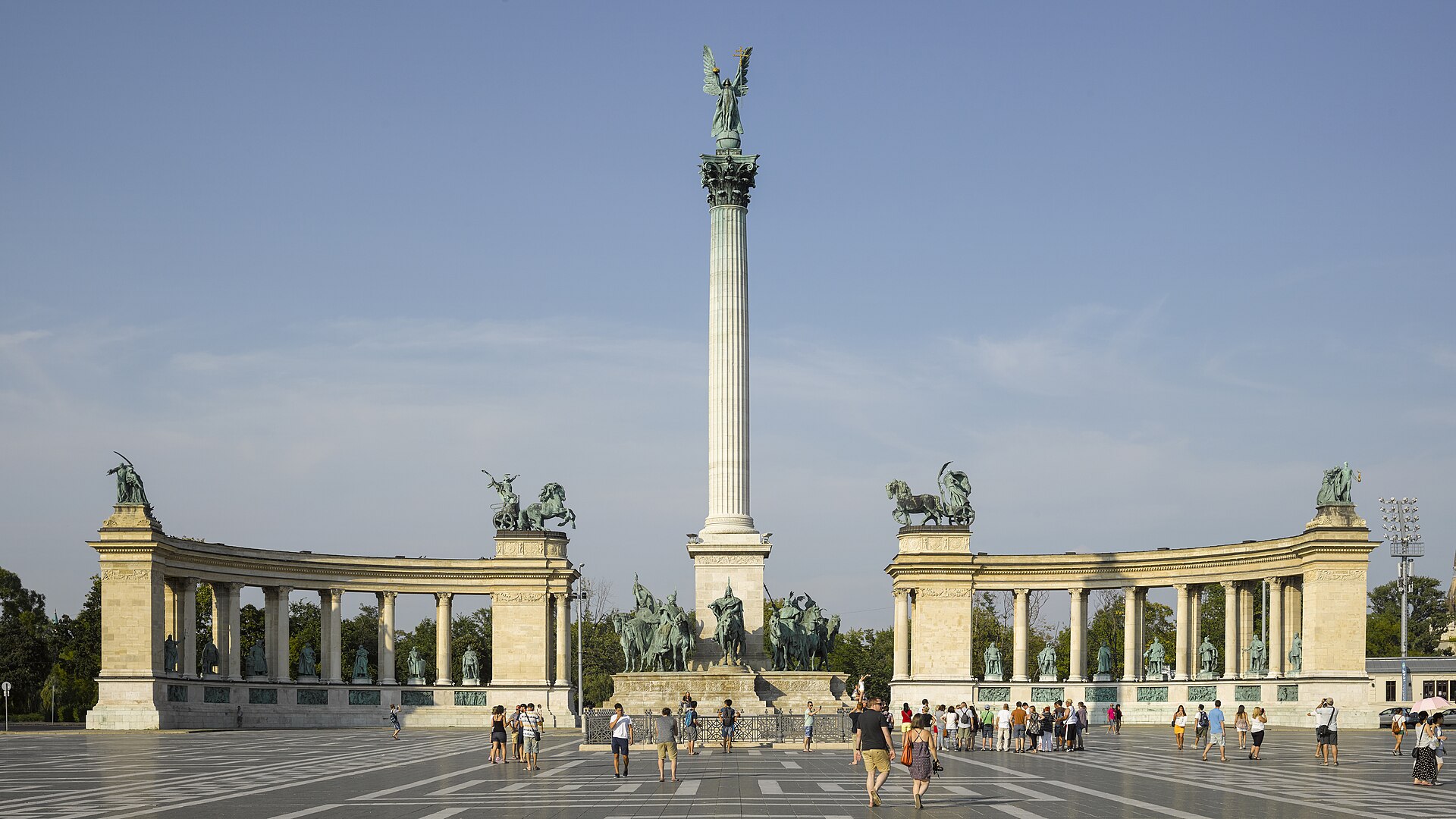
Heroes' Square, or Hősök tere, is one of the most significant public spaces in Budapest, located at the end of Andrássy Avenue. It serves as a monumental tribute to the historical figures who shaped the Hungarian nation, anchored by the Millennium Monument which was commissioned to commemorate the 1,000th anniversary of the Hungarian conquest of the Carpathian Basin.
The square is defined by a central column topped by the Archangel Gabriel, flanked by two semi-circular colonnades. These colonnades house bronze statues of the seven chieftains of the Magyars and other prominent figures from Hungarian history, creating a grand architectural ensemble that reflects the nationalistic fervor of the Austro-Hungarian era.
Key Facts
- Materials
- Stone, Bronze
- Civilization
- Hungarian
- Accessibility
- Fully accessible at ground level
- Date(s)
- 1896-1929
- Condition
- Well-preserved, public landmark
- Original Function
- Commemorative monument for the Millennium of Hungary
- Key Figures
- Albert Schickedanz, György Zala
Millennium Celebrations
1896The square was designed as the centerpiece for the 1896 Millennium Exhibition, celebrating 1,000 years since the Magyar settlement. Construction began in 1896, though the final statues were not completed until decades later.
Completion and Statuary
1900-1929The central column and the colonnades were gradually populated with statues. The original Habsburg monarchs were replaced after World War II with figures from the Hungarian struggle for independence, reflecting shifting political tides.
Modern Era
20th Century - PresentThe square has served as a site for major political demonstrations and state ceremonies. It remains a primary tourist destination and a symbol of Hungarian national identity, maintained as part of the Andrássy Avenue UNESCO World Heritage site.
Cultural Significance
Heroes' Square is the symbolic heart of Hungarian national history. It functions as a pantheon of the nation's leaders, bridging the gap between the legendary origins of the Magyar tribes and the modern Hungarian state. Its location at the terminus of the historic Andrássy Avenue underscores its importance in the urban planning and cultural narrative of Budapest.
The square has historically been a focal point for public expression, from the 1989 reburial of Imre Nagy, which signaled the end of communist rule in Hungary, to contemporary state celebrations. It remains a site where the collective memory of the nation is physically manifested and publicly observed.
Interpretive Notes
Scholarly debates and areas of uncertainty
Debates often center on the historical selection of the figures depicted in the colonnades. The replacement of Habsburg monarchs with national heroes following the Second World War is frequently analyzed by historians as a deliberate act of 'memory politics' intended to reframe Hungary's historical narrative away from imperial associations.
Visiting Information
Entry Rules
The square is a public space and is open 24 hours a day, seven days a week. There is no entry fee.
Best Times to Visit
Early morning or late evening to avoid large crowds and to view the monument illuminated at night.
Photography
No restrictions for personal photography. Commercial filming requires a permit from the Budapest municipal authorities.
Preservation Notes
The statues and stone structures are subject to regular cleaning and maintenance. Visitors are requested to refrain from climbing on the pedestals or the monument base.
Nearby POIs
11 shown- Budapest Hall of Art0.1 km
- Budapest Museum of Fine Arts0.2 km
- Vajdahunyad Castle0.3 km
- House of Terror Museum1.3 km
- St. Stephen's Basilica2.4 km
- Liberty Square2.4 km
- Hungarian Parliament Building2.6 km
- Margaret Island2.7 km
- Hungarian National Museum2.9 km
- Hungarian Railway Museum3.4 km
- Fisherman's Bastion3.5 km
Sources & Further Reading
- [1]Budapest: A History of the City — András Gerő. Corvina Books (2006)
- [2]The Millennium Monument and the Construction of National Identity — József Sisa. Journal of Architecture and Urbanism (2012)
Key Facts
- Materials
- Stone, Bronze
- Civilization
- Hungarian
- Accessibility
- Fully accessible at ground level
- Date(s)
- 1896-1929
- Condition
- Well-preserved, public landmark
- Original Function
- Commemorative monument for the Millennium of Hungary
- Key Figures
- Albert Schickedanz, György Zala
Nearby POIs
11 shown- Budapest Hall of Art0.1 km
- Budapest Museum of Fine Arts0.2 km
- Vajdahunyad Castle0.3 km
- House of Terror Museum1.3 km
- St. Stephen's Basilica2.4 km
- Liberty Square2.4 km
- Hungarian Parliament Building2.6 km
- Margaret Island2.7 km
- Hungarian National Museum2.9 km
- Hungarian Railway Museum3.4 km
- Fisherman's Bastion3.5 km