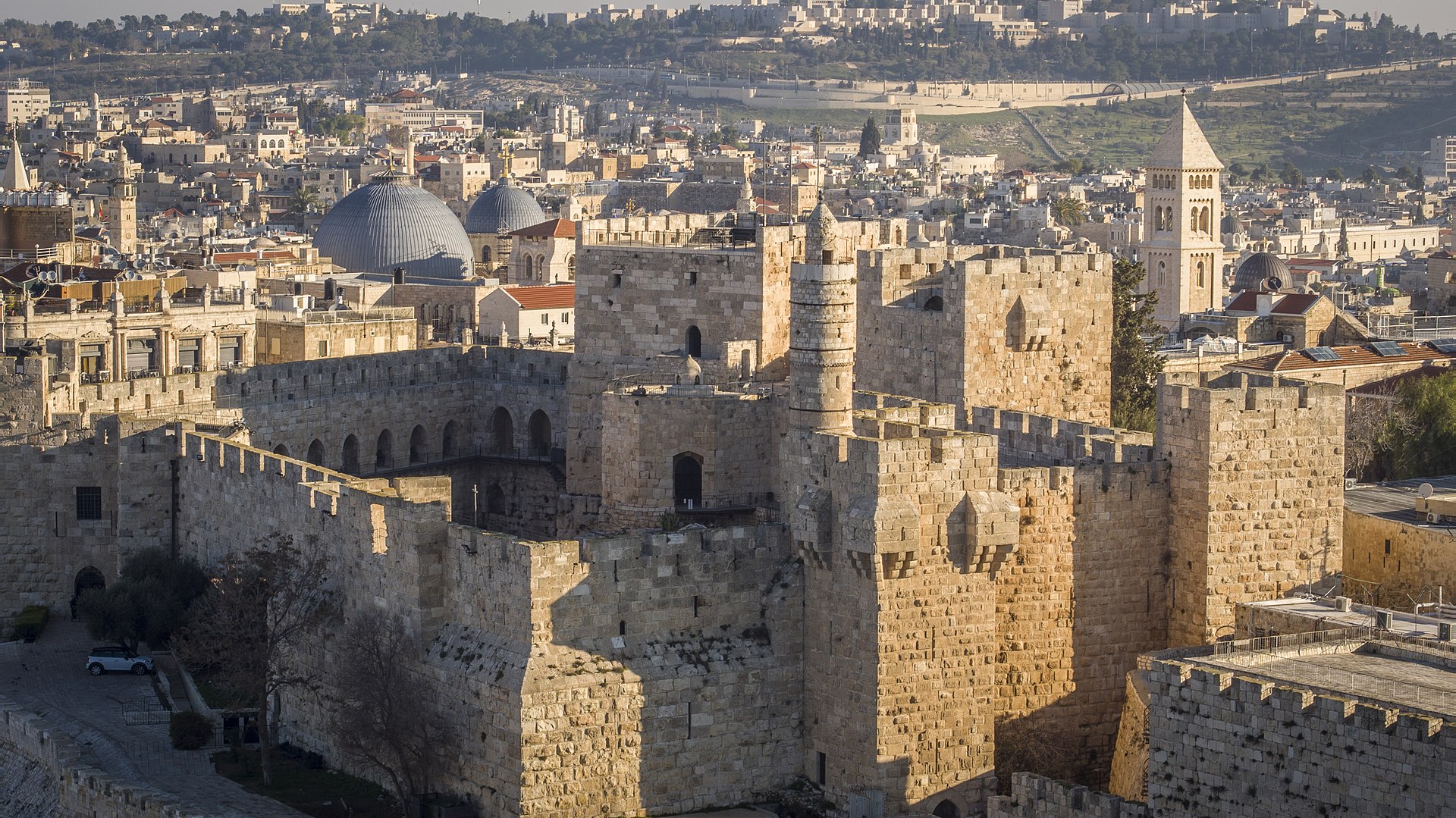
The Tower of David, also known as the Jerusalem Citadel, is an ancient fortification located near the Jaffa Gate entrance to the Old City of Jerusalem. The site has served as a strategic defensive position for over two millennia, with its foundations dating back to the Hasmonean period and later expanded by Herod the Great to protect his royal palace.
Throughout its history, the citadel has been destroyed and rebuilt by various ruling powers, including the Crusaders, Ayyubids, and Ottomans. Today, the complex houses the Tower of David Museum, which documents the history of Jerusalem through archaeological remains and multimedia exhibits, while the ramparts offer panoramic views of the Old City.
Key Facts
- Materials
- Limestone, Ashlar masonry
- Civilization
- Hasmonean, Herodian, Islamic, Crusader, Ottoman
- Accessibility
- Partially accessible; some areas involve uneven stone steps
- Date(s)
- 2nd century BCE - 17th century CE
- Condition
- Restored and active as a museum
- Original Function
- Fortress and palace defense
- Key Figures
- Herod the Great, Suleiman the Magnificent
Hasmonean and Herodian Origins
2nd century BCE - 1st century CEThe earliest fortifications were built by the Hasmoneans to defend the western side of the city. Herod the Great later expanded the site, constructing three massive towers to protect his palace, one of which—the Phasael Tower—remains the base of the current 'Tower of David'.
Medieval Transformations
11th - 13th centuryFollowing the Crusader conquest of Jerusalem in 1099, the citadel was significantly reinforced. It was later dismantled and rebuilt by the Ayyubids under Al-Mu'azzam Isa in the early 13th century to prevent the city from being used as a base by future crusading forces.
Ottoman Expansion
16th - 19th centurySuleiman the Magnificent rebuilt the citadel between 1537 and 1541, adding the iconic minaret that dominates the skyline. The structure served as a military barracks and prison throughout the Ottoman period.
Modern Era
20th century - presentFollowing the British Mandate, the site was converted into a museum in 1989. Extensive archaeological excavations conducted in the late 20th century revealed layers of history spanning from the Iron Age to the present day.
Cultural Significance
The Tower of David serves as a physical timeline of Jerusalem's complex history, representing the layers of conquest and cultural shifts that have defined the city. It is a central landmark for both local residents and international visitors, symbolizing the resilience and strategic importance of Jerusalem throughout the ages.
Interpretive Notes
Scholarly debates and areas of uncertainty
The identification of the site as the 'Tower of David' is a medieval misnomer; while the citadel sits on ancient foundations, there is no archaeological evidence linking the structure to the biblical King David. Scholars continue to debate the exact layout of the Herodian palace complex that once stood adjacent to the towers.
Visiting Information
Entry Rules
Open daily. Tickets are required for entry to the museum and ramparts. Modest dress is recommended as the site is located within the Old City.
Best Times to Visit
Early morning or late afternoon to avoid the midday heat and peak tour group hours. The evening sound and light show is a popular attraction.
Photography
Photography is permitted throughout the site. Tripods require prior authorization for commercial use.
Preservation Notes
The site is a protected archaeological zone. Visitors are requested to stay on designated paths and refrain from climbing on ancient masonry.
Nearby POIs
11 shownSources & Further Reading
- [1]The Jerusalem Citadel: A History — Hillel Geva. Israel Exploration Society (2014)
- [2]The Tower of David Museum: Archaeological Excavations — Renate Rosenthal-Heginbottom. Tower of David Museum Publications (2005)
Key Facts
- Materials
- Limestone, Ashlar masonry
- Civilization
- Hasmonean, Herodian, Islamic, Crusader, Ottoman
- Accessibility
- Partially accessible; some areas involve uneven stone steps
- Date(s)
- 2nd century BCE - 17th century CE
- Condition
- Restored and active as a museum
- Original Function
- Fortress and palace defense
- Key Figures
- Herod the Great, Suleiman the Magnificent