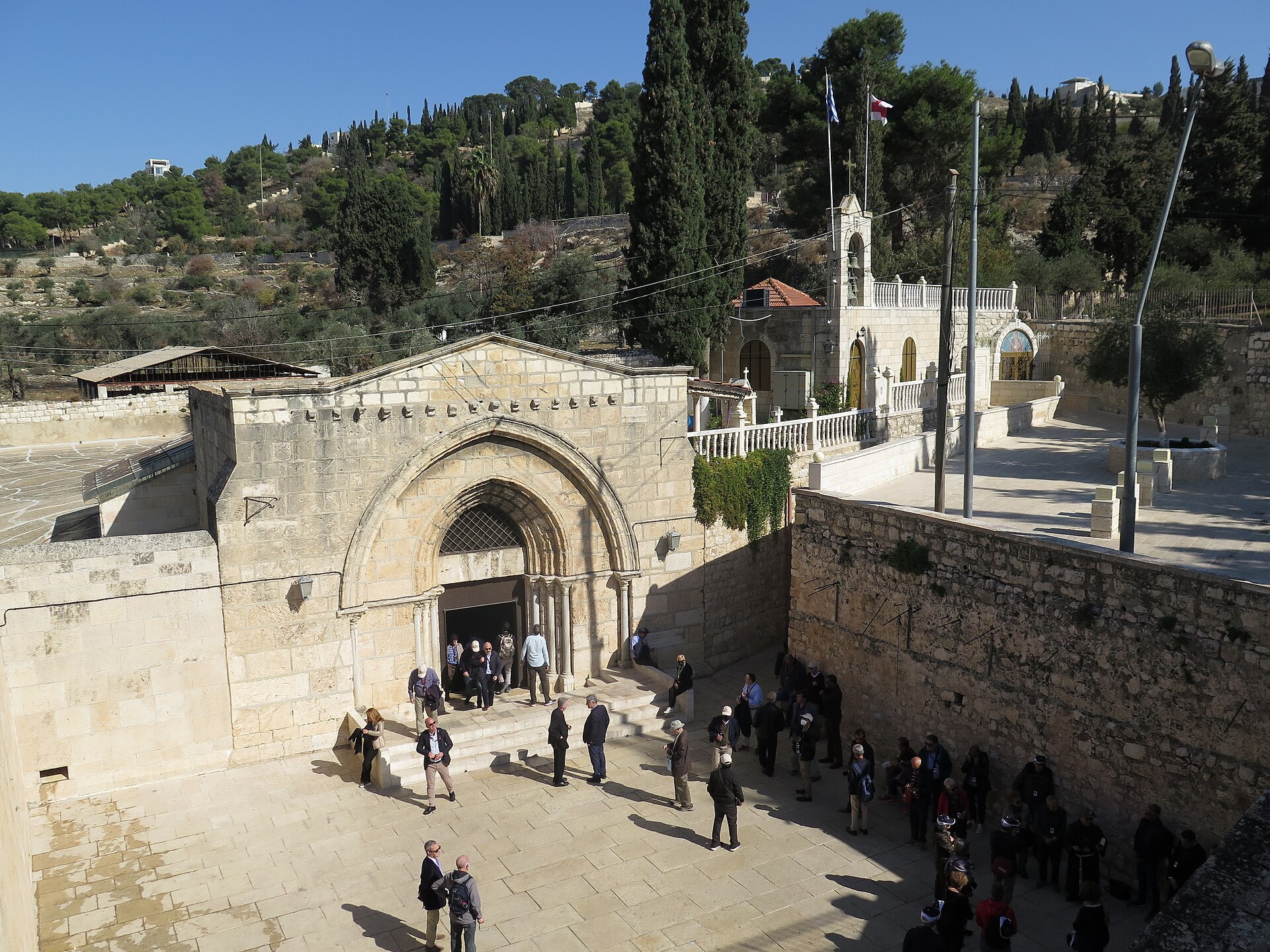
The Church of the Sepulchre of Saint Mary, also known as the Tomb of the Virgin Mary, is a Christian church located in the Kidron Valley at the foot of the Mount of Olives in Jerusalem. The structure is built around an ancient rock-cut tomb that, according to Eastern Christian tradition, served as the final resting place of Mary, the mother of Jesus.
The current subterranean structure dates primarily to the 12th century, featuring a wide stone staircase leading down to the tomb chamber. The site is shared by several Christian denominations, including the Greek Orthodox, Armenian Apostolic, and Syriac Orthodox churches, and remains an active site of pilgrimage and liturgical worship.
Key Facts
- Materials
- Limestone, Stone masonry
- Civilization
- Crusader / Byzantine
- Accessibility
- Staircase access only; not wheelchair accessible
- Date(s)
- 12th century (current structure)
- Condition
- Active, well-preserved
- Original Function
- Funerary site and church
- Key Figures
- Mary (mother of Jesus)
Early Foundations
5th centuryThe earliest church at this location was built in the 5th century. It was later destroyed and rebuilt in the 6th century by Emperor Maurice, though the original rock-cut tomb remained the focal point of the site.
Crusader Reconstruction
12th centuryThe present-day structure was largely constructed by the Crusaders in the 12th century. They established a Benedictine monastery on the site and added the distinctive Gothic-style entrance and staircase.
Modern Era
19th century - presentFollowing the Ottoman period, the site has been maintained by the various Christian denominations under the Status Quo agreement. It continues to serve as a major pilgrimage destination, particularly during the Feast of the Dormition.
Cultural Significance
The site holds profound significance for Eastern Orthodox and Oriental Orthodox Christians, who venerate it as the location of the Dormition and Assumption of the Virgin Mary. It serves as a symbol of the historical continuity of Christian presence in Jerusalem and is a focal point for liturgical life in the Holy Land.
Beyond its religious importance, the church is a significant example of Crusader-era architecture in Jerusalem. Its shared custody among multiple denominations reflects the complex religious landscape of the Old City and its surrounding valleys.
Interpretive Notes
Scholarly debates and areas of uncertainty
The historical authenticity of the tomb as the actual burial place of Mary is a subject of theological rather than archaeological consensus. While the tomb itself dates to the 1st century CE, there is no contemporary historical evidence confirming the identity of the person interred within.
Visiting Information
Entry Rules
Open daily. Entry is free. Modest dress is required (shoulders and knees covered). Visitors should be prepared for a steep descent via stone stairs.
Best Times to Visit
Early morning or late afternoon to avoid large tour groups. The site is particularly busy during the Feast of the Dormition in August.
Photography
Photography is permitted, but flash is discouraged inside the tomb chamber. Respectful behavior is required as it is an active place of worship.
Preservation Notes
The site is subterranean and prone to high humidity; visitors should be cautious on the stone steps which can be slippery. Do not touch the ancient rock surfaces.
Nearby POIs
11 shownSources & Further Reading
- [1]The Churches of the Crusader Kingdom of Jerusalem — Denys Pringle. Cambridge University Press (1993)
- [2]Jerusalem: The Holy City — Martin Gilbert. Henry Holt and Co. (1996)
Key Facts
- Materials
- Limestone, Stone masonry
- Civilization
- Crusader / Byzantine
- Accessibility
- Staircase access only; not wheelchair accessible
- Date(s)
- 12th century (current structure)
- Condition
- Active, well-preserved
- Original Function
- Funerary site and church
- Key Figures
- Mary (mother of Jesus)