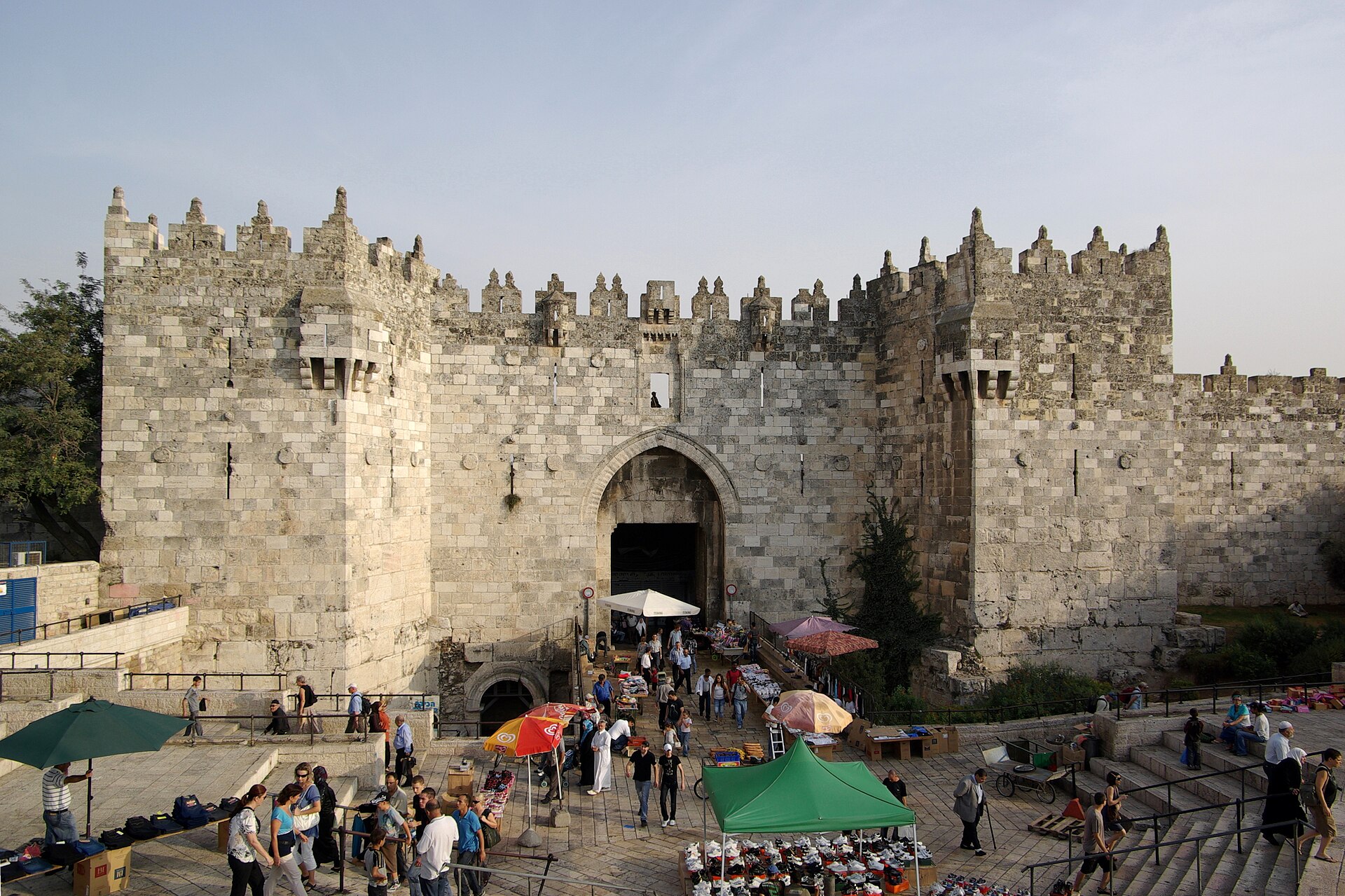
Damascus Gate, known in Arabic as Bab al-Amud and in Hebrew as Sha'ar Shechem, serves as the principal entrance to the Old City of Jerusalem. The current structure was constructed in 1537 by the Ottoman Sultan Suleiman the Magnificent, incorporating elements from earlier fortifications that date back to the Roman period.
The gate is characterized by its distinctive crenelated towers and a central archway that historically served as the starting point for the road leading north toward Nablus and Damascus. Beneath the modern street level, archaeological excavations have revealed the remains of a monumental Roman gate built by Emperor Hadrian in the 2nd century CE, which once featured a triple-arched entrance.
Key Facts
- Materials
- Limestone, Mortar
- Civilization
- Ottoman Empire
- Accessibility
- Accessible via public plaza; uneven stone surfaces inside
- Date(s)
- 1537 CE (Ottoman structure)
- Condition
- Well-preserved and active pedestrian entrance
- Original Function
- City gate and defensive fortification
- Key Figures
- Suleiman the Magnificent, Hadrian
Roman Foundations
2nd Century CEFollowing the Roman reconstruction of Jerusalem as Aelia Capitolina, Emperor Hadrian commissioned a monumental gate. Archaeological remains show a triple-arched structure, with the central arch serving as the primary passage.
Byzantine and Early Islamic Periods
4th-11th CenturyThe gate continued to serve as the northern entrance to the city. During this time, the area surrounding the gate became a center for commercial activity and religious pilgrimage.
Ottoman Reconstruction
1537 CESultan Suleiman the Magnificent ordered the rebuilding of the Old City walls. The current Damascus Gate was erected on the foundations of the earlier structures, utilizing the traditional defensive design of the era.
Modern Era
20th Century - PresentThe gate remains the busiest entrance to the Old City. Extensive excavations in the 1960s and 1980s exposed the Roman-era gate, which is now accessible to the public as an archaeological site.
Cultural Significance
Damascus Gate is the primary social and commercial hub for the Palestinian population of East Jerusalem. It serves as a vital link between the Old City and the bustling markets of the surrounding neighborhoods.
Beyond its functional role, the gate is a symbol of Jerusalem's layered history, where Ottoman architecture physically rests upon Roman foundations, reflecting the city's complex historical narrative.
Interpretive Notes
Scholarly debates and areas of uncertainty
There is ongoing discussion regarding the exact layout of the Roman-era gate and its relationship to the 'Third Wall' of Jerusalem described by Josephus. Scholars continue to debate the extent of the Roman fortifications and how they integrated with the city's topography during the 2nd century.
Visiting Information
Entry Rules
Open 24/7 as it is a public thoroughfare. No tickets required.
Best Times to Visit
Early morning for photography before the market crowds arrive. Friday afternoons are particularly busy due to prayers at the nearby Al-Aqsa Mosque.
Photography
None for personal use. Respectful behavior is expected as it is a high-traffic public area.
Preservation Notes
The site is an active pedestrian thoroughfare; please remain on designated paths. Archaeological areas beneath the gate require careful navigation due to uneven stone steps.
Nearby POIs
11 shownSources & Further Reading
- [1]The Walls of Jerusalem — Kathleen Kenyon. Oxford University Press (1967)
- [2]Jerusalem: The Biography — Simon Sebag Montefiore. Weidenfeld & Nicolson (2011)
Key Facts
- Materials
- Limestone, Mortar
- Civilization
- Ottoman Empire
- Accessibility
- Accessible via public plaza; uneven stone surfaces inside
- Date(s)
- 1537 CE (Ottoman structure)
- Condition
- Well-preserved and active pedestrian entrance
- Original Function
- City gate and defensive fortification
- Key Figures
- Suleiman the Magnificent, Hadrian