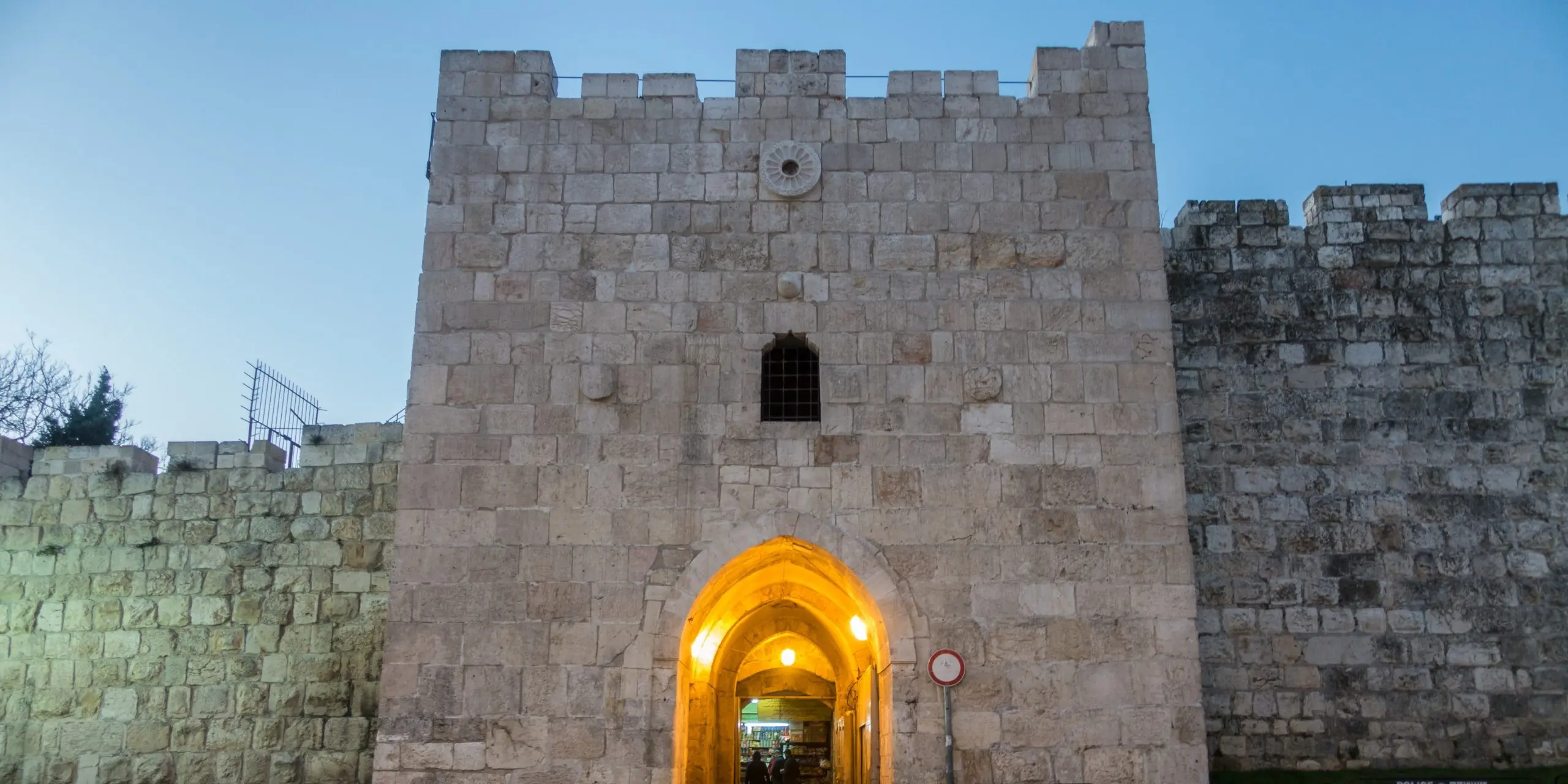
Herod's Gate, also known as the Flower Gate or Bab az-Zahra, is one of the seven open gates of the Old City of Jerusalem. Located in the northern wall, it serves as a primary pedestrian and vehicular access point connecting the Muslim Quarter of the Old City to the Palestinian neighborhood of Bab az-Zahra.
Unlike the grander gates of the Suleimanic walls, Herod's Gate was originally a small postern gate. It was expanded into its current form during the late 19th century to accommodate the growing traffic between the walled city and the expanding residential areas outside the walls.
Key Facts
- Materials
- Limestone
- Civilization
- Ottoman
- Accessibility
- Accessible to pedestrians and limited vehicular traffic
- Date(s)
- 1875
- Condition
- Active, well-maintained
- Original Function
- Postern gate for city access
- Key Figures
- Sultan Abdul Hamid II
Ottoman Origins
16th centuryThe gate was originally constructed as a small, narrow postern gate during the reign of Suleiman the Magnificent, when the current walls of the Old City were built between 1537 and 1541.
19th Century Expansion
1875As Jerusalem began to expand beyond the city walls in the late 19th century, the Ottoman authorities widened the gate to allow for easier passage of people and goods between the Muslim Quarter and the developing neighborhoods to the north.
Modern Era
20th century - presentThe gate remains a vital artery for the local population. It has undergone various conservation efforts to maintain the structural integrity of the surrounding wall sections while continuing to function as a busy thoroughfare.
Cultural Significance
Herod's Gate serves as a critical social and economic link for the residents of the Muslim Quarter. Its name, 'Flower Gate' (Bab az-Zahra), reflects the historical presence of gardens and orchards that once characterized the area outside the northern wall. It remains a focal point for daily life, connecting the dense urban fabric of the Old City with the commercial and residential life of East Jerusalem.
Interpretive Notes
Scholarly debates and areas of uncertainty
There is minor scholarly debate regarding the naming of the gate; while commonly referred to as Herod's Gate in Western guidebooks, the name is not historically linked to Herod the Great, but rather a misidentification by 16th-century pilgrims who believed the gate led to the house of Herod Antipas.
Visiting Information
Entry Rules
Open 24 hours. No tickets required. The gate is a public thoroughfare.
Best Times to Visit
Early morning or late afternoon to observe the daily commute of local residents. Avoid Friday afternoons during peak prayer times if seeking a quiet visit.
Photography
None, though respect for local pedestrians and traffic is expected.
Preservation Notes
The gate is part of the protected Old City walls. Do not climb on the masonry or obstruct the flow of traffic.
Nearby POIs
11 shown- Rockefeller Archeological Museum0.3 km
- Damascus Gate0.4 km
- Dome of the Rock0.6 km
- Church of the Holy Sepulchre0.6 km
- Church of the Sepulchre of Saint Mary0.6 km
- Western Wall0.7 km
- Museum on the Seam0.7 km
- Tower of David0.9 km
- David's Tomb1.3 km
- L. A. Mayer Museum for Islamic Art2.5 km
- Bible Lands Museum3.1 km
Sources & Further Reading
- [1]The Walls of Jerusalem — Denys Pringle. Oxford University Press (2007)
- [2]Jerusalem: The Biography — Simon Sebag Montefiore. Weidenfeld & Nicolson (2011)
Key Facts
- Materials
- Limestone
- Civilization
- Ottoman
- Accessibility
- Accessible to pedestrians and limited vehicular traffic
- Date(s)
- 1875
- Condition
- Active, well-maintained
- Original Function
- Postern gate for city access
- Key Figures
- Sultan Abdul Hamid II
Nearby POIs
11 shown- Rockefeller Archeological Museum0.3 km
- Damascus Gate0.4 km
- Dome of the Rock0.6 km
- Church of the Holy Sepulchre0.6 km
- Church of the Sepulchre of Saint Mary0.6 km
- Western Wall0.7 km
- Museum on the Seam0.7 km
- Tower of David0.9 km
- David's Tomb1.3 km
- L. A. Mayer Museum for Islamic Art2.5 km
- Bible Lands Museum3.1 km