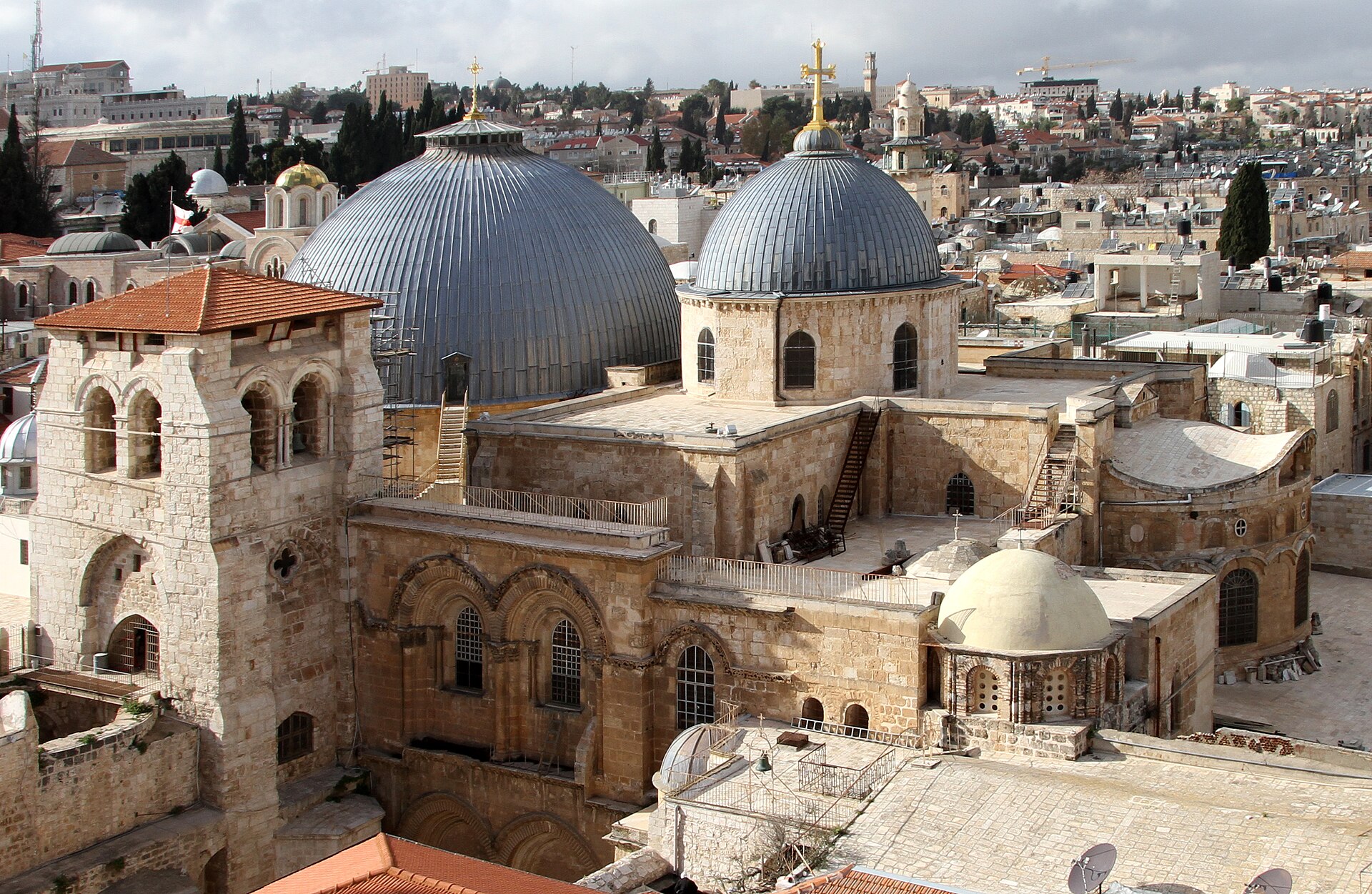
The Church of the Holy Sepulchre is located in the Christian Quarter of the Old City of Jerusalem. It is widely considered the site of the crucifixion, burial, and resurrection of Jesus of Nazareth, making it one of the most significant pilgrimage destinations in Christendom since the 4th century.
The current structure is a complex architectural amalgamation resulting from centuries of destruction, reconstruction, and expansion. It houses the Aedicule, a small shrine enclosing the traditional site of the tomb, and the Rock of Calvary, where the crucifixion is believed to have occurred. The site is jointly managed by several Christian denominations under a strict status quo agreement.
Key Facts
- Materials
- Limestone, Marble, Wood
- Civilization
- Byzantine, Crusader
- Accessibility
- Limited; uneven stone floors and narrow passages
- Date(s)
- 325-335 CE (original); 1149 CE (current main structure)
- Condition
- Active, multi-denominational place of worship
- Original Function
- Christian pilgrimage site and basilica
- Key Figures
- Saint Helena, Constantine the Great, Queen Melisende
Constantinian Foundation
4th century CEFollowing the Council of Nicaea, Emperor Constantine the Great ordered the construction of a church over the site identified by his mother, Saint Helena, as the tomb of Jesus. The original complex included a rotunda and a basilica.
Destruction and Reconstruction
1009-1149 CEThe original structures were largely destroyed by the Fatimid Caliph al-Hakim bi-Amr Allah in 1009. The site was partially rebuilt by the Byzantines, but the current Romanesque structure was primarily established by the Crusaders in the 12th century.
Status Quo and Modern Era
18th century - presentThe 'Status Quo' agreement, formalized in the 18th and 19th centuries, dictates the rights and responsibilities of the various denominations—primarily the Greek Orthodox, Armenian Apostolic, and Roman Catholic churches—who share custody of the building.
Cultural Significance
The church serves as the spiritual epicenter for millions of Christians worldwide. Its complex management reflects the deep historical and theological intersections of the various traditions that maintain the site, serving as a symbol of both unity and the historical divisions within Christianity.
Interpretive Notes
Scholarly debates and areas of uncertainty
The authenticity of the site's location has been debated since the 19th century. While the site was identified in the 4th century, some scholars have proposed the 'Garden Tomb' as an alternative location, though archaeological evidence generally supports the traditional site's location outside the city walls of the 1st century.
Visiting Information
Entry Rules
Open daily. Admission is free. Modest dress is required (shoulders and knees covered). The church can be extremely crowded; visitors are advised to arrive early in the morning.
Best Times to Visit
Early morning (before 7:00 AM) to avoid large tour groups and long queues for the Aedicule.
Photography
Photography is permitted, but flash and tripods are strictly prohibited. Respectful behavior is required as it is an active place of worship.
Preservation Notes
The structure is subject to ongoing maintenance under the Status Quo. Visitors should be aware of scaffolding and temporary barriers used for structural preservation.
Nearby POIs
11 shownSources & Further Reading
- [1]The Church of the Holy Sepulchre — Martin Biddle. Yale University Press (1999)
- [2]The Architecture of the Holy Sepulchre — Robert Ousterhout. Journal of the Society of Architectural Historians (1989)
Key Facts
- Materials
- Limestone, Marble, Wood
- Civilization
- Byzantine, Crusader
- Accessibility
- Limited; uneven stone floors and narrow passages
- Date(s)
- 325-335 CE (original); 1149 CE (current main structure)
- Condition
- Active, multi-denominational place of worship
- Original Function
- Christian pilgrimage site and basilica
- Key Figures
- Saint Helena, Constantine the Great, Queen Melisende