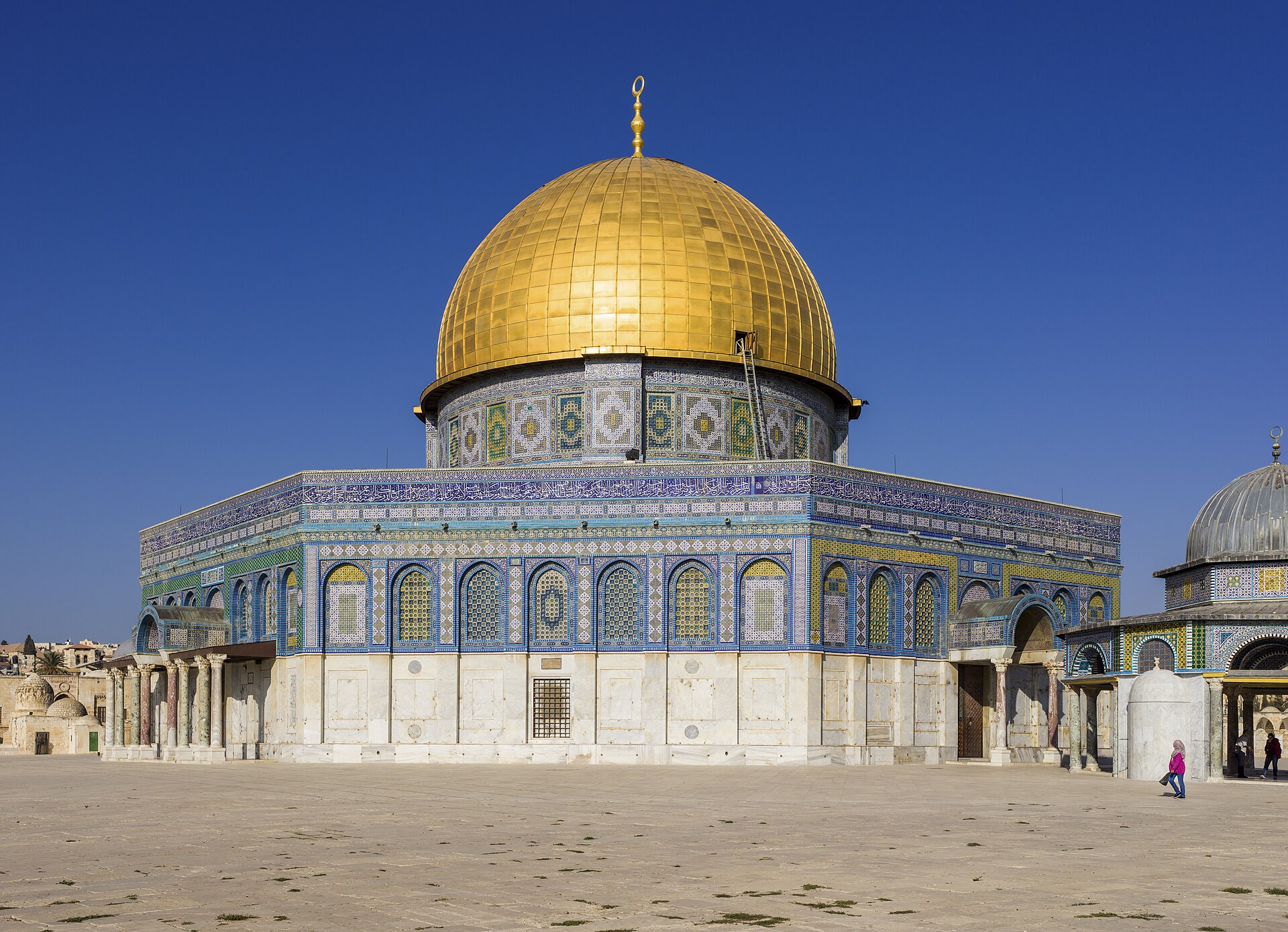
The Dome of the Rock is an Islamic shrine located on the Temple Mount in the Old City of Jerusalem. Completed in 691–692 CE during the reign of the Umayyad Caliph Abd al-Malik ibn Marwan, it is one of the oldest extant works of Islamic architecture. The structure is built over the Foundation Stone, a site of profound religious significance in both Judaism and Islam.
The building is renowned for its octagonal plan and its iconic golden dome, which dominates the Jerusalem skyline. Its interior is decorated with intricate mosaics, marble, and calligraphy, reflecting a synthesis of Byzantine and Sassanid artistic influences. It remains a central site of pilgrimage and a focal point of the religious and political landscape of the Middle East.
Key Facts
- Materials
- Gold leaf, Ceramic tiles, Marble, Wood
- Civilization
- Umayyad Caliphate
- Accessibility
- Restricted to non-Muslims; specific entry hours apply
- Date(s)
- 691-692 CE
- Condition
- Well-preserved, active religious site
- Original Function
- Shrine and commemorative monument
- Key Figures
- Abd al-Malik ibn Marwan, Suleiman the Magnificent
Construction and Origins
7th Century CECommissioned by Caliph Abd al-Malik, the structure was built to commemorate the site of the Prophet Muhammad's Night Journey and to assert the presence of Islam in Jerusalem. It was constructed on the site of the former Second Temple.
Crusader Period
1099-1187 CEFollowing the Crusader conquest of Jerusalem, the Dome was converted into a church known as the Templum Domini. It was placed under the administration of the Augustinian Canons and later the Knights Templar, who believed the site was the location of Solomon's Temple.
Ayyubid and Ottoman Restoration
12th-16th CenturyAfter Saladin recaptured Jerusalem in 1187, the building was restored to its Islamic function. Significant renovations occurred under Suleiman the Magnificent in the 16th century, who replaced the exterior mosaics with the iconic Iznik tiles.
Modern Era
20th Century - PresentThe 20th century saw major restoration projects, including the replacement of the lead dome with an aluminum-bronze alloy in the 1960s, which was later gilded in the 1990s through a donation by King Hussein of Jordan.
Cultural Significance
The Dome of the Rock serves as a primary symbol of Islamic identity and architectural achievement. Its location on the Haram al-Sharif makes it one of the most sacred sites in Islam, while its proximity to the Western Wall and the site of the Jewish Temples makes it a focal point of intense religious and geopolitical significance.
For the local population, the site is a cornerstone of Palestinian cultural heritage and a symbol of Jerusalem's historical continuity. It remains a site of daily prayer and a powerful emblem in the broader discourse surrounding the status of Jerusalem.
Interpretive Notes
Scholarly debates and areas of uncertainty
Scholars continue to debate the original intent behind the building's construction, specifically whether it was intended as a rival to the Kaaba in Mecca or as a monument to the triumph of Islam over Christianity and Judaism. Additionally, the exact location of the original Jewish Temple in relation to the Dome remains a subject of ongoing archaeological and historical discussion.
Visiting Information
Entry Rules
Access for non-Muslims is restricted to specific gates and limited hours, typically excluding Fridays, Saturdays, and Islamic holidays. Visitors must adhere to a strict dress code covering shoulders and legs. Security screening is mandatory.
Best Times to Visit
Early morning hours during weekdays offer the best opportunity for access. Avoid peak tourist seasons and religious holidays to minimize crowds and potential access restrictions.
Photography
Photography is permitted in the exterior courtyard, but photography inside the Dome is strictly prohibited for non-Muslims. Professional equipment and drones are prohibited.
Preservation Notes
The site is under the custodianship of the Jerusalem Islamic Waqf. Visitors are expected to maintain respectful behavior and remain within designated tourist pathways.
Nearby POIs
11 shownSources & Further Reading
- [1]The Dome of the Rock — Oleg Grabar. Rizzoli (2006)
- [2]The Architecture of the Dome of the Rock — K.A.C. Creswell. Early Muslim Architecture (1989)
Key Facts
- Materials
- Gold leaf, Ceramic tiles, Marble, Wood
- Civilization
- Umayyad Caliphate
- Accessibility
- Restricted to non-Muslims; specific entry hours apply
- Date(s)
- 691-692 CE
- Condition
- Well-preserved, active religious site
- Original Function
- Shrine and commemorative monument
- Key Figures
- Abd al-Malik ibn Marwan, Suleiman the Magnificent