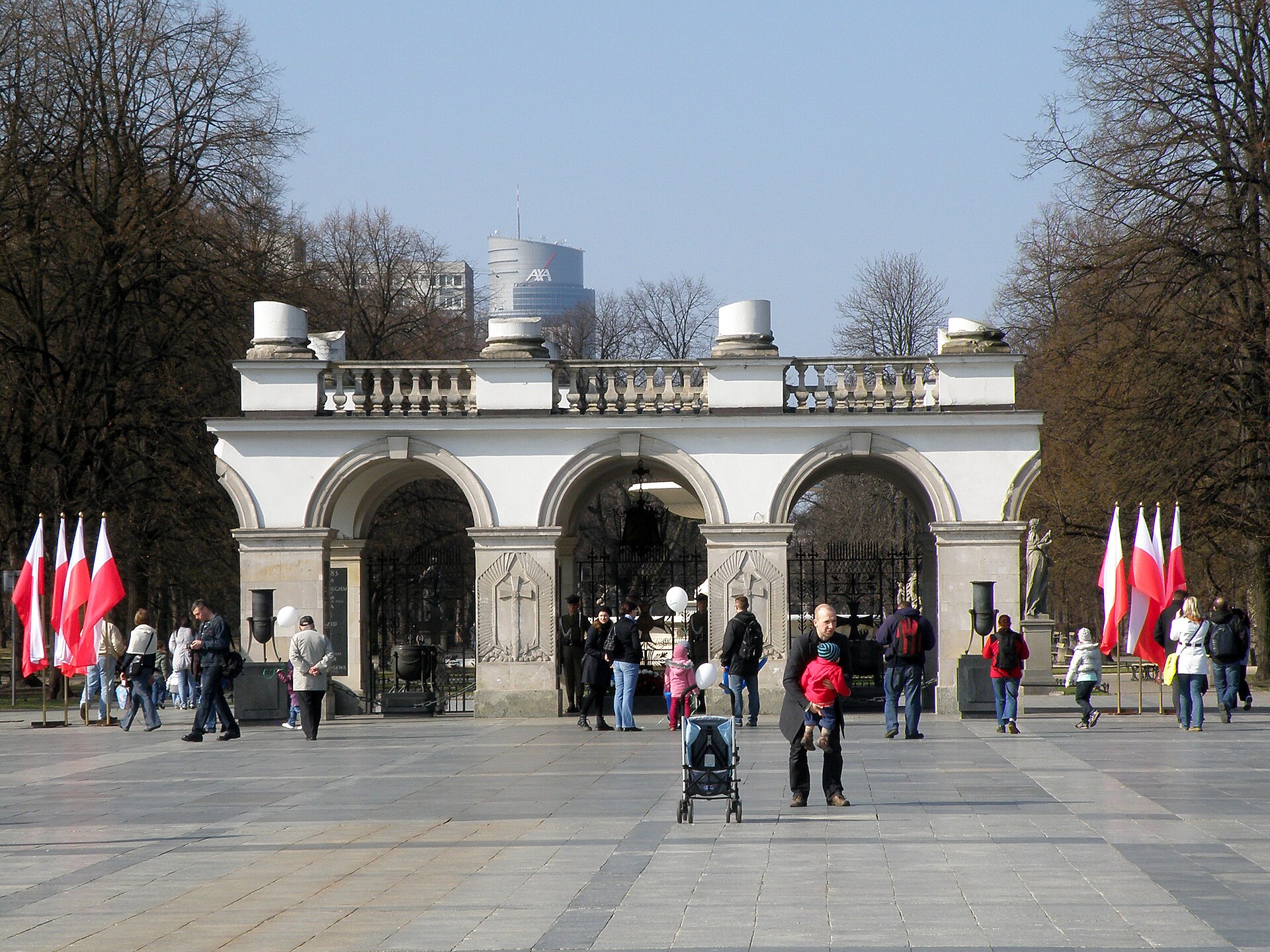
The Tomb of the Unknown Soldier in Warsaw is a national monument dedicated to the unidentified soldiers who sacrificed their lives for Poland. Located in Piłsudski Square, the monument occupies the remaining three central arches of the Saxon Palace, which was largely destroyed during World War II.
The site features an eternal flame and is guarded by a permanent honor guard from the Representative Battalion of the Polish Armed Forces. It serves as the primary location for state ceremonies, military commemorations, and official visits by foreign dignitaries, symbolizing the nation's resilience and historical memory.
Key Facts
- Materials
- Stone, Concrete
- Civilization
- Polish
- Accessibility
- Fully accessible at ground level in Piłsudski Square
- Date(s)
- 1925
- Condition
- Well-preserved, active site of state ceremony
- Original Function
- War memorial
- Key Figures
- Józef Piłsudski, Władysław Sikorski
Establishment
1925The tomb was established in 1925 under the central arcade of the Saxon Palace. The remains of an unidentified soldier, brought from the Lwów defense sector, were interred beneath the monument to represent all fallen Polish combatants.
World War II and Destruction
1939-1945During the German occupation of Warsaw, the Saxon Palace was systematically demolished following the Warsaw Uprising in 1944. The three central arches of the arcade were the only significant portions of the structure to survive the destruction.
Post-War Reconstruction
1946-presentFollowing the war, the surviving arches were preserved and restored to serve as the permanent site for the tomb. The monument has since become the focal point for Polish national identity and military tradition.
Cultural Significance
The tomb is the most important military memorial in Poland. It functions as a site of national pilgrimage and is the location where the state honors its military history. The presence of the eternal flame and the constant guard reflect the ongoing commitment of the Polish state to remember those who died for national independence.
Interpretive Notes
Scholarly debates and areas of uncertainty
Debates occasionally arise regarding the potential reconstruction of the entire Saxon Palace, which would fundamentally alter the spatial context and visibility of the current monument.
Visiting Information
Entry Rules
Open to the public 24/7. Visitors are expected to maintain a respectful demeanor. The changing of the guard occurs every hour.
Best Times to Visit
During the changing of the guard ceremony or on national holidays such as Independence Day (November 11) and Constitution Day (May 3).
Photography
Personal photography is permitted. Commercial photography requires prior authorization from the Polish military authorities.
Preservation Notes
Maintain a respectful distance from the honor guard. Do not cross the marked boundaries near the eternal flame.
Nearby POIs
11 shownSources & Further Reading
- [1]Warsaw: The History of the Capital — Richard J. Hunter. University of Warsaw Press (2010)
- [2]The Saxon Palace and the Tomb of the Unknown Soldier — Marek Kwiatkowski. Warsaw Historical Society (2005)
Key Facts
- Materials
- Stone, Concrete
- Civilization
- Polish
- Accessibility
- Fully accessible at ground level in Piłsudski Square
- Date(s)
- 1925
- Condition
- Well-preserved, active site of state ceremony
- Original Function
- War memorial
- Key Figures
- Józef Piłsudski, Władysław Sikorski