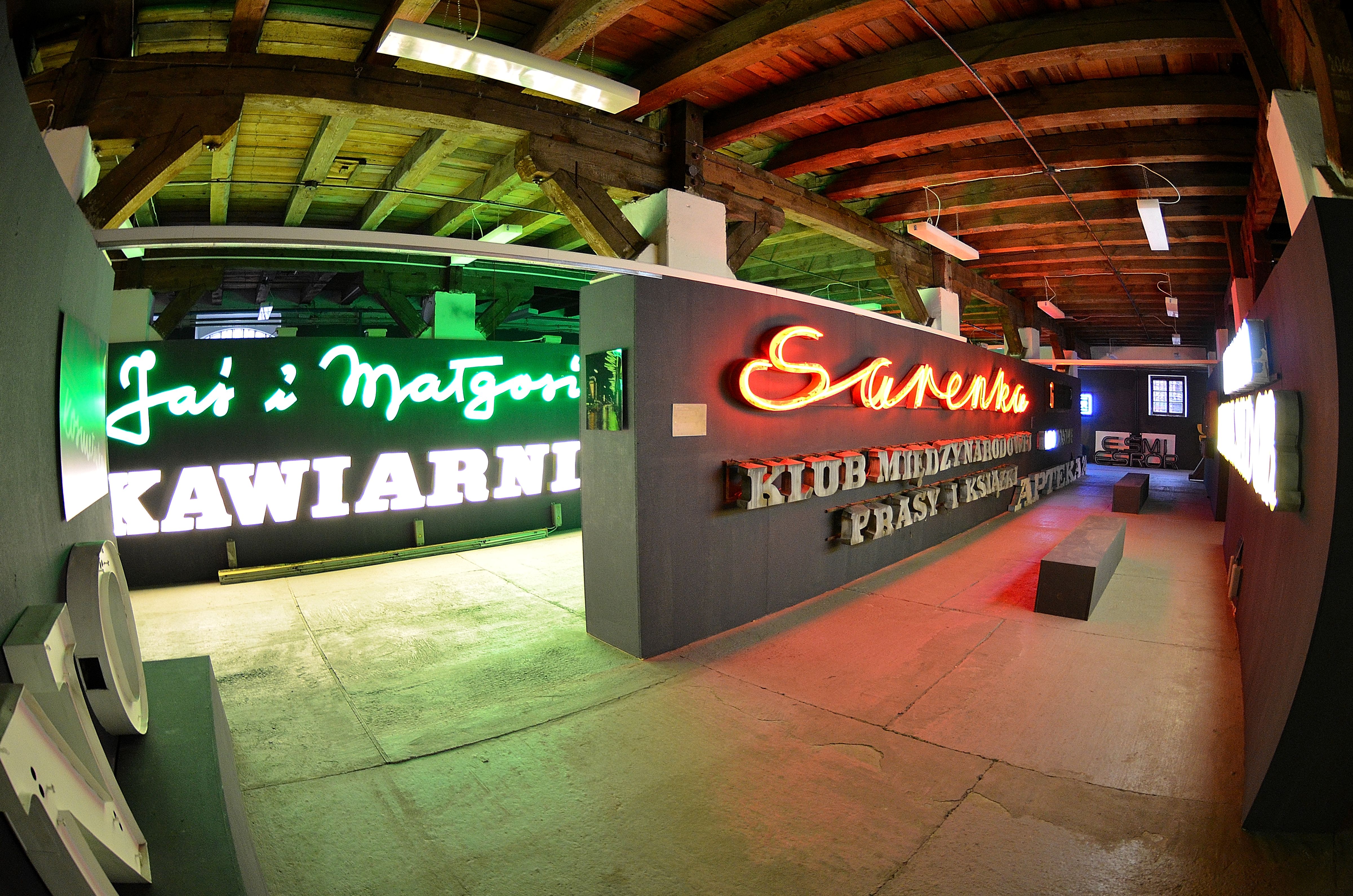
The Neon Museum in Warsaw is a private institution dedicated to the preservation and restoration of Cold War-era neon signage. Located within the Soho Factory complex in the Praga district, the museum houses a significant collection of light installations that once adorned storefronts, cinemas, and public buildings across Poland during the mid-to-late twentieth century.
The collection serves as a repository for Polish graphic design and urban iconography, documenting a period when neon was utilized as a tool for both commercial advertising and state-sponsored urban beautification. By salvaging these artifacts from demolition or decay, the museum provides insight into the aesthetic evolution of the socialist era and the subsequent transition of Polish urban landscapes.
Key Facts
- Materials
- Glass tubing, Metal housing, Electrical transformers
- Civilization
- Polish
- Accessibility
- Ground floor access, wheelchair friendly
- Date(s)
- 2005
- Condition
- Active, well-maintained
- Original Function
- Museum and preservation center
- Key Figures
- Ilona Karwińska, David S. Hill
Origins and Collection
2005-2012The project began as a photographic documentation effort by Ilona Karwińska to capture the disappearing neon signs of Warsaw. This initiative evolved into a formal collection as the founders began physically salvaging signs that were being removed during urban modernization projects.
Establishment at Soho Factory
2012-PresentThe museum found a permanent home in the Soho Factory, a revitalized industrial site in the Praga district. This location allowed for the public display of the growing collection, which now includes hundreds of restored neon signs and historical documents.
Cultural Significance
The museum is central to the study of 'neonization' in the Eastern Bloc, a unique phenomenon where neon was used to brighten the grey urban environment of the socialist era. It represents a shift in how post-communist societies value their recent history, moving from the rejection of socialist-era aesthetics to their preservation as cultural heritage.
Interpretive Notes
Scholarly debates and areas of uncertainty
There is ongoing discussion regarding the classification of these signs as either commercial advertising or state-sanctioned art. Scholars debate the extent to which these installations were intended to serve the public good versus their role as propaganda tools for the socialist state.
Visiting Information
Entry Rules
Open daily with standard operating hours. Tickets can be purchased on-site or via the official website. No specific dress code required.
Best Times to Visit
Weekday afternoons to avoid weekend crowds. The museum is best experienced in the late afternoon or evening when the neon lights are most visible.
Photography
Personal photography is permitted. Professional or commercial photography requires prior arrangement with museum management.
Preservation Notes
The collection consists of fragile glass and electrical components. Visitors are requested to maintain distance from the exhibits and avoid touching the artifacts.
Nearby POIs
11 shown- Palace of Culture and Science
- Fotoplastikon Warszawski0.4 km
- Church of the Holy Cross1.1 km
- Tomb of the Unknown Soldier1.1 km
- Fryderyk Chopin Museum1.3 km
- National Museum in Warsaw1.3 km
- Warsaw Rising Museum1.7 km
- St. Anne's Church1.7 km
- Sigismund's Column1.8 km
- Royal Castle in Warsaw1.9 km
- Copernicus Science Centre1.9 km
Sources & Further Reading
- [1]Polish Neon — Ilona Karwińska. Mark Batty Publisher (2011)
- [2]The Neon Museum: Preserving the Light of the Cold War — David S. Hill. Journal of Urban History (2015)
Key Facts
- Materials
- Glass tubing, Metal housing, Electrical transformers
- Civilization
- Polish
- Accessibility
- Ground floor access, wheelchair friendly
- Date(s)
- 2005
- Condition
- Active, well-maintained
- Original Function
- Museum and preservation center
- Key Figures
- Ilona Karwińska, David S. Hill
Nearby POIs
11 shown- Palace of Culture and Science
- Fotoplastikon Warszawski0.4 km
- Church of the Holy Cross1.1 km
- Tomb of the Unknown Soldier1.1 km
- Fryderyk Chopin Museum1.3 km
- National Museum in Warsaw1.3 km
- Warsaw Rising Museum1.7 km
- St. Anne's Church1.7 km
- Sigismund's Column1.8 km
- Royal Castle in Warsaw1.9 km
- Copernicus Science Centre1.9 km