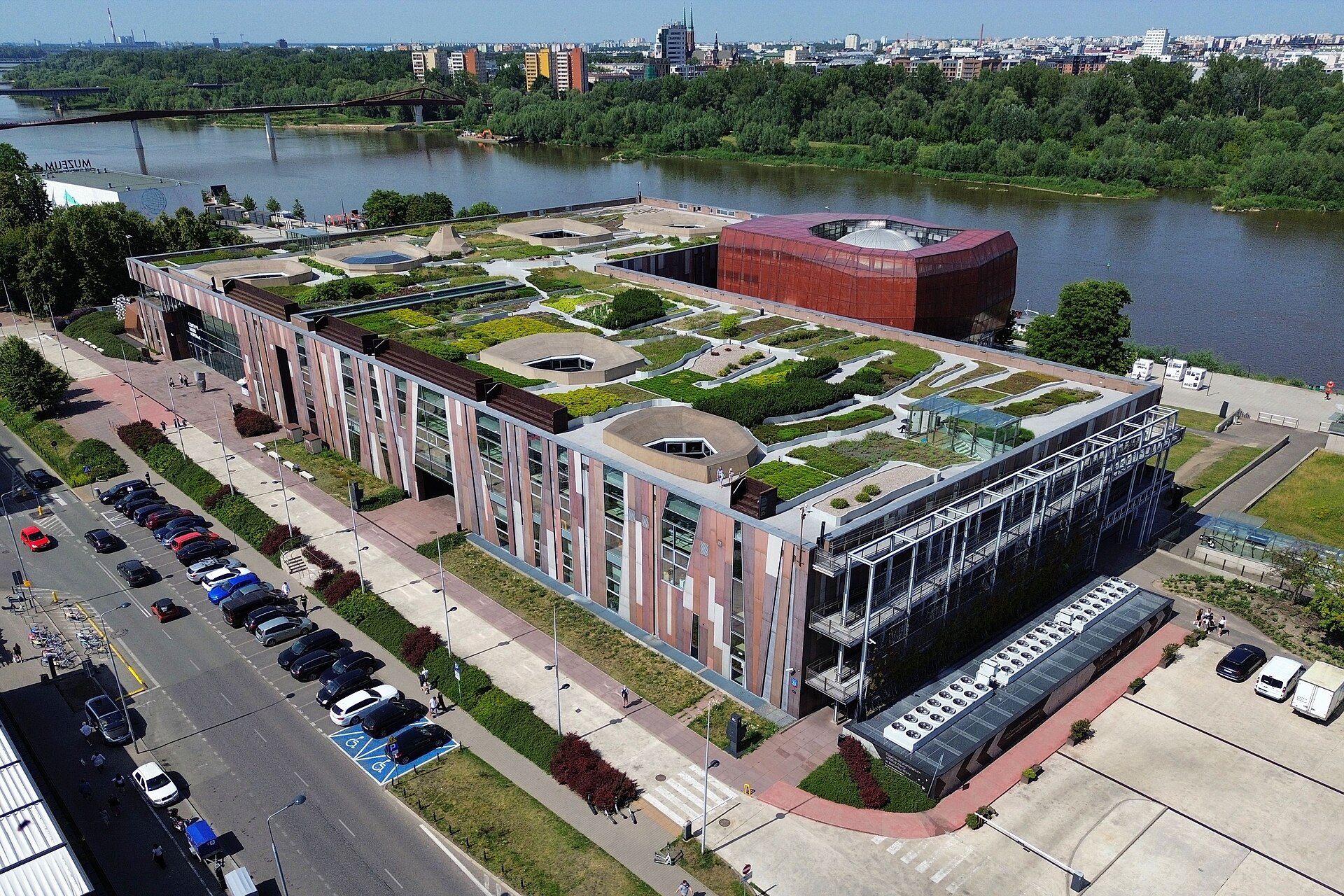
The Copernicus Science Centre is a prominent scientific institution located on the banks of the Vistula River in Warsaw, Poland. Opened in 2010, the facility serves as a hub for science communication and public engagement, featuring an extensive array of interactive exhibits designed to facilitate hands-on learning across various scientific disciplines.
The architectural design of the complex, characterized by its modern, glass-and-concrete structure, integrates seamlessly with the surrounding parkland. Beyond its permanent galleries, the center houses a planetarium, a robotic theater, and laboratories, functioning as both a tourist destination and a center for educational research and development.
Key Facts
- Materials
- Glass, Concrete, Steel
- Civilization
- Modern Poland
- Accessibility
- Fully wheelchair accessible
- Date(s)
- 2006-2010
- Condition
- Active, well-maintained
- Original Function
- Science museum and educational center
- Key Figures
- Robert Firmhofer
Inception and Planning
2004-2006The project was initiated by the City of Warsaw to create a modern space for scientific education. An international architectural competition was held in 2005, which was won by the firm RAr-2 Laboratorium Architektury.
Construction and Opening
2006-2010Construction began in 2006 with funding from the European Union and the City of Warsaw. The center officially opened its doors to the public in November 2010, quickly becoming one of the most visited cultural institutions in Poland.
Expansion and Modernization
2011-PresentSince its opening, the center has expanded its facilities, including the addition of the Heavens of Copernicus planetarium in 2011 and the Discovery Park, an outdoor educational space, in 2013. It continues to update its exhibits to reflect contemporary scientific advancements.
Cultural Significance
The Copernicus Science Centre has played a pivotal role in shifting the approach to science education in Poland, moving away from traditional lecture-based models toward interactive, inquiry-based learning. It serves as a key landmark in Warsaw's urban revitalization efforts along the Vistula River.
It is a central venue for the annual Warsaw Science Festival and acts as a meeting point for researchers, educators, and the general public, fostering a culture of curiosity and critical thinking within the national educational landscape.
Interpretive Notes
Scholarly debates and areas of uncertainty
Discussions regarding the center often focus on the balance between entertainment and rigorous scientific education. Scholars debate the effectiveness of 'edutainment' models in long-term knowledge retention compared to more structured pedagogical approaches.
Visiting Information
Entry Rules
Open daily. Tickets are required and should be purchased in advance online due to high demand. Visitors are encouraged to allocate at least 3-4 hours for a full experience.
Best Times to Visit
Weekday mornings during the school year are the quietest times to visit. Weekends and school holidays are typically very crowded.
Photography
Personal photography is permitted throughout the galleries. Professional photography or filming requires prior authorization from the administration.
Preservation Notes
Visitors are requested to handle interactive exhibits with care to ensure their continued functionality for other guests. Food and drink are restricted to designated cafe areas.
Nearby POIs
11 shown- Fryderyk Chopin Museum0.7 km
- Church of the Holy Cross0.9 km
- St. Anne's Church1.1 km
- Royal Castle in Warsaw1.1 km
- National Museum in Warsaw1.2 km
- Tomb of the Unknown Soldier1.2 km
- Sigismund's Column1.2 km
- St. John's Archcathedral1.3 km
- Muzeum Warszawy1.5 km
- Warsaw Uprising Monument1.8 km
- Palace of Culture and Science1.9 km
Sources & Further Reading
- [1]Copernicus Science Centre: A New Model for Science Communication — Robert Firmhofer. Journal of Science Communication (2012)View
- [2]Architecture of the Copernicus Science Centre — Janusz Marszalek. Warsaw Architectural Review (2011)
Key Facts
- Materials
- Glass, Concrete, Steel
- Civilization
- Modern Poland
- Accessibility
- Fully wheelchair accessible
- Date(s)
- 2006-2010
- Condition
- Active, well-maintained
- Original Function
- Science museum and educational center
- Key Figures
- Robert Firmhofer
Nearby POIs
11 shown- Fryderyk Chopin Museum0.7 km
- Church of the Holy Cross0.9 km
- St. Anne's Church1.1 km
- Royal Castle in Warsaw1.1 km
- National Museum in Warsaw1.2 km
- Tomb of the Unknown Soldier1.2 km
- Sigismund's Column1.2 km
- St. John's Archcathedral1.3 km
- Muzeum Warszawy1.5 km
- Warsaw Uprising Monument1.8 km
- Palace of Culture and Science1.9 km