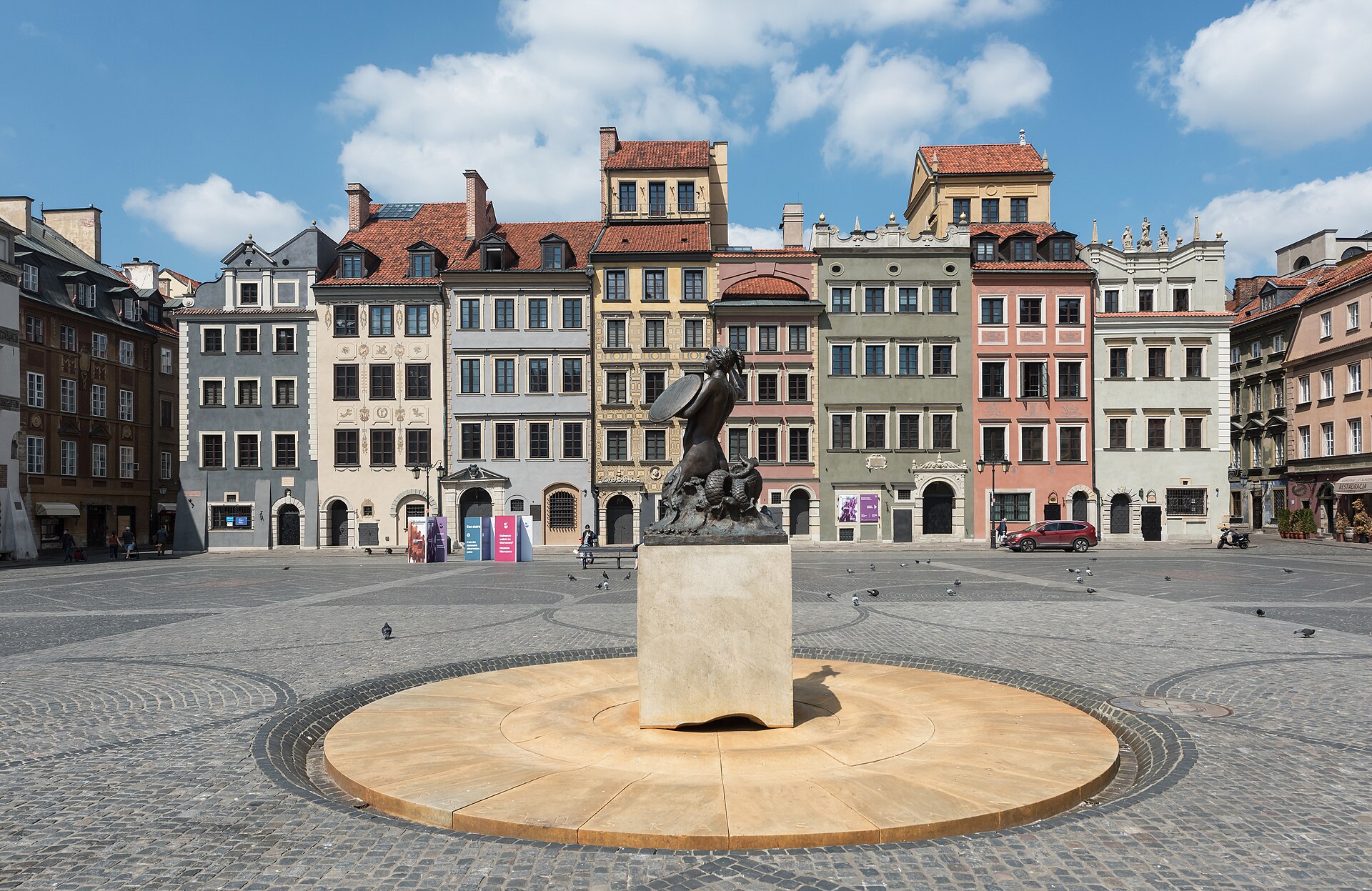
The Museum of Warsaw is located within eleven reconstructed tenement houses on the Old Town Market Square. The institution serves as the primary repository for the city's history, housing a vast collection of artifacts that document the urban evolution, social life, and cultural development of Warsaw from its medieval foundation to the present day.
The museum's permanent exhibition, titled 'The Things of Warsaw,' utilizes thousands of objects—ranging from archaeological finds and historical documents to everyday household items—to narrate the city's complex history. The site itself is a significant example of post-war reconstruction, as the tenement houses were meticulously rebuilt following the near-total destruction of the Old Town during the Second World War.
Key Facts
- Materials
- Brick, Stone, Plaster
- Civilization
- Polish
- Accessibility
- Wheelchair accessible with elevator access to most floors
- Date(s)
- 15th century (original tenements), 1948-1954 (reconstruction)
- Condition
- Fully restored and operational as a museum
- Original Function
- Residential tenement houses
- Key Figures
- Jan Zachwatowicz
Origins of the Tenements
15th-18th centuryThe eleven tenement houses forming the museum were originally built between the 15th and 18th centuries. These buildings served as residences for wealthy merchants and patricians, reflecting the architectural styles of their respective eras, including Gothic, Renaissance, and Baroque elements.
Destruction and Reconstruction
1944-1954During the Warsaw Uprising and the subsequent systematic destruction of the city by German forces in 1944, the Old Town was reduced to rubble. The reconstruction of the tenement houses between 1948 and 1954 was a landmark project in Polish post-war heritage preservation, led by architect Jan Zachwatowicz.
Establishment of the Museum
1936-presentThe museum was founded in 1936 as the Museum of Old Warsaw. Following the war, it was re-established in its current location on the Market Square. In recent years, the institution underwent a comprehensive modernization to integrate the eleven distinct buildings into a cohesive exhibition space.
Cultural Significance
The Museum of Warsaw is central to the city's identity, acting as a bridge between the pre-war heritage and the modern capital. By preserving the material culture of Warsaw, it provides a tangible connection to the city's resilience and its history of reconstruction.
The museum also plays a vital role in the preservation of the Old Town, which is a UNESCO World Heritage site. It serves as a focal point for public discourse on urban memory and the ethics of architectural reconstruction.
Interpretive Notes
Scholarly debates and areas of uncertainty
There is ongoing academic discussion regarding the authenticity of the post-war reconstruction of the Old Town. Scholars debate the extent to which the rebuilt tenements represent a faithful restoration of historical forms versus a symbolic, idealized interpretation of Warsaw's past.
Visiting Information
Entry Rules
Open Tuesday through Sunday. Tickets can be purchased online or at the box office. Visitors are encouraged to check the official website for current opening hours and information on free admission days.
Best Times to Visit
Weekday mornings are generally quieter. The museum is particularly relevant during the anniversary of the Warsaw Uprising (August 1st) and Warsaw Heritage Days.
Photography
Personal photography is permitted without flash or tripods. Commercial photography requires prior authorization from the museum administration.
Preservation Notes
Visitors are requested to refrain from touching the artifacts. Due to the historic nature of the tenement houses, some floor levels may be uneven.
Nearby POIs
11 shown- St. John's Archcathedral0.2 km
- Sigismund's Column0.3 km
- Royal Castle in Warsaw0.4 km
- Warsaw Uprising Monument0.4 km
- St. Anne's Church0.5 km
- Tomb of the Unknown Soldier1 km
- Monument to the Ghetto Heroes1.2 km
- POLIN Museum of the History of Polish Jews1.2 km
- Church of the Holy Cross1.3 km
- Copernicus Science Centre1.5 km
- Fryderyk Chopin Museum1.7 km
Sources & Further Reading
- [1]The Reconstruction of Warsaw — Jan Zachwatowicz. Arkady (1970)
- [2]Warsaw: The History of a City — Norman Davies. Oxford University Press (2003)
Key Facts
- Materials
- Brick, Stone, Plaster
- Civilization
- Polish
- Accessibility
- Wheelchair accessible with elevator access to most floors
- Date(s)
- 15th century (original tenements), 1948-1954 (reconstruction)
- Condition
- Fully restored and operational as a museum
- Original Function
- Residential tenement houses
- Key Figures
- Jan Zachwatowicz
Nearby POIs
11 shown- St. John's Archcathedral0.2 km
- Sigismund's Column0.3 km
- Royal Castle in Warsaw0.4 km
- Warsaw Uprising Monument0.4 km
- St. Anne's Church0.5 km
- Tomb of the Unknown Soldier1 km
- Monument to the Ghetto Heroes1.2 km
- POLIN Museum of the History of Polish Jews1.2 km
- Church of the Holy Cross1.3 km
- Copernicus Science Centre1.5 km
- Fryderyk Chopin Museum1.7 km