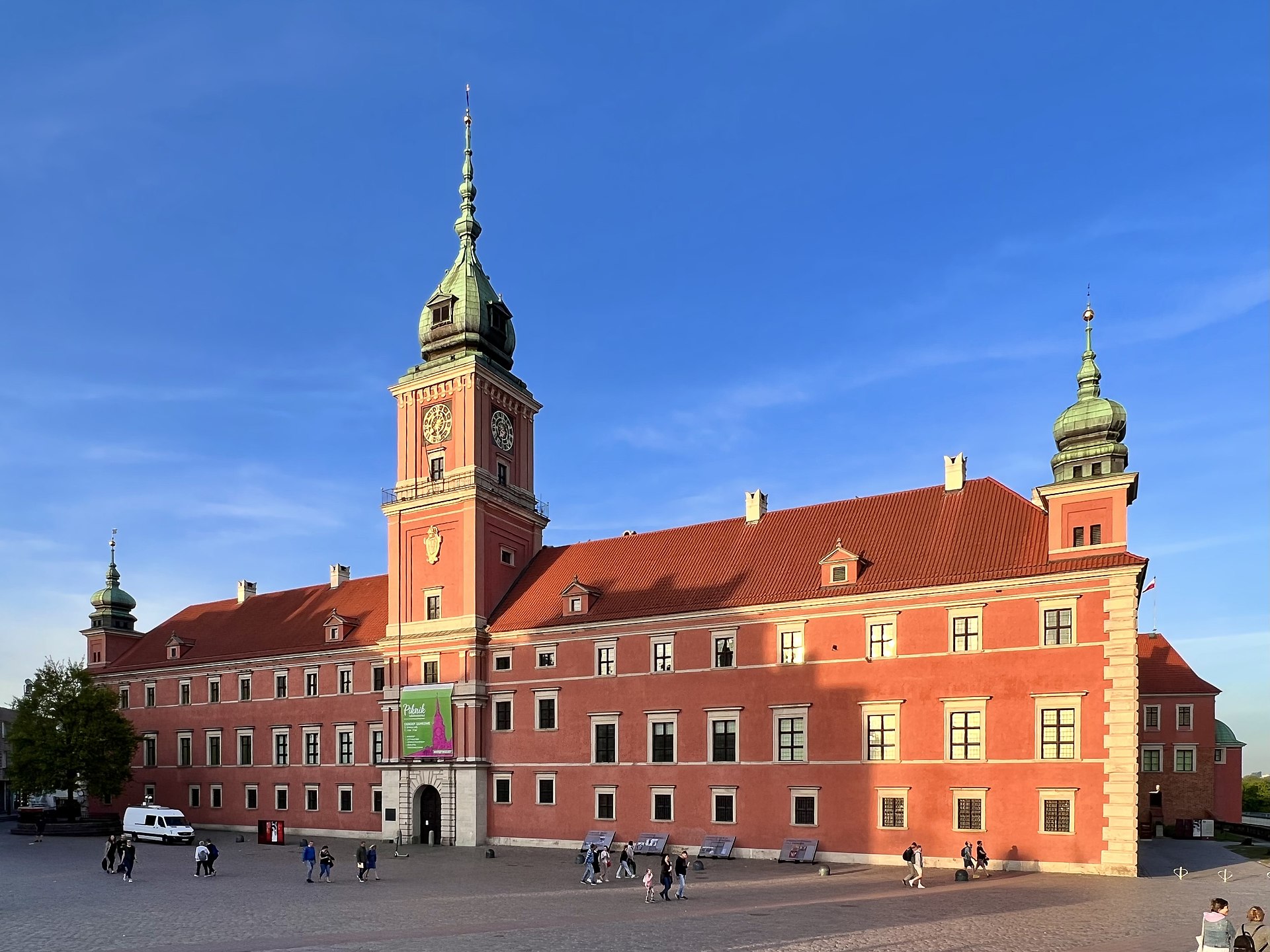
The Royal Castle in Warsaw served as the official residence of the Polish monarchs for centuries. Originally constructed in the 14th century as a fortified residence for the Dukes of Masovia, it was expanded into a grand royal palace during the 16th and 17th centuries, particularly under the patronage of King Sigismund III Vasa, who moved the Polish capital from Kraków to Warsaw.
The current structure is a meticulous reconstruction of the original palace, which was systematically demolished by German forces during World War II. Following the war, the castle was rebuilt between 1971 and 1984 using salvaged architectural fragments and historical documentation, serving today as a museum and a symbol of Polish national resilience and cultural continuity.
Key Facts
- Materials
- Brick, Stone, Stucco, Marble
- Civilization
- Polish
- Accessibility
- Wheelchair accessible with elevators to main floors
- Date(s)
- 14th century (original), 1971-1984 (reconstruction)
- Condition
- Fully restored and active as a museum
- Original Function
- Royal residence and seat of the Sejm
- Key Figures
- Sigismund III Vasa, Stanisław August Poniatowski
Origins and Royal Seat
14th-16th centuryThe castle began as a wooden and brick fortification for the Dukes of Masovia. After the incorporation of Masovia into the Polish Crown, it was transformed into a royal residence, becoming the permanent seat of the Polish-Lithuanian Commonwealth's parliament.
Golden Age and Baroque Expansion
17th centuryUnder King Sigismund III Vasa, the castle was rebuilt in the early Baroque style. It became the political heart of the Commonwealth, hosting the Sejm and serving as the center of royal administration and court life.
Destruction and Reconstruction
1939-1984During the 1944 Warsaw Uprising, the castle was intentionally blown up by German forces. After decades of political debate, the decision to reconstruct the castle was finalized in 1971, funded largely by public donations to restore the nation's symbolic center.
Cultural Significance
The Royal Castle is the primary symbol of Polish statehood. Its destruction and subsequent reconstruction represent the survival of Polish identity despite the trauma of the 20th century. The Senate Chamber, where the Constitution of 3 May 1791—the first modern constitution in Europe—was adopted, remains a site of profound historical importance for the nation.
Interpretive Notes
Scholarly debates and areas of uncertainty
The reconstruction of the castle sparked significant debate among architectural historians regarding the ethics of 'recreating' a destroyed monument versus preserving the ruins as a memorial. The project is now widely cited in heritage studies as a successful example of social mobilization for cultural preservation.
Visiting Information
Entry Rules
Open Tuesday through Sunday. Tickets are required for entry to the main exhibition halls. Visitors must pass through a security checkpoint. Large bags must be left in the cloakroom.
Best Times to Visit
Weekday mornings are best to avoid weekend crowds. The castle is particularly significant during national holidays such as May 3rd (Constitution Day) and November 11th (Independence Day).
Photography
Personal photography is permitted without flash or tripods. Professional photography requires prior authorization from the museum administration.
Preservation Notes
The castle contains many original architectural elements salvaged from the rubble. Visitors are requested to refrain from touching the tapestries and period furniture.
Nearby POIs
11 shown- Sigismund's Column0.1 km
- St. John's Archcathedral0.2 km
- St. Anne's Church0.2 km
- Muzeum Warszawy0.4 km
- Warsaw Uprising Monument0.7 km
- Tomb of the Unknown Soldier0.8 km
- Church of the Holy Cross1 km
- Copernicus Science Centre1.1 km
- Fryderyk Chopin Museum1.4 km
- Monument to the Ghetto Heroes1.5 km
- POLIN Museum of the History of Polish Jews1.5 km
Sources & Further Reading
- [1]The Royal Castle in Warsaw: A History — Andrzej Rottermund. Zamek Królewski w Warszawie (2002)
- [2]Warsaw: The Reconstruction of the Royal Castle — Marek Kwiatkowski. Arkady (1985)
Key Facts
- Materials
- Brick, Stone, Stucco, Marble
- Civilization
- Polish
- Accessibility
- Wheelchair accessible with elevators to main floors
- Date(s)
- 14th century (original), 1971-1984 (reconstruction)
- Condition
- Fully restored and active as a museum
- Original Function
- Royal residence and seat of the Sejm
- Key Figures
- Sigismund III Vasa, Stanisław August Poniatowski
Nearby POIs
11 shown- Sigismund's Column0.1 km
- St. John's Archcathedral0.2 km
- St. Anne's Church0.2 km
- Muzeum Warszawy0.4 km
- Warsaw Uprising Monument0.7 km
- Tomb of the Unknown Soldier0.8 km
- Church of the Holy Cross1 km
- Copernicus Science Centre1.1 km
- Fryderyk Chopin Museum1.4 km
- Monument to the Ghetto Heroes1.5 km
- POLIN Museum of the History of Polish Jews1.5 km