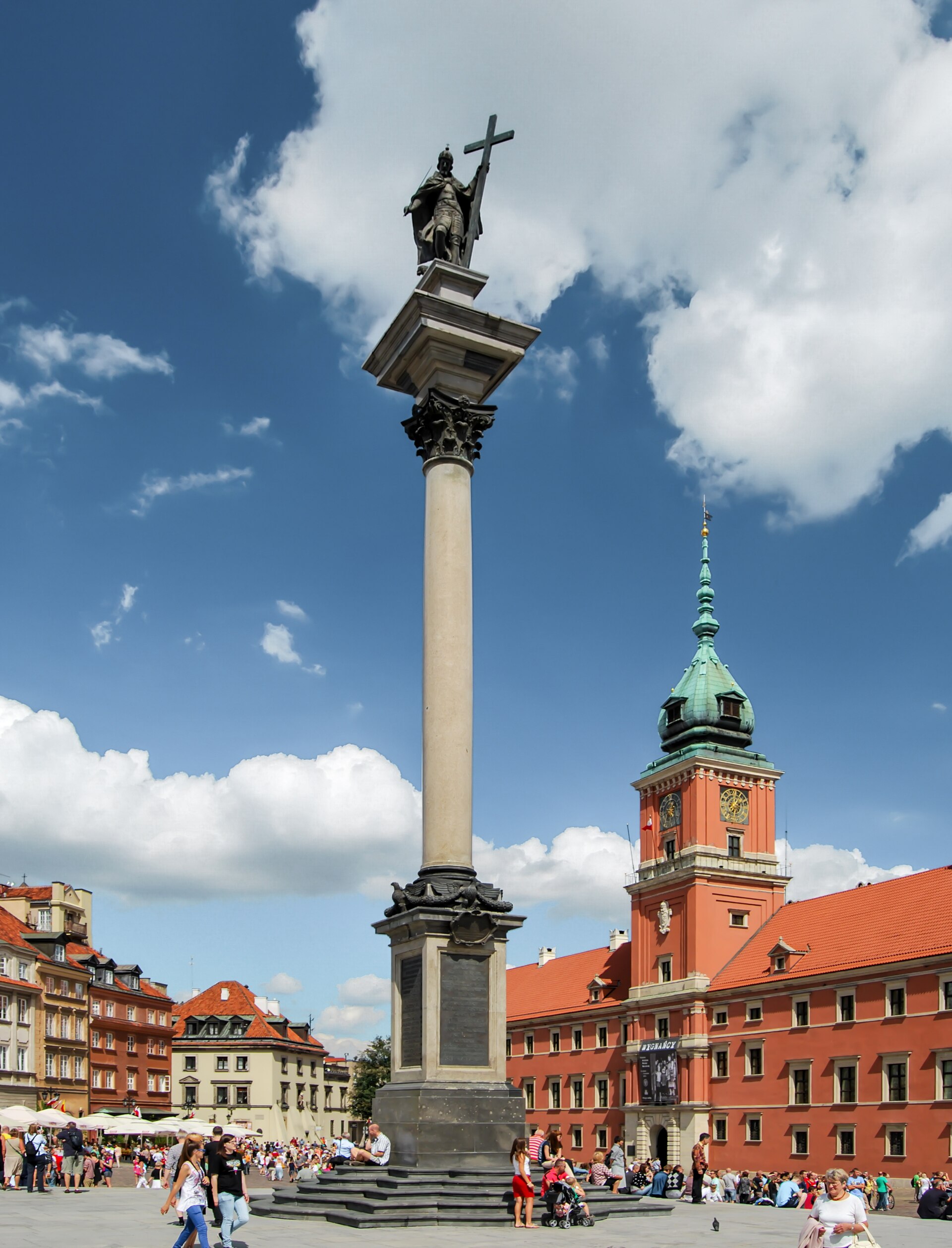
Sigismund's Column is a seventeenth-century monument located in Castle Square in Warsaw, Poland. Commissioned by King Władysław IV Vasa, it was erected between 1643 and 1644 to honor his father, King Sigismund III Vasa, who is credited with moving the Polish capital from Kraków to Warsaw in 1596.
The monument consists of a bronze statue of the monarch atop a twenty-two-meter granite Corinthian column. The statue depicts the king in armor, holding a cross in one hand and a sword in the other, symbolizing his role as a defender of the faith and the state. The column has undergone several reconstructions, most notably following its destruction during the Warsaw Uprising in 1944.
Key Facts
- Materials
- Granite, Bronze, Sandstone
- Civilization
- Polish-Lithuanian Commonwealth
- Accessibility
- Public square, fully accessible
- Date(s)
- 1643-1644
- Condition
- Restored
- Original Function
- Commemorative monument
- Key Figures
- Sigismund III Vasa, Władysław IV Vasa, Augustin Locci, Constantino Tencalla
Commission and Construction
1643-1644The column was commissioned by King Władysław IV Vasa to commemorate his father. It was designed by the Italian architect Constantino Tencalla and the sculptor Clemente Molli, with the bronze statue cast by Daniel Tym.
Destruction and Reconstruction
1944During the Warsaw Uprising in 1944, the column was toppled by German forces and shattered. The original bronze statue was damaged but survived, and the granite shaft was replaced during the post-war reconstruction of the city in 1949.
Modern Status
1949-PresentThe monument stands as a symbol of Warsaw's resilience and restoration. It serves as a central landmark in the historic Old Town, which is recognized as a UNESCO World Heritage site.
Cultural Significance
Sigismund's Column is one of the most recognizable symbols of Warsaw and a focal point of the city's historic center. It represents the transition of Warsaw into the capital of the Polish-Lithuanian Commonwealth and serves as a testament to the city's survival through the destruction of World War II.
Interpretive Notes
Scholarly debates and areas of uncertainty
There is minor scholarly discussion regarding the extent to which the 1949 reconstruction utilized original fragments versus entirely new materials, particularly concerning the granite shaft, which was sourced from a different quarry than the original seventeenth-century column.
Visiting Information
Entry Rules
The monument is located in a public square and is accessible at all times without entry fees or restrictions.
Best Times to Visit
Early morning or late evening to avoid heavy tourist crowds in Castle Square. The monument is particularly notable when illuminated at night.
Photography
None; the monument is in a public space.
Preservation Notes
The monument is maintained by the city of Warsaw. Visitors should refrain from climbing on the pedestal or base.
Nearby POIs
11 shown- St. Anne's Church0.1 km
- Royal Castle in Warsaw0.1 km
- St. John's Archcathedral0.2 km
- Muzeum Warszawy0.3 km
- Warsaw Uprising Monument0.6 km
- Tomb of the Unknown Soldier0.7 km
- Church of the Holy Cross1 km
- Copernicus Science Centre1.2 km
- Monument to the Ghetto Heroes1.3 km
- Fryderyk Chopin Museum1.4 km
- POLIN Museum of the History of Polish Jews1.4 km
Sources & Further Reading
- [1]Warsaw: The History of a City — Norman Davies. Oxford University Press (2004)
- [2]The Reconstruction of Warsaw — Jarosław Zieliński. Warsaw Historical Society (2012)
Key Facts
- Materials
- Granite, Bronze, Sandstone
- Civilization
- Polish-Lithuanian Commonwealth
- Accessibility
- Public square, fully accessible
- Date(s)
- 1643-1644
- Condition
- Restored
- Original Function
- Commemorative monument
- Key Figures
- Sigismund III Vasa, Władysław IV Vasa, Augustin Locci, Constantino Tencalla
Nearby POIs
11 shown- St. Anne's Church0.1 km
- Royal Castle in Warsaw0.1 km
- St. John's Archcathedral0.2 km
- Muzeum Warszawy0.3 km
- Warsaw Uprising Monument0.6 km
- Tomb of the Unknown Soldier0.7 km
- Church of the Holy Cross1 km
- Copernicus Science Centre1.2 km
- Monument to the Ghetto Heroes1.3 km
- Fryderyk Chopin Museum1.4 km
- POLIN Museum of the History of Polish Jews1.4 km