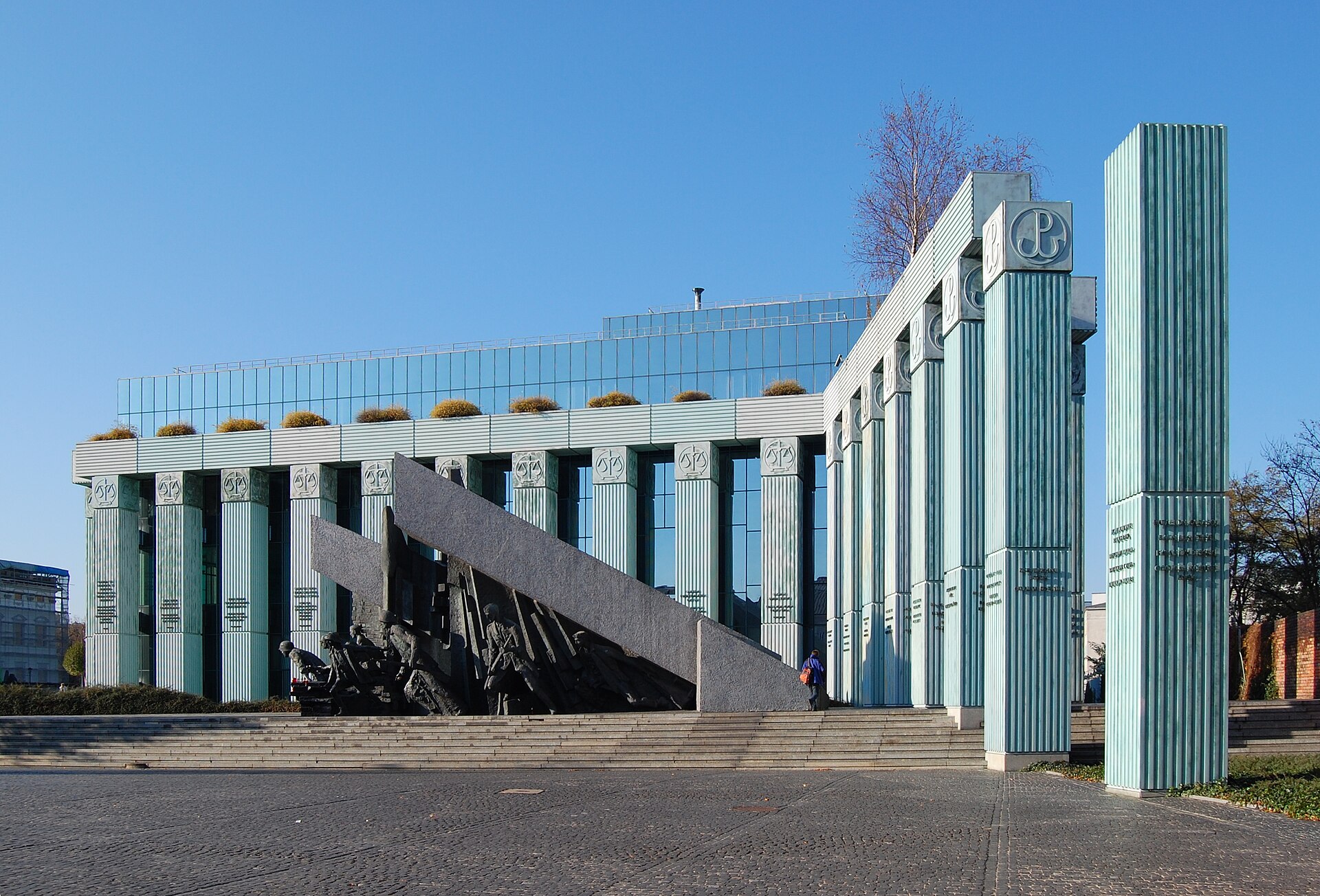
The Warsaw Uprising Monument is a prominent sculptural complex located in Krasiński Square in Warsaw, Poland. Unveiled on August 1, 1989, to mark the 45th anniversary of the 1944 Warsaw Uprising, the monument serves as a national tribute to the Polish Home Army soldiers and civilians who fought against Nazi German occupation during the Second World War.
The monument consists of two distinct bronze groups designed by sculptor Wincenty Kućma and architect Jacek Budyn. One section depicts a group of insurgents emerging from a sewer, a reference to the tactical use of the city's underground network during the conflict, while the other portrays a group of fighters defending a collapsing building. The dynamic, expressive figures are set against a backdrop of symbolic ruins, capturing the intensity and tragedy of the 63-day struggle.
Key Facts
- Materials
- Bronze, Concrete
- Civilization
- Polish
- Accessibility
- Public square, fully accessible
- Date(s)
- 1989
- Condition
- Well-preserved
- Original Function
- Commemorative monument
- Key Figures
- Wincenty Kućma, Jacek Budyn
Historical Context
1944The Warsaw Uprising was the largest single military effort taken by any European resistance movement during World War II. It aimed to liberate Warsaw from Nazi German occupation before the arrival of the Soviet Red Army.
Commission and Design
1980sFollowing years of political sensitivity regarding the Uprising under the communist regime, the project was finally realized in the late 1980s. A competition was held, and the design by Wincenty Kućma was selected for its emotional resonance and scale.
Unveiling
1989The monument was officially unveiled on August 1, 1989, coinciding with the 45th anniversary of the outbreak of the Uprising. It has since become the primary site for state ceremonies commemorating the event.
Cultural Significance
The monument is a central site of Polish national memory. It represents the sacrifice of the Home Army and the civilian population of Warsaw, serving as a focal point for annual commemorations held every August 1st, known as 'W-Hour'.
Beyond its commemorative role, the site is a landmark of Polish monumental sculpture. Its location in Krasiński Square, near the Supreme Court and the site of the former Warsaw Ghetto, reinforces its connection to the city's complex wartime history and its resilience.
Interpretive Notes
Scholarly debates and areas of uncertainty
There is ongoing discussion regarding the aesthetic representation of the Uprising in public art, specifically the balance between heroic realism and the abstract, expressionist style chosen by Kućma. Some critics have debated the placement of the monument in relation to the nearby Ghetto Heroes Monument, discussing how these two distinct historical traumas are spatially and symbolically navigated in the urban landscape.
Visiting Information
Entry Rules
The monument is located in a public square and is accessible 24 hours a day. No entry fees or tickets are required.
Best Times to Visit
August 1st is the most significant time to visit, though it is extremely crowded due to official state ceremonies. Early mornings throughout the year offer the best opportunity to view the details of the sculpture without crowds.
Photography
Personal photography is permitted. Commercial photography or filming may require municipal permits.
Preservation Notes
The bronze surfaces are subject to natural weathering. Visitors are asked not to climb on the sculptural elements to prevent damage to the bronze and the surrounding stone base.
Nearby POIs
11 shown- Muzeum Warszawy0.4 km
- St. John's Archcathedral0.5 km
- Sigismund's Column0.6 km
- Royal Castle in Warsaw0.7 km
- St. Anne's Church0.7 km
- Monument to the Ghetto Heroes0.8 km
- POLIN Museum of the History of Polish Jews0.9 km
- Tomb of the Unknown Soldier1 km
- Church of the Holy Cross1.4 km
- Polish Army Museum1.7 km
- Copernicus Science Centre1.8 km
Sources & Further Reading
- [1]Warsaw Uprising: The Polish Resistance — Norman Davies. Oxford University Press (2004)
- [2]Commemorating the Warsaw Uprising — Piotr Majewski. Journal of Polish History (2015)
Key Facts
- Materials
- Bronze, Concrete
- Civilization
- Polish
- Accessibility
- Public square, fully accessible
- Date(s)
- 1989
- Condition
- Well-preserved
- Original Function
- Commemorative monument
- Key Figures
- Wincenty Kućma, Jacek Budyn
Nearby POIs
11 shown- Muzeum Warszawy0.4 km
- St. John's Archcathedral0.5 km
- Sigismund's Column0.6 km
- Royal Castle in Warsaw0.7 km
- St. Anne's Church0.7 km
- Monument to the Ghetto Heroes0.8 km
- POLIN Museum of the History of Polish Jews0.9 km
- Tomb of the Unknown Soldier1 km
- Church of the Holy Cross1.4 km
- Polish Army Museum1.7 km
- Copernicus Science Centre1.8 km