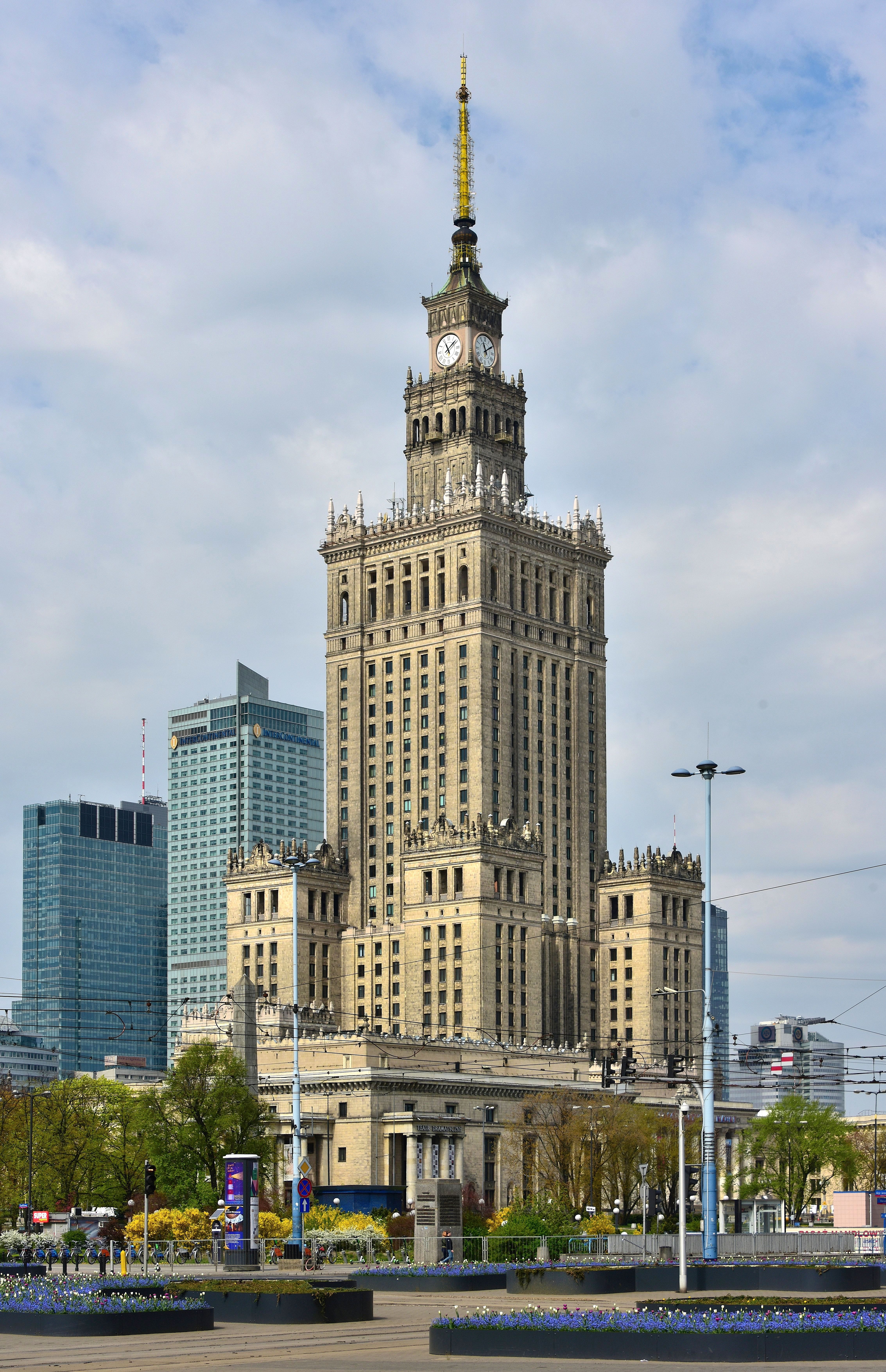
The Palace of Culture and Science is a landmark high-rise building in central Warsaw, Poland. Completed in 1955, it was designed by Soviet architect Lev Rudnev as a 'gift' from the Soviet Union to the people of Poland. The structure serves as a synthesis of Socialist Realist architecture and Polish historical motifs, incorporating elements inspired by Art Deco and Polish Renaissance architecture.
Standing at 237 meters, it remains one of the tallest buildings in Poland. The palace functions as a multi-purpose complex, housing theaters, cinemas, museums, and the Polish Academy of Sciences. Despite its controversial origins as a symbol of Soviet influence, it has become an iconic, albeit polarizing, feature of the Warsaw skyline.
Key Facts
- Materials
- Ceramic sintered blocks, Sandstone, Marble
- Civilization
- Polish People's Republic
- Accessibility
- Wheelchair accessible with elevators to observation deck
- Date(s)
- 1952-1955
- Condition
- Active, well-maintained
- Original Function
- Cultural and scientific center
- Key Figures
- Lev Rudnev, Józef Sigalin
Conception and Construction
1952-1955The building was constructed following the destruction of Warsaw during World War II. It was intended to be a centerpiece of the city's reconstruction, symbolizing the alliance between the Soviet Union and the newly formed Polish People's Republic.
Symbolism and Controversy
1955-1989Throughout the communist era, the Palace served as the primary venue for state events and cultural exhibitions. It was frequently viewed by the public as a symbol of Soviet domination, leading to debates regarding its preservation following the fall of communism.
Modern Era
1989-PresentSince the transition to democracy, the building has been repurposed as a commercial and cultural hub. It was officially registered as a protected monument in 2007, solidifying its status as a permanent, if debated, part of Warsaw's architectural heritage.
Cultural Significance
The Palace of Culture and Science occupies a complex position in Polish national identity. While historically associated with the imposition of Soviet ideology, it has evolved into a beloved, if ironic, symbol of Warsaw. It represents the architectural ambition of the mid-20th century and remains a central hub for the city's cultural life.
Interpretive Notes
Scholarly debates and areas of uncertainty
Architectural historians frequently debate the extent to which the building successfully integrates Polish historical motifs versus imposing a purely Soviet aesthetic. Additionally, there is ongoing discussion regarding the ethics of preserving a structure that served as a primary symbol of the Soviet-backed regime.
Visiting Information
Entry Rules
The building is open to the public daily. Entry to the main lobby is free, while tickets are required for the observation deck, theaters, and specific museum exhibitions.
Best Times to Visit
Late afternoon for sunset views from the 30th-floor observation deck. Weekdays are generally less crowded than weekends.
Photography
Personal photography is permitted throughout the public areas and the observation deck. Commercial photography requires prior authorization from the building administration.
Preservation Notes
The building is a protected heritage site. Visitors are requested to respect the interior architecture and follow signage regarding restricted areas.
Nearby POIs
11 shownSources & Further Reading
- [1]
- [2]Socialist Realism in Poland — Bolesław Bierut. Warsaw University Press (1955)
Key Facts
- Materials
- Ceramic sintered blocks, Sandstone, Marble
- Civilization
- Polish People's Republic
- Accessibility
- Wheelchair accessible with elevators to observation deck
- Date(s)
- 1952-1955
- Condition
- Active, well-maintained
- Original Function
- Cultural and scientific center
- Key Figures
- Lev Rudnev, Józef Sigalin