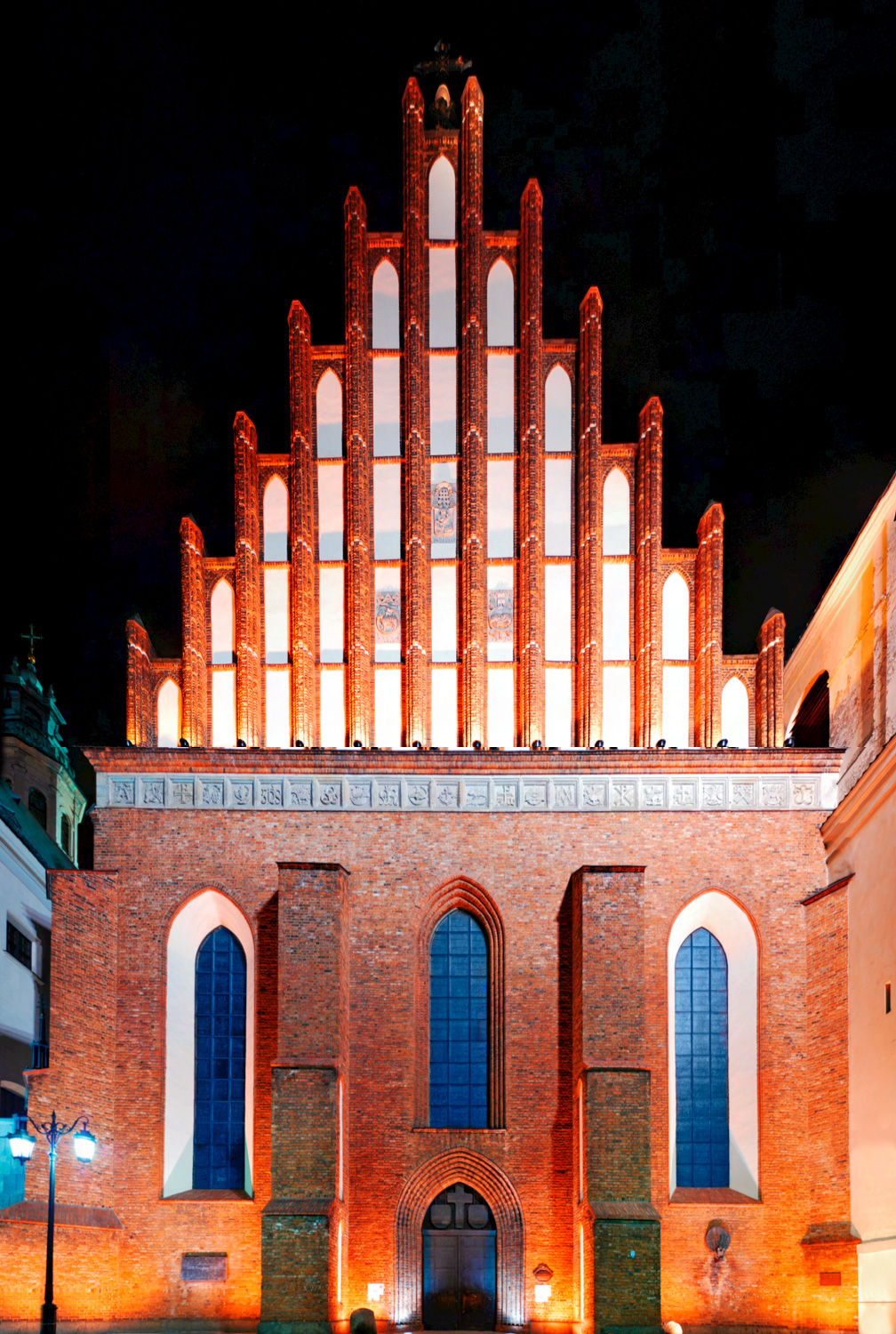
St. John's Archcathedral is one of the oldest churches in Warsaw, originally constructed in the 14th century as a parish church for the city. It serves as a primary example of Masovian Gothic architecture, characterized by its distinctive brick facade and soaring verticality. Throughout its history, the cathedral has functioned as a site of royal coronations, state funerals, and the burial place for numerous Polish monarchs, dukes of Masovia, and prominent national figures.
The structure suffered near-total destruction during the 1944 Warsaw Uprising. Following the war, it was meticulously reconstructed based on 17th-century iconographic records, as the original Gothic form had been obscured by later Baroque additions. Today, it stands as a symbol of Warsaw's resilience and serves as the seat of the Archbishop of Warsaw.
Key Facts
- Materials
- Brick, Stone
- Civilization
- Polish
- Accessibility
- Ground level accessible
- Date(s)
- 14th century
- Condition
- Reconstructed and active
- Original Function
- Parish Church
- Key Figures
- Stanisław August Poniatowski, Henryk Sienkiewicz, Gabriel Narutowicz
Origins and Gothic Foundation
14th centuryThe church was founded in the 14th century as the parish church of Warsaw. It was elevated to the status of a collegiate church in 1406 by Janusz I of Warsaw, marking its growing importance in the region.
Royal Significance
16th-18th centuryThe cathedral became a central site for Polish statehood, hosting the coronations of King Stanisław Leszczyński and King Stanisław August Poniatowski. It also served as the final resting place for the last Dukes of Masovia.
Destruction and Reconstruction
1944-1960During the Warsaw Uprising, the cathedral was used as a defensive position and was subsequently demolished by German forces using explosives. Post-war reconstruction focused on restoring the building to its presumed 14th-century Gothic appearance, stripping away later architectural layers.
Cultural Significance
St. John's Archcathedral is deeply embedded in the national consciousness of Poland. It is a site of memory for the Warsaw Uprising and a repository of national heritage, housing the tombs of significant figures including the last King of Poland and the Nobel Prize-winning author Henryk Sienkiewicz.
Interpretive Notes
Scholarly debates and areas of uncertainty
The post-war reconstruction remains a subject of architectural debate. Critics and historians have discussed the validity of the 'Gothic' restoration, which prioritized a medieval aesthetic over the Baroque elements that existed immediately prior to the cathedral's destruction.
Visiting Information
Entry Rules
Open daily for visitors and worshippers. Entry is free, though donations are encouraged. Modest dress is required as it is an active place of worship.
Best Times to Visit
Weekday mornings are generally quieter. The cathedral is particularly significant during national holidays and state commemorations.
Photography
Photography is permitted for personal use without flash. Tripods and commercial equipment require prior authorization.
Preservation Notes
Visitors are asked to remain silent and respect ongoing religious services. Do not touch the historical tombs or liturgical artifacts.
Nearby POIs
11 shown- Royal Castle in Warsaw0.2 km
- Sigismund's Column0.2 km
- Muzeum Warszawy0.2 km
- St. Anne's Church0.3 km
- Warsaw Uprising Monument0.5 km
- Tomb of the Unknown Soldier0.9 km
- Church of the Holy Cross1.1 km
- Copernicus Science Centre1.3 km
- Monument to the Ghetto Heroes1.3 km
- POLIN Museum of the History of Polish Jews1.4 km
- Fryderyk Chopin Museum1.5 km
Sources & Further Reading
- [1]Warsaw: The Architecture of the City — Marek Kwiatkowski. Arkady (1985)
- [2]The Reconstruction of Warsaw's Old Town — Jadwiga Roguska. Journal of Architectural Conservation (2002)
Key Facts
- Materials
- Brick, Stone
- Civilization
- Polish
- Accessibility
- Ground level accessible
- Date(s)
- 14th century
- Condition
- Reconstructed and active
- Original Function
- Parish Church
- Key Figures
- Stanisław August Poniatowski, Henryk Sienkiewicz, Gabriel Narutowicz
Nearby POIs
11 shown- Royal Castle in Warsaw0.2 km
- Sigismund's Column0.2 km
- Muzeum Warszawy0.2 km
- St. Anne's Church0.3 km
- Warsaw Uprising Monument0.5 km
- Tomb of the Unknown Soldier0.9 km
- Church of the Holy Cross1.1 km
- Copernicus Science Centre1.3 km
- Monument to the Ghetto Heroes1.3 km
- POLIN Museum of the History of Polish Jews1.4 km
- Fryderyk Chopin Museum1.5 km