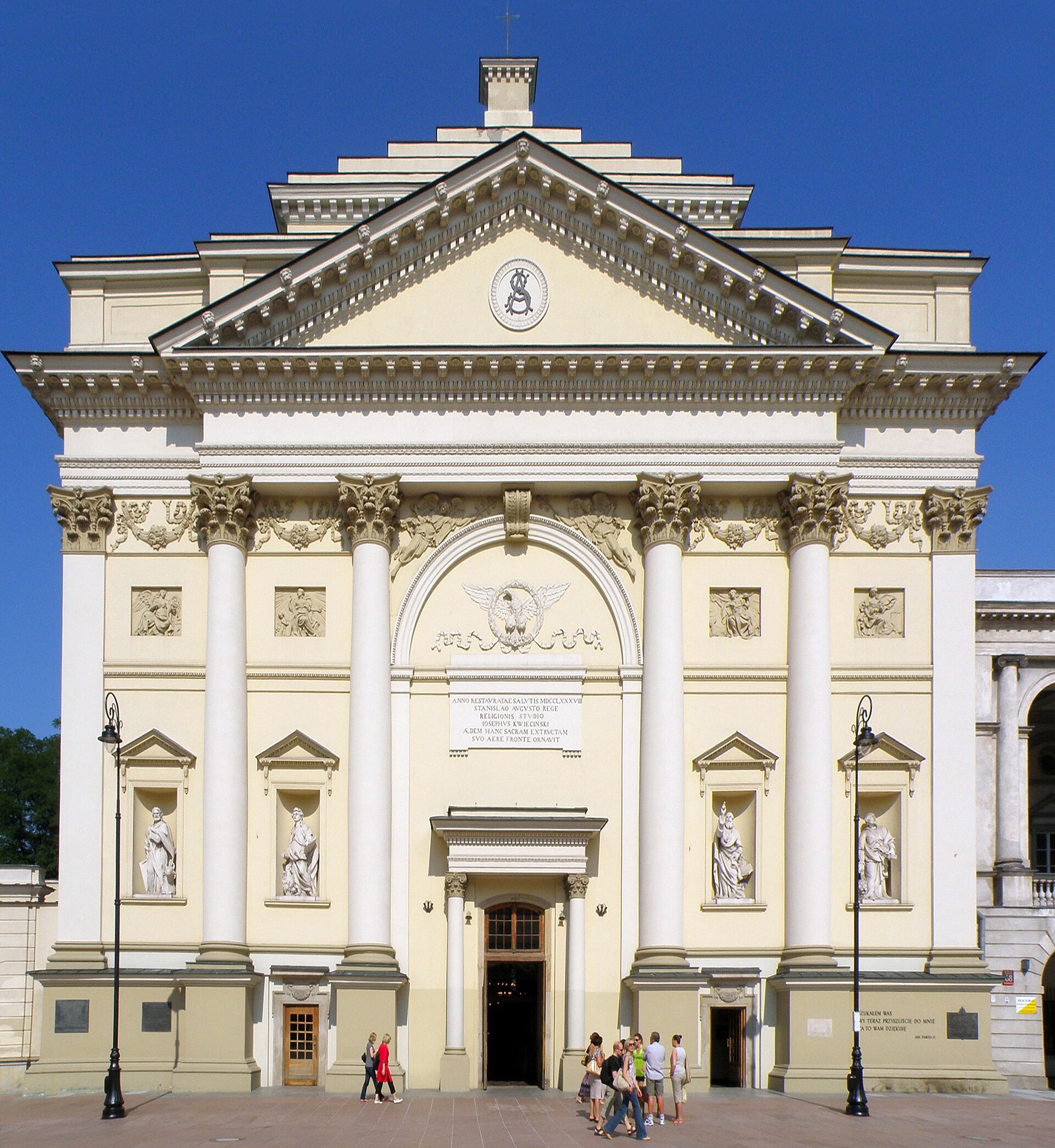
St. Anne's Church, located on Krakowskie Przedmieście in Warsaw, is one of the city's most notable historical landmarks. Originally founded in 1454 for the Bernardine Order, the church has undergone numerous reconstructions due to wars and fires, resulting in a complex architectural profile that blends various historical styles.
The current structure is defined by its striking Neoclassical facade, designed by Chrystian Piotr Aigner and completed in 1788. This exterior contrasts with the interior, which retains a rich Baroque and Rococo aesthetic, characterized by elaborate gilded altars, intricate wood carvings, and masterful illusionistic ceiling frescoes that create a sense of immense depth and grandeur.
Key Facts
- Materials
- Brick, Stucco, Marble, Gold leaf
- Civilization
- Polish
- Accessibility
- Ground level accessible, limited interior mobility
- Date(s)
- 1454 (original), 1788 (facade)
- Condition
- Well-preserved, active parish church
- Original Function
- Monastic church
- Key Figures
- Chrystian Piotr Aigner, Queen Anna Jagiellonka
Founding and Early Years
15th centuryThe church was established in 1454 by Duchess Anna Fiodorowna for the Bernardine monks. The original building was a modest Gothic structure that served the local community and the nearby royal castle.
Baroque Transformation
17th centuryFollowing damage during the Deluge, the church was rebuilt in the Baroque style. This period saw the addition of the ornate interior decorations and the characteristic illusionistic paintings that define the nave today.
Neoclassical Facade
1788The iconic Neoclassical facade was added by architect Chrystian Piotr Aigner. This addition was intended to harmonize the church with the evolving urban landscape of Warsaw's Royal Route.
Wartime Survival
1944During the Warsaw Uprising and the subsequent systematic destruction of the city by German forces, St. Anne's Church miraculously survived with relatively minor structural damage compared to surrounding buildings, allowing it to remain a spiritual focal point for the city.
Cultural Significance
St. Anne's Church serves as a vital symbol of Warsaw's resilience. It is one of the few historic buildings in the city center that escaped total destruction during World War II, making it a repository of authentic pre-war art and architecture. It remains a central site for religious life and academic ceremonies, often hosting events for the nearby University of Warsaw.
Interpretive Notes
Scholarly debates and areas of uncertainty
There is ongoing academic discussion regarding the extent of the original 15th-century Gothic foundations that remain beneath the current structure, as modern renovations have made it difficult to conduct non-invasive archaeological surveys of the crypts.
Visiting Information
Entry Rules
Open daily for visitors and worshippers. Entry is free, though donations are encouraged. Please maintain silence and refrain from sightseeing during ongoing liturgical services.
Best Times to Visit
Weekday mornings are best to avoid the heavy tourist traffic of the Royal Route. The church is particularly significant during major Catholic holidays and the annual Warsaw Uprising commemorations.
Photography
Non-commercial photography is permitted without flash. Tripods and professional equipment require prior permission from the parish office.
Preservation Notes
The interior frescoes are highly sensitive to light and humidity. Visitors are asked to stay within designated areas and avoid touching the gilded surfaces or altarpieces.
Nearby POIs
11 shown- Sigismund's Column0.1 km
- Royal Castle in Warsaw0.2 km
- St. John's Archcathedral0.3 km
- Muzeum Warszawy0.5 km
- Tomb of the Unknown Soldier0.6 km
- Warsaw Uprising Monument0.7 km
- Church of the Holy Cross0.8 km
- Copernicus Science Centre1.1 km
- Fryderyk Chopin Museum1.2 km
- Monument to the Ghetto Heroes1.4 km
- POLIN Museum of the History of Polish Jews1.5 km
Sources & Further Reading
- [1]Warsaw: The Architecture of the City — Marek Kwiatkowski. PWN Scientific Publishers (1998)
- [2]The Churches of Warsaw: A Historical Guide — Jerzy Łoziński. Arkady (2005)
Key Facts
- Materials
- Brick, Stucco, Marble, Gold leaf
- Civilization
- Polish
- Accessibility
- Ground level accessible, limited interior mobility
- Date(s)
- 1454 (original), 1788 (facade)
- Condition
- Well-preserved, active parish church
- Original Function
- Monastic church
- Key Figures
- Chrystian Piotr Aigner, Queen Anna Jagiellonka
Nearby POIs
11 shown- Sigismund's Column0.1 km
- Royal Castle in Warsaw0.2 km
- St. John's Archcathedral0.3 km
- Muzeum Warszawy0.5 km
- Tomb of the Unknown Soldier0.6 km
- Warsaw Uprising Monument0.7 km
- Church of the Holy Cross0.8 km
- Copernicus Science Centre1.1 km
- Fryderyk Chopin Museum1.2 km
- Monument to the Ghetto Heroes1.4 km
- POLIN Museum of the History of Polish Jews1.5 km