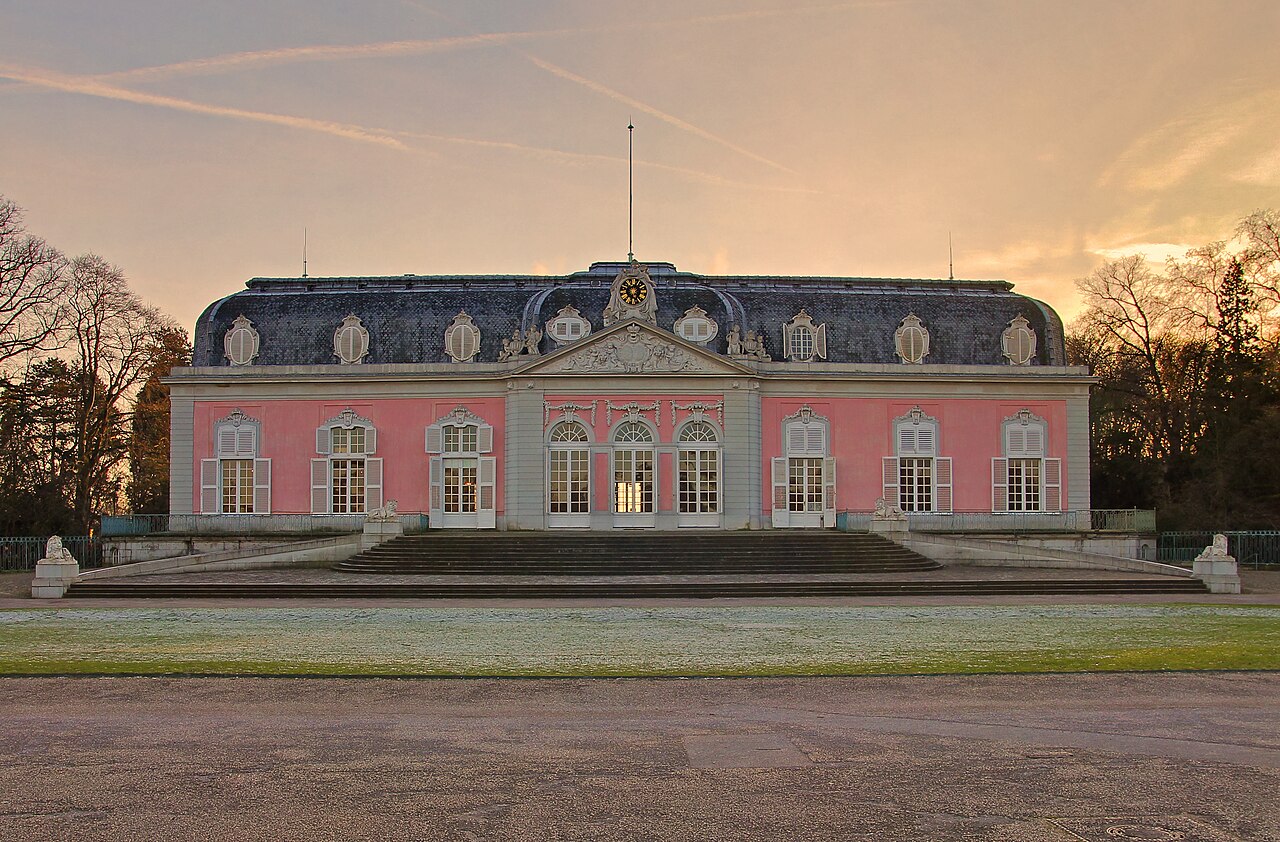
Schloss Benrath is a maison de plaisance located in Düsseldorf, Germany, commissioned by Elector Palatine Charles Theodore and constructed between 1755 and 1773. Designed by the French architect Nicolas de Pigage, the palace serves as a prime example of the transition from the ornate late Baroque style to the more restrained early Neoclassical aesthetic.
The complex consists of a central corps de logis flanked by two symmetrical wings, all set within an extensive 60-hectare park that includes formal gardens and a large reflecting pool. The palace was intended as a summer residence and hunting lodge, reflecting the refined lifestyle of the 18th-century court through its sophisticated interior design and harmonious integration with the surrounding landscape.
Key Facts
- Materials
- Sandstone, Brick, Stucco
- Civilization
- Electorate of the Palatinate
- Accessibility
- Ground floor accessible; some upper levels restricted
- Date(s)
- 1755-1773
- Condition
- Well-preserved, functions as a museum complex
- Original Function
- Summer residence and hunting lodge
- Key Figures
- Charles Theodore, Elector Palatine, Nicolas de Pigage
Commission and Design
1755Elector Charles Theodore commissioned the palace to replace an older hunting lodge. He selected Nicolas de Pigage, who had studied in Paris, to create a design that would reflect the latest trends in European architecture.
Construction Phase
1755-1773The project was executed over nearly two decades. The central building was completed first, followed by the wings and the elaborate garden layout, which was designed to create a seamless transition between the architecture and the natural environment.
Court Life and Decline
18th-19th centuryThe palace served as a summer retreat for the Elector and his court. Following the Napoleonic era and the subsequent political shifts in the region, the palace lost its primary function as a royal residence and underwent various periods of maintenance and neglect.
Modern Preservation
20th century - presentIn the 20th century, the site was converted into a museum complex. Today, it houses the Museum of European Garden Art and the Museum of Natural History, with ongoing restoration efforts focused on preserving the original interior stucco and the historic garden layout.
Cultural Significance
Schloss Benrath is significant for its role in the development of European garden design and architecture. It represents the 'maison de plaisance' concept, where the building and the park are treated as a single, unified work of art. The site is a central cultural landmark in Düsseldorf, hosting concerts and exhibitions that maintain its historical legacy as a center of courtly refinement.
Beyond its architectural value, the palace is a key site for the study of 18th-century garden history, as the park remains one of the few examples of a largely intact late Baroque garden design in Germany.
Interpretive Notes
Scholarly debates and areas of uncertainty
There is ongoing scholarly discussion regarding the extent to which the interior design was influenced by contemporary French versus Italian models. While Pigage's French training is evident, some art historians argue that the spatial organization of the corps de logis shows a unique synthesis of regional German preferences and international trends.
Visiting Information
Entry Rules
The palace and park are open to the public. Tickets are required for guided tours of the interior and entry to the museums. Visitors are expected to follow standard museum conduct; large bags are not permitted inside the palace rooms.
Best Times to Visit
Spring and summer are ideal for visiting to experience the gardens in bloom. Weekdays offer a quieter experience compared to weekends.
Photography
Personal photography is permitted in the gardens. Photography inside the palace interior is generally restricted to protect the historic artifacts and interior finishes.
Preservation Notes
Visitors are requested to stay on designated paths within the gardens to protect the historic landscaping. Touching of interior surfaces, furniture, or wall decorations is strictly prohibited.
Nearby POIs
10 shownSources & Further Reading
- [1]Schloss Benrath: Architektur und Gartenkunst — Nicolas de Pigage. Düsseldorf University Press (1998)
- [2]The Maison de Plaisance in the 18th Century — Hans-Joachim Raupp. Journal of European Architectural History (2012)
Key Facts
- Materials
- Sandstone, Brick, Stucco
- Civilization
- Electorate of the Palatinate
- Accessibility
- Ground floor accessible; some upper levels restricted
- Date(s)
- 1755-1773
- Condition
- Well-preserved, functions as a museum complex
- Original Function
- Summer residence and hunting lodge
- Key Figures
- Charles Theodore, Elector Palatine, Nicolas de Pigage