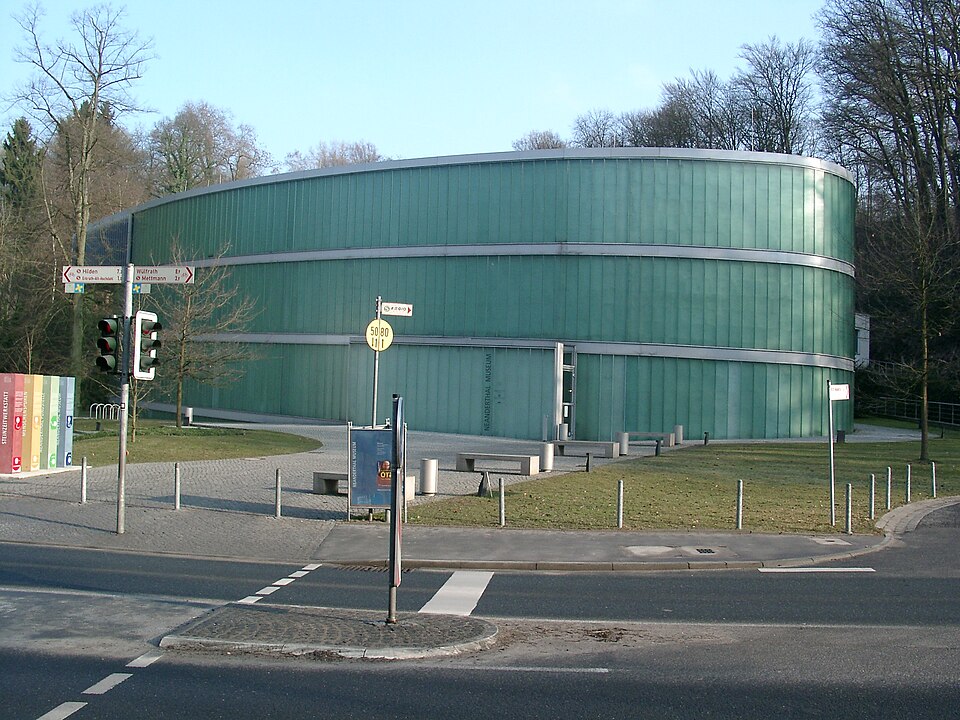
The Neanderthal Museum is located in Mettmann, Germany, near the site of the Feldhofer Grotte where the first recognized Neanderthal fossil remains were discovered in 1856. The museum building, designed by architects Günter Zamp Kelp, Julius Krauss, and Arno Brandlhuber, is a striking modern structure that serves as a center for the study and public interpretation of human evolution.
The exhibits provide a comprehensive chronological journey through the development of humanity, beginning with the origins of life and moving through the emergence of the genus Homo. A significant portion of the museum is dedicated to the life, culture, and eventual disappearance of Neanderthals, contextualizing their existence within the broader framework of human history and their interactions with early modern humans.
Key Facts
- Materials
- Steel, Glass, Concrete
- Civilization
- Modern
- Accessibility
- Fully wheelchair accessible
- Date(s)
- 1996
- Condition
- Active
- Original Function
- Museum of human evolution
- Key Figures
- Johann Carl Fuhlrott, Hermann Schaaffhausen
The 1856 Discovery
1856Workers in the Neander Valley (Neandertal) discovered fossilized bones in the Feldhofer Grotte. Initially dismissed as the remains of a cave bear or a deformed human, the discovery was later identified by Johann Carl Fuhlrott and Hermann Schaaffhausen as a distinct, ancient form of human, sparking a major scientific debate regarding human origins.
Early Museum Efforts
1921-1995The first museum dedicated to the Neanderthal discovery was established in 1921 in a nearby building. As interest in paleoanthropology grew throughout the 20th century, the need for a larger, more modern facility to house the growing collection and provide educational resources became apparent.
The Modern Museum
1996-PresentThe current museum building opened in 1996, situated in the valley near the original discovery site. It has since become a leading institution for research and public outreach, utilizing interactive technology to present complex evolutionary concepts to a wide audience.
Cultural Significance
The museum holds a unique place in the history of science as it marks the location where the concept of 'Neanderthal man' was first established. It serves as a focal point for understanding the human narrative, challenging visitors to consider the biological and cultural connections between extinct hominids and contemporary humans.
Beyond its scientific role, the museum is a landmark of modern architecture in the region and a significant educational hub that influences how the public perceives evolutionary biology and the deep history of the European continent.
Interpretive Notes
Scholarly debates and areas of uncertainty
The primary scholarly debates surrounding the museum's subject matter involve the nature of the interaction between Neanderthals and Homo sapiens, including the extent of interbreeding and the reasons for the Neanderthal extinction. Additionally, the interpretation of Neanderthal symbolic behavior and cognitive capacity remains a subject of ongoing archaeological investigation.
Visiting Information
Entry Rules
Open Tuesday to Sunday, 10:00 to 18:00. Closed on Mondays. Tickets can be purchased online or at the museum entrance. No specific dress code required.
Best Times to Visit
Weekdays outside of school holidays offer the quietest experience for viewing the exhibits.
Photography
Personal photography is permitted for non-commercial use. Flash and tripods are prohibited inside the exhibition galleries.
Preservation Notes
The museum is climate-controlled to protect sensitive artifacts. Visitors are requested to refrain from touching display cases and to follow marked paths through the chronological exhibits.
Nearby POIs
10 shownSources & Further Reading
- [1]The Neanderthals: Rediscovered — Dimitra Papagianni and Michael A. Morse. Thames & Hudson (2015)
- [2]
Key Facts
- Materials
- Steel, Glass, Concrete
- Civilization
- Modern
- Accessibility
- Fully wheelchair accessible
- Date(s)
- 1996
- Condition
- Active
- Original Function
- Museum of human evolution
- Key Figures
- Johann Carl Fuhlrott, Hermann Schaaffhausen