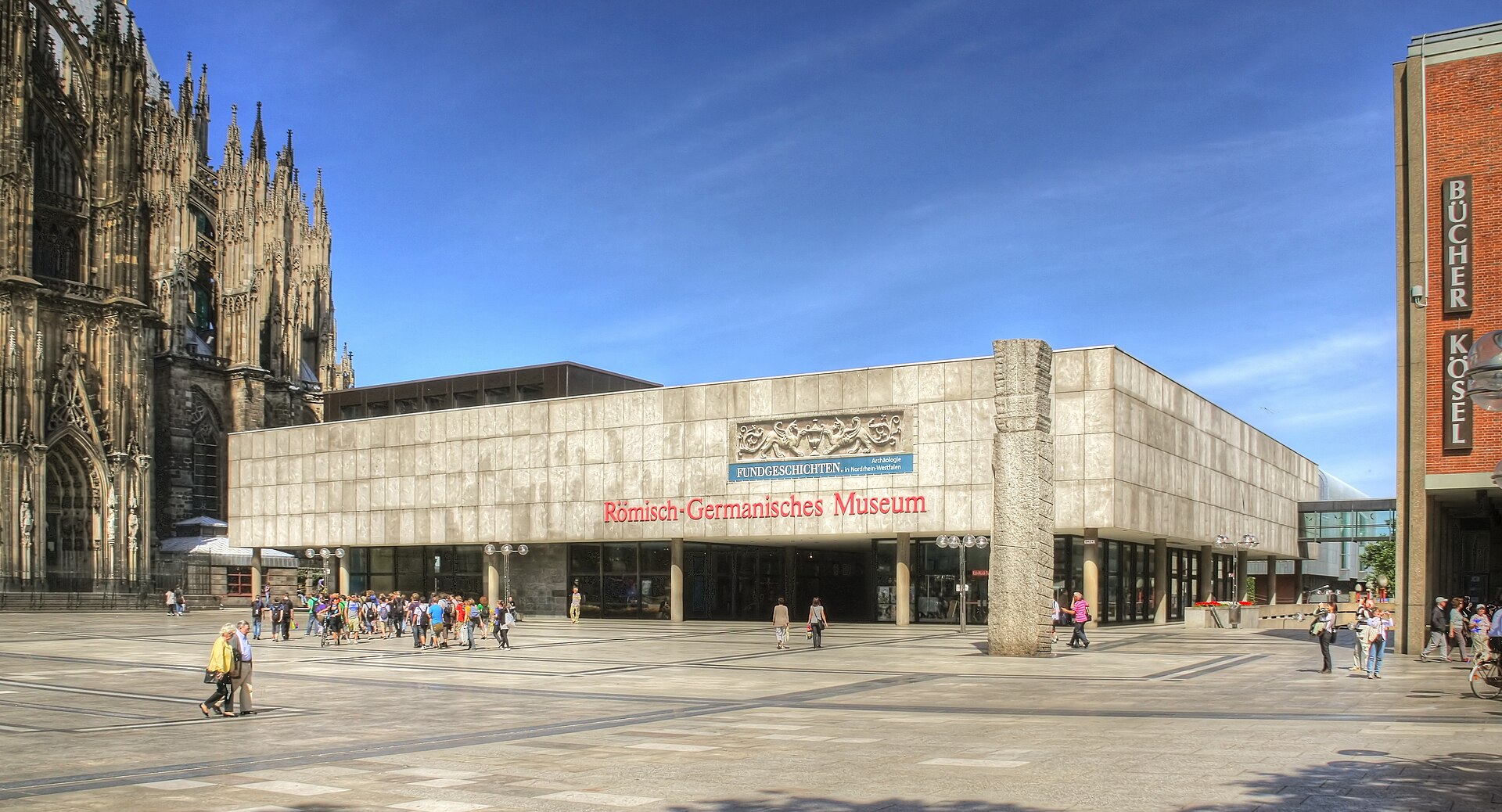
The Romano-Germanic Museum (Römisch-Germanisches Museum) in Cologne is an archaeological museum built directly over the site of a third-century Roman villa. The structure was designed by architects Heinz Röcke and Klaus Renner and opened in 1974, specifically to preserve and display the famous Dionysus mosaic in its original location.
The museum houses an extensive collection of artifacts from the Roman settlement of Colonia Claudia Ara Agrippinensium, which served as the capital of the Roman province of Germania Inferior. Its holdings include one of the world's most significant collections of Roman glass, as well as numerous funerary monuments, jewelry, and everyday objects that illustrate the daily life and cultural fusion of the Roman and Germanic populations in the Rhineland.
Key Facts
- Materials
- Concrete, Glass, Steel
- Civilization
- Roman
- Accessibility
- Fully wheelchair accessible
- Date(s)
- 1974
- Condition
- Active museum
- Original Function
- Archaeological museum and site protection
- Key Figures
- Heinz Röcke, Klaus Renner
Discovery of the Dionysus Mosaic
1941During the construction of an air-raid shelter in 1941, workers uncovered the well-preserved Dionysus mosaic. The discovery prompted the decision to build a permanent museum structure over the site to protect the mosaic in situ.
Museum Construction
1970-1974The modern museum building was constructed to integrate the ancient Roman villa foundations with contemporary exhibition spaces. It was inaugurated in 1974 to serve as the primary repository for Roman-era findings in Cologne.
Modern Renovation
2019-PresentThe museum is currently undergoing a comprehensive renovation and modernization project to update its infrastructure and exhibition concepts, ensuring the long-term preservation of its extensive collection.
Cultural Significance
The museum is central to understanding Cologne's identity as a former Roman provincial capital. By preserving the Dionysus mosaic in its original context, it bridges the gap between the ancient urban layout and the modern city, serving as a primary educational resource for the history of the Rhineland.
Interpretive Notes
Scholarly debates and areas of uncertainty
Discussions often center on the conservation challenges of maintaining the in situ Dionysus mosaic within a climate-controlled modern building, as well as the ongoing debate regarding the repatriation of certain provincial artifacts.
Visiting Information
Entry Rules
Open Tuesday to Sunday. Tickets can be purchased at the entrance or online. Bags larger than A4 size must be stored in lockers.
Best Times to Visit
Weekday mornings are generally quieter, allowing for better viewing of the mosaic and glass collections.
Photography
Non-commercial photography is permitted without flash or tripods.
Preservation Notes
Maintain distance from the mosaic floor. Do not touch glass display cases.
Nearby POIs
10 shownSources & Further Reading
- [1]
- [2]The Roman Heritage of Cologne — Hansgerd Hellenkemper. Archaeological Institute of Cologne (2015)
Key Facts
- Materials
- Concrete, Glass, Steel
- Civilization
- Roman
- Accessibility
- Fully wheelchair accessible
- Date(s)
- 1974
- Condition
- Active museum
- Original Function
- Archaeological museum and site protection
- Key Figures
- Heinz Röcke, Klaus Renner