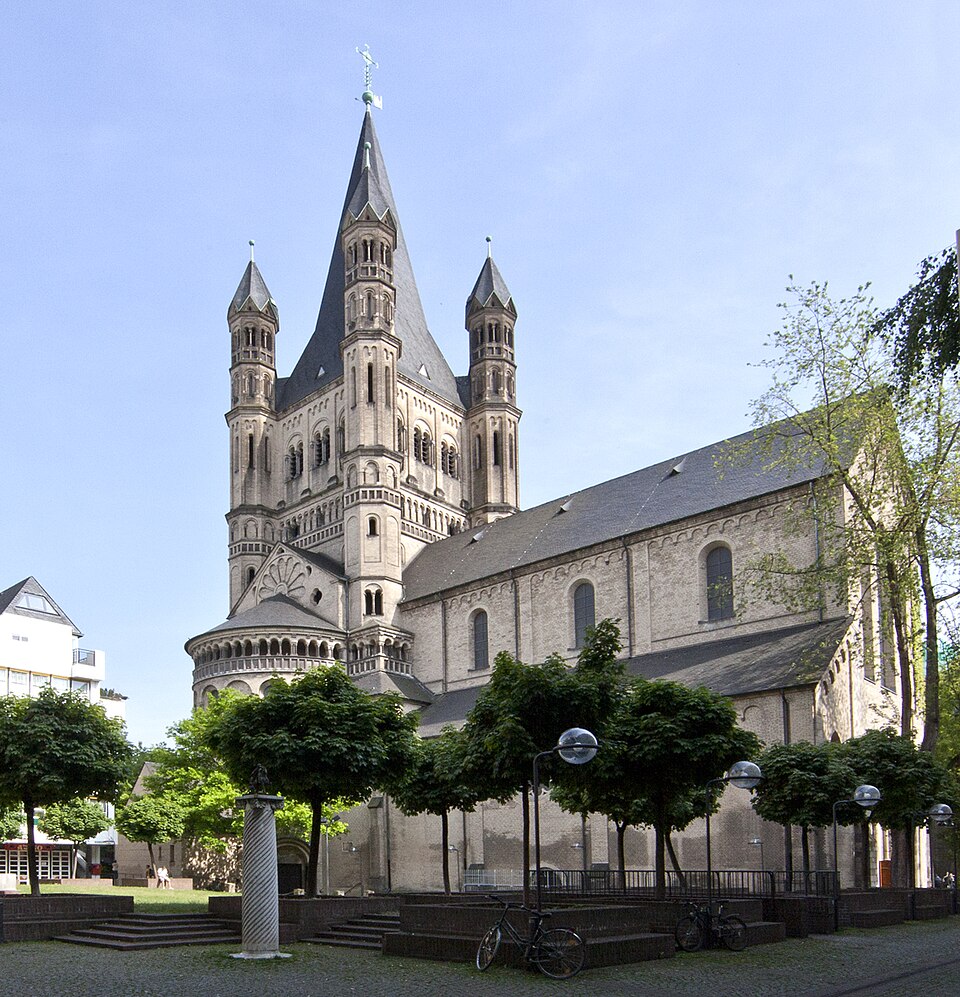
Great Saint Martin Church (Groß St. Martin) is a prominent Romanesque church located in the old town of Cologne, Germany. Built on the foundations of a Roman storehouse and an earlier Merovingian chapel, the current structure is renowned for its massive four-towered crossing and its distinctive trefoil choir, which dominates the city's skyline along the Rhine river.
The church underwent significant modifications throughout the Middle Ages, including the addition of Gothic elements. Following extensive damage during World War II, the church was meticulously reconstructed between 1948 and 1985, restoring its medieval silhouette while preserving the archaeological layers of the Roman site beneath the nave.
Key Facts
- Materials
- Tuff, Brick, Sandstone
- Civilization
- Medieval German
- Accessibility
- Ground level accessible
- Date(s)
- 1150–1250 CE
- Condition
- Restored, active parish church
- Original Function
- Benedictine monastery church
- Key Figures
- Archbishop Bruno the Great
Roman Origins
1st century CEThe site was originally occupied by a large Roman warehouse complex situated on an island in the Rhine. Archaeological excavations have revealed these foundations beneath the current church floor.
Romanesque Construction
1150–1250 CEThe current Romanesque structure was built to replace an earlier church destroyed by fire. It was designed as a Benedictine monastery church, featuring the iconic trefoil choir that remains its most recognizable architectural feature.
World War II and Reconstruction
1945–1985 CEThe church was severely damaged during Allied bombing raids in 1945. Reconstruction efforts spanned several decades, focusing on restoring the exterior to its Romanesque form while integrating the historical archaeological site into the visitor experience.
Cultural Significance
Great Saint Martin serves as a vital symbol of Cologne's resilience and its deep historical connection to the Rhine. It represents the transition from Roman urban planning to medieval ecclesiastical architecture, acting as a bridge between the city's ancient past and its post-war reconstruction.
Interpretive Notes
Scholarly debates and areas of uncertainty
There is ongoing academic discussion regarding the extent to which the post-war reconstruction accurately reflects the original 12th-century interior layout versus modern interpretations of Romanesque aesthetics.
Visiting Information
Entry Rules
Open to the public daily. Entry is free, though donations are encouraged. Modest dress is requested as it is an active place of worship.
Best Times to Visit
Weekday mornings offer the quietest experience for viewing the architecture. The surrounding old town area is best visited during daylight hours.
Photography
Personal photography is permitted without flash. Tripods are prohibited.
Preservation Notes
Visitors are asked to remain on designated paths to protect the archaeological excavations visible within the church.
Nearby POIs
10 shownSources & Further Reading
- [1]Cologne: The Romanesque Churches — Hiltrud Kier. J.P. Bachem Verlag (2005)
- [2]Groß St. Martin: Archäologie und Baugeschichte — Sven Schütte. Stadt Köln (2012)
Key Facts
- Materials
- Tuff, Brick, Sandstone
- Civilization
- Medieval German
- Accessibility
- Ground level accessible
- Date(s)
- 1150–1250 CE
- Condition
- Restored, active parish church
- Original Function
- Benedictine monastery church
- Key Figures
- Archbishop Bruno the Great