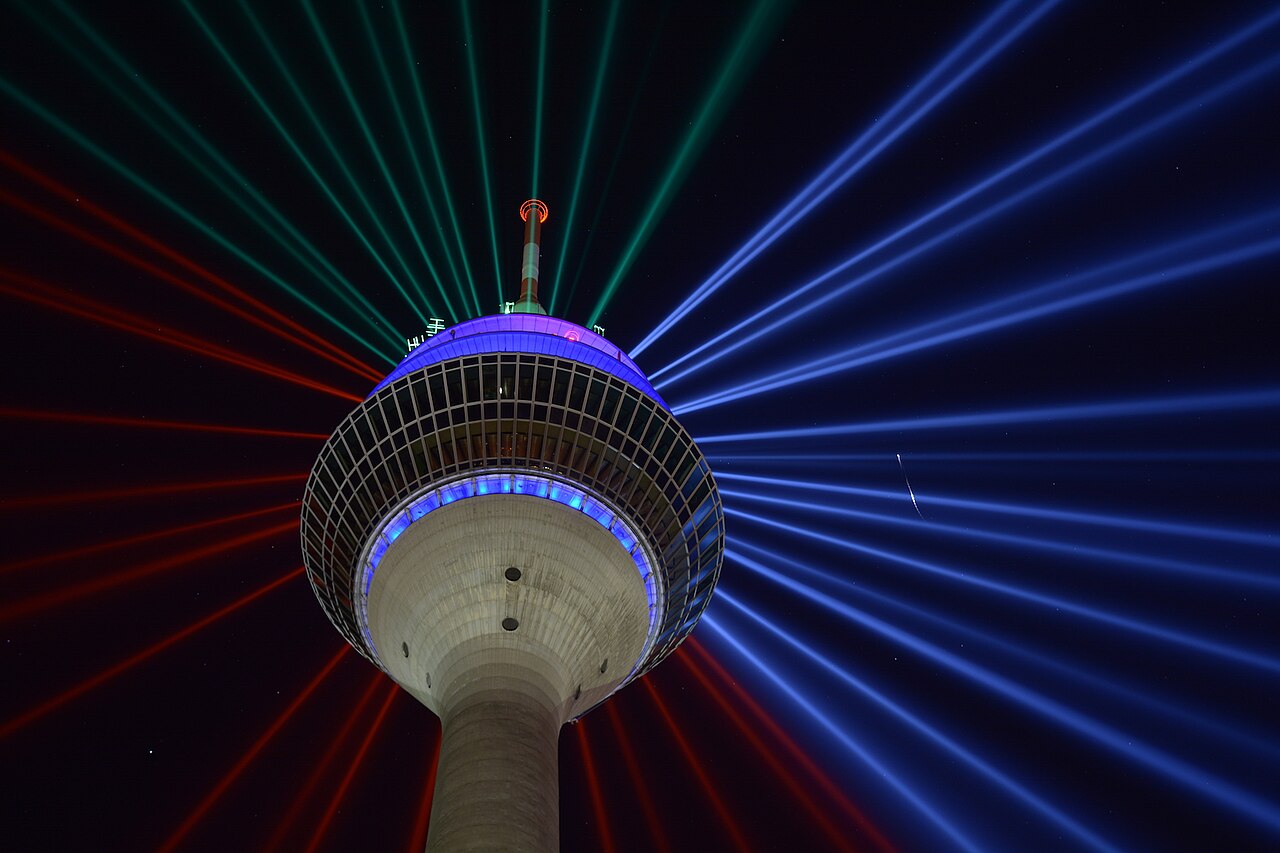
The Rheinturm, or Rhine Tower, is a telecommunications tower located in Düsseldorf, Germany. Standing at a total height of 240.5 meters, it serves as a prominent landmark and a functional hub for radio and television broadcasting. The structure is situated near the Landtag of North Rhine-Westphalia and the MedienHafen, marking a significant point along the Rhine river.
Designed by architect Harald Deilmann, the tower is best known for its unique light installation, the 'Lichtzeitpegel,' which functions as the world's largest digital clock. The time is displayed vertically in a decimal format using light portholes along the tower's shaft, providing a distinct visual feature that is visible from across the city.
Key Facts
- Materials
- Reinforced concrete, Steel, Glass
- Civilization
- Modern Germany
- Accessibility
- Wheelchair accessible to observation deck
- Date(s)
- 1979-1981
- Condition
- Active
- Original Function
- Telecommunications and observation
- Key Figures
- Harald Deilmann
Planning and Construction
1979-1981The tower was commissioned to improve telecommunications infrastructure in the Düsseldorf region. Construction began in 1979 under the direction of architect Harald Deilmann, utilizing reinforced concrete to reach its significant height.
Inauguration and Function
1981The Rheinturm was officially opened in 1981. Beyond its technical role in broadcasting, it was designed to include public amenities, such as an observation deck and a revolving restaurant, to serve as a tourist attraction.
Modern Upgrades
21st CenturyThe tower has undergone periodic maintenance and technical upgrades to its broadcasting equipment and lighting systems, ensuring its continued relevance as both a utility structure and a city icon.
Cultural Significance
The Rheinturm is a symbol of Düsseldorf's modernization and its status as a media and telecommunications hub. The 'Lichtzeitpegel' clock has become an integral part of the city's nocturnal skyline, representing a fusion of functional engineering and public art that defines the local urban identity.
Interpretive Notes
Scholarly debates and areas of uncertainty
There is limited scholarly debate regarding the tower, though architectural critics occasionally discuss its impact on the historical skyline of Düsseldorf and the aesthetic integration of its functional lighting systems within the urban landscape.
Visiting Information
Entry Rules
Open daily. Tickets are required for access to the observation deck. Visitors must pass through security screening upon entry.
Best Times to Visit
Sunset and evening hours are recommended to view the 'Lichtzeitpegel' clock in operation and to see the illuminated city skyline.
Photography
Personal photography is permitted. Commercial photography or professional filming requires prior authorization from the tower management.
Preservation Notes
The structure is maintained by the local telecommunications authority. Visitors are expected to follow standard safety protocols while on the observation deck.
Nearby POIs
10 shownSources & Further Reading
- [1]Düsseldorf: Architekturführer — Roland Kanz. Dietrich Reimer Verlag (2001)
- [2]The Rhine Tower: Engineering and Design — Harald Deilmann. Bauwelt (1982)
Key Facts
- Materials
- Reinforced concrete, Steel, Glass
- Civilization
- Modern Germany
- Accessibility
- Wheelchair accessible to observation deck
- Date(s)
- 1979-1981
- Condition
- Active
- Original Function
- Telecommunications and observation
- Key Figures
- Harald Deilmann