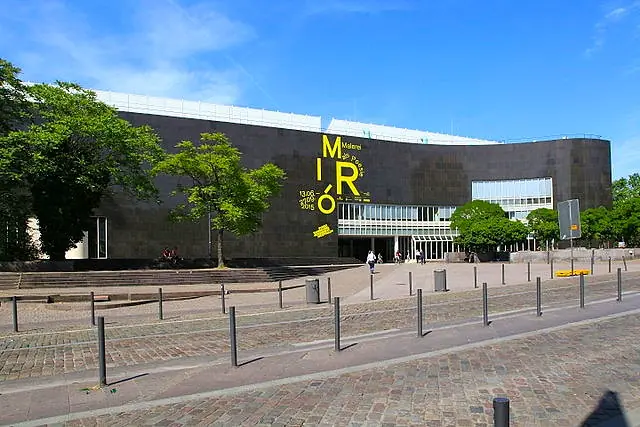
The Kunstsammlung Nordrhein-Westfalen is the art collection of the German state of North Rhine-Westphalia, housed across three distinct venues in Düsseldorf: K20 at Grabbeplatz, K21 in the Ständehaus, and the Schmela Haus. The institution is internationally recognized for its extensive holdings of 20th-century modernism, particularly its significant collection of works by Paul Klee, as well as major pieces by Pablo Picasso, Henri Matisse, and the Surrealists.
Beyond its permanent collection, the museum serves as a dynamic space for contemporary art, hosting rotating exhibitions that engage with current social and political themes. The K21 venue, located in the historic Ständehaus, is particularly noted for its large-scale installations and its glass-domed architecture, which integrates historical 19th-century design with modern exhibition requirements.
Key Facts
- Materials
- Black granite (K20 facade), Glass, Steel, Stone
- Civilization
- German
- Accessibility
- Fully wheelchair accessible across all venues
- Date(s)
- 1961 (Founding)
- Condition
- Active and well-maintained
- Original Function
- State art collection and exhibition space
- Key Figures
- Paul Klee, Pablo Picasso, Max Ernst
Foundation and Early Years
1960sThe collection was established in 1961 by the state of North Rhine-Westphalia. Its initial focus was the acquisition of 20th-century art, with a foundational purchase of 88 works by Paul Klee from the artist's estate, which remains the core of the museum's identity.
Expansion to K20
1986The K20 building at Grabbeplatz was opened in 1986 to provide a permanent home for the growing collection. Designed by Dissing+Weitling, the building is characterized by its distinctive black granite facade, which has become a landmark of Düsseldorf's cultural district.
Opening of K21
2002The museum expanded its footprint by opening K21 in the former Ständehaus, the seat of the former provincial parliament. This venue was dedicated to contemporary art, utilizing the building's historic architecture to house large-scale, site-specific installations.
Modern Integration
2009-PresentThe Schmela Haus, a former gallery designed by Aldo van Eyck, was integrated into the museum's portfolio in 2009. Today, the three venues operate as a unified institution, balancing historical modernist masterpieces with cutting-edge contemporary discourse.
Cultural Significance
The Kunstsammlung serves as a primary cultural anchor for the Rhine-Ruhr region, bridging the gap between classical modernism and contemporary practice. Its collection of Paul Klee's work is considered one of the most comprehensive in the world, making it a site of pilgrimage for scholars of the Bauhaus and Expressionist movements.
Furthermore, the museum plays a vital role in the urban identity of Düsseldorf, with its venues occupying significant architectural spaces that reflect the city's transition from an industrial hub to a center for international art and design.
Interpretive Notes
Scholarly debates and areas of uncertainty
Discussions often center on the balance between the museum's role as a custodian of historical modernist canon and its mandate to present experimental contemporary art. There is ongoing scholarly interest in how the disparate architectural styles of the K20 and K21 venues influence the curatorial narrative of the collection.
Visiting Information
Entry Rules
Open Tuesday to Sunday. Tickets can be purchased online or at the box office. Concessions are available for students and seniors. Bags larger than A4 size must be stored in lockers.
Best Times to Visit
Weekday mornings are generally quieter. The museum is often busier during the opening weeks of major temporary exhibitions.
Photography
Non-commercial photography for private use is permitted in most areas without flash or tripods. Specific temporary exhibitions may prohibit photography due to copyright restrictions.
Preservation Notes
Maintain a respectful distance from all artworks. Do not touch surfaces or frames. Climate control is strictly regulated; please avoid bringing food or drink into the galleries.
Nearby POIs
10 shownSources & Further Reading
- [1]
- [2]Paul Klee: The Collection of the Kunstsammlung — Marion Ackermann. Prestel (2012)
Key Facts
- Materials
- Black granite (K20 facade), Glass, Steel, Stone
- Civilization
- German
- Accessibility
- Fully wheelchair accessible across all venues
- Date(s)
- 1961 (Founding)
- Condition
- Active and well-maintained
- Original Function
- State art collection and exhibition space
- Key Figures
- Paul Klee, Pablo Picasso, Max Ernst