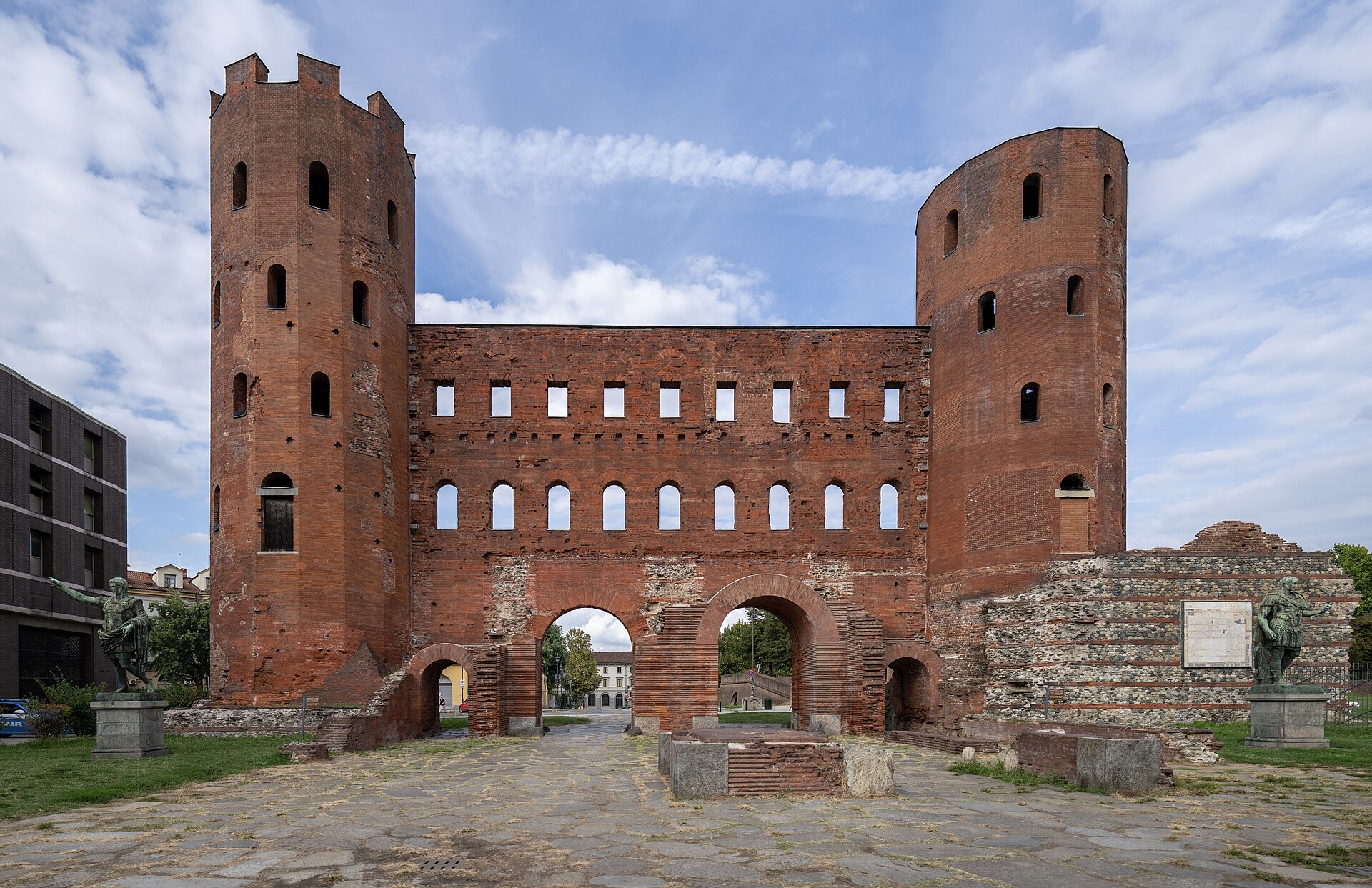
The Porta Palatina is a monumental Roman city gate located in Turin, Italy, serving as the primary northern entrance to the ancient colony of Julia Augusta Taurinorum. Constructed during the 1st century BCE, it represents one of the best-preserved Roman gateways of its kind in the world, featuring a central courtyard flanked by two sixteen-sided towers.
The structure consists of a central gate with four entrances—two for vehicles and two for pedestrians—integrated into the original defensive walls of the city. Throughout the centuries, the gate has been repurposed as a fortification, a prison, and a residential structure, which contributed to its survival while other Roman-era walls were dismantled for urban expansion.
Key Facts
- Materials
- Brick, Stone
- Civilization
- Roman
- Accessibility
- Open-air public park access, fully accessible
- Date(s)
- 1st century BCE
- Condition
- Well-preserved archaeological monument
- Original Function
- City gate and defensive fortification
- Key Figures
- Augustus
Foundation of Julia Augusta Taurinorum
1st century BCEThe gate was built as part of the defensive wall system for the newly established Roman colony of Julia Augusta Taurinorum, likely under the reign of Augustus. It served as the Porta Principalis Dextera, controlling the northern access to the city.
Medieval and Renaissance Reuse
Middle AgesDuring the medieval period, the gate was incorporated into the city's defensive structures and later served as a prison. The towers were modified, and the structure became known as the 'Palazzo delle Torri'.
Modern Restoration
19th-20th centuryIn the 19th century, the gate was cleared of later additions that had obscured its Roman features. Systematic archaeological excavations in the 20th century further stabilized the structure and integrated it into the surrounding archaeological park.
Cultural Significance
The Porta Palatina stands as the most significant physical link to Turin's Roman origins. It serves as a focal point for the city's archaeological heritage, bridging the gap between the ancient Roman grid and the modern urban layout of the historic center.
Locally, the site is a popular public space that hosts cultural events and serves as a landmark for the surrounding market district, reflecting the continuous use of the area from antiquity to the present day.
Interpretive Notes
Scholarly debates and areas of uncertainty
There is ongoing academic discussion regarding the exact original height of the towers and the extent of the decorative elements that once adorned the upper levels of the gate, as much of the original facade was lost during medieval modifications.
Visiting Information
Entry Rules
The site is located in a public park and is open 24 hours a day. No tickets are required.
Best Times to Visit
Early morning or late afternoon for photography, as the gate is located in an open area with limited shade.
Photography
None; the site is in a public space.
Preservation Notes
The site is monitored by the local archaeological authorities. Visitors are requested not to climb on the ancient masonry or leave litter in the park area.
Nearby POIs
11 shown- Palazzo Reale di Torino0.3 km
- Museo d'Arte Orientale, MAO0.3 km
- Palazzo Madama0.5 km
- Palazzo Carignano0.7 km
- Museo Egizio0.7 km
- Museo Nazionale del Cinema0.9 km
- Chiesa della Gran Madre di Dio1.8 km
- Chiesa di Santa Maria del Monte dei Cappuccini2 km
- Villa della Regina2.7 km
- Borgo Medioevale2.9 km
- Museo Nazionale dell'Automobile4.9 km
Sources & Further Reading
- [1]Torino romana: la Porta Palatina — Luisa Brecciaroli Taborelli. Edizioni del Capricorno (2015)
- [2]The Roman City of Augusta Taurinorum — G. P. Brogiolo. Journal of Roman Archaeology (2002)
Key Facts
- Materials
- Brick, Stone
- Civilization
- Roman
- Accessibility
- Open-air public park access, fully accessible
- Date(s)
- 1st century BCE
- Condition
- Well-preserved archaeological monument
- Original Function
- City gate and defensive fortification
- Key Figures
- Augustus
Nearby POIs
11 shown- Palazzo Reale di Torino0.3 km
- Museo d'Arte Orientale, MAO0.3 km
- Palazzo Madama0.5 km
- Palazzo Carignano0.7 km
- Museo Egizio0.7 km
- Museo Nazionale del Cinema0.9 km
- Chiesa della Gran Madre di Dio1.8 km
- Chiesa di Santa Maria del Monte dei Cappuccini2 km
- Villa della Regina2.7 km
- Borgo Medioevale2.9 km
- Museo Nazionale dell'Automobile4.9 km