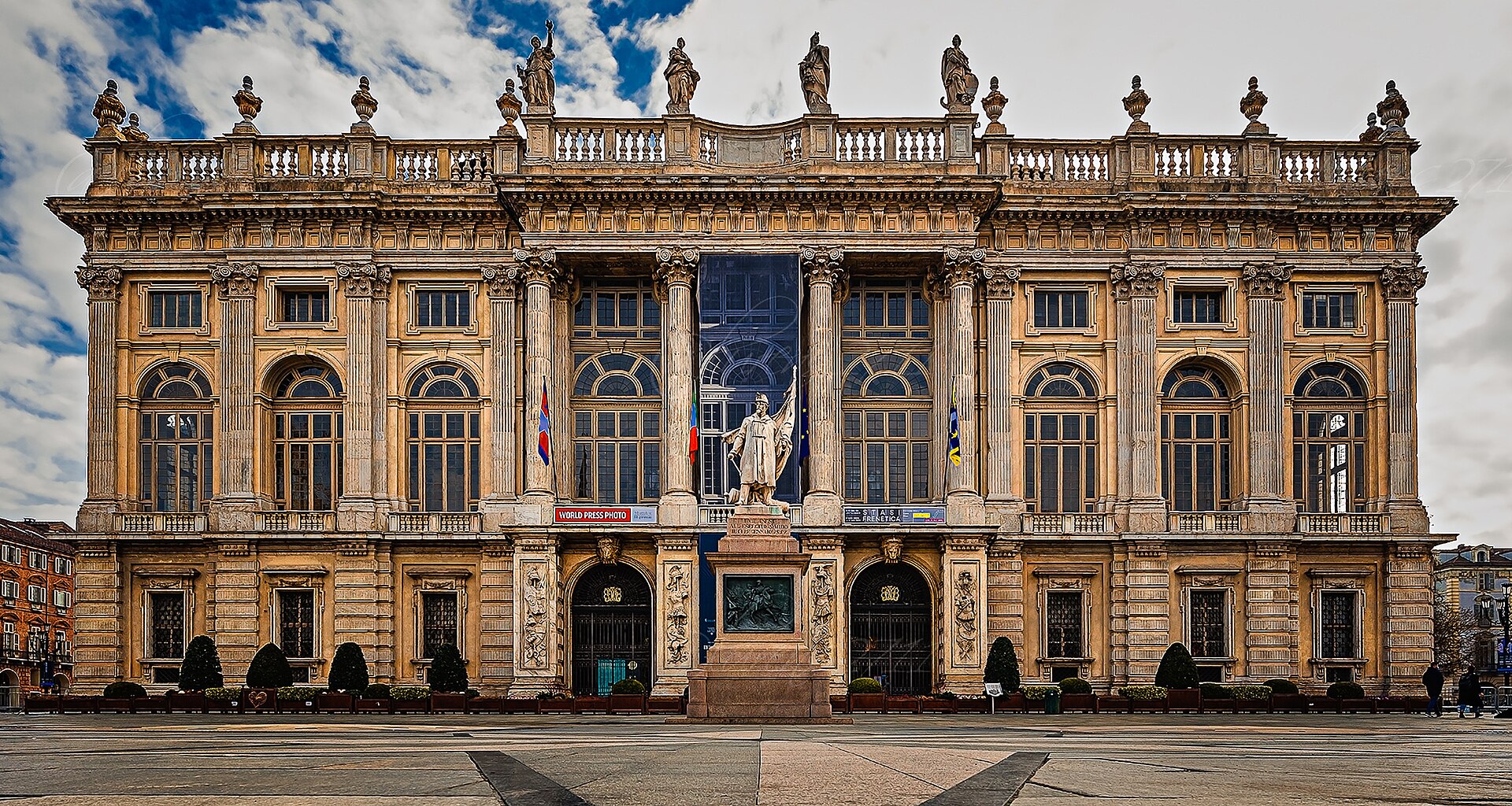
Palazzo Madama is a historic palace located in the center of Piazza Castello in Turin. The structure is a complex architectural palimpsest, featuring a medieval fortress core that was later expanded and transformed into a sophisticated Baroque residence for the House of Savoy.
The palace served as the seat of the first Senate of the Kingdom of Italy following the unification of the country. Today, it houses the Museo Civico d'Arte Antica, which holds an extensive collection of paintings, sculptures, and decorative arts spanning from the Middle Ages to the 18th century.
Key Facts
- Materials
- Brick, Marble, Stone
- Civilization
- Savoyard
- Accessibility
- Wheelchair accessible with elevator access to upper floors
- Date(s)
- 1st century BCE - 18th century CE
- Condition
- Restored and active as a museum
- Original Function
- Roman gate and medieval fortress
- Key Figures
- Marie Jeanne of Savoy, Marie Christine of France, Filippo Juvarra
Roman and Medieval Origins
1st century BCE - 14th centuryThe site originated as the Porta Praetoria, a gate in the Roman walls of Augusta Taurinorum. During the Middle Ages, the structure was converted into a fortified castle by the Acaja branch of the House of Savoy, serving as a defensive stronghold.
The Royal Residence
17th centuryThe palace earned its name from the 'Madama Reale' (Royal Madams), Marie Christine of France and Marie Jeanne of Savoy, who resided here. They commissioned significant renovations that began the transition from a fortress to a noble residence.
Baroque Transformation
1718-1721Architect Filippo Juvarra was commissioned to design the grand Baroque facade that faces Piazza Castello. This addition transformed the palace into a masterpiece of Piedmontese Baroque architecture, characterized by its monumental staircase and light-filled galleries.
Political Significance
1848-1865Following the Statuto Albertino, the palace became the seat of the Subalpine Senate, the upper house of the Parliament of the Kingdom of Sardinia, and later the first Senate of the unified Kingdom of Italy.
Cultural Significance
Palazzo Madama is a symbol of Turin's evolution from a Roman military outpost to the capital of the Kingdom of Italy. Its architecture reflects the shifting political power of the House of Savoy, blending medieval defensive structures with the refined aesthetic of the Baroque era.
As the site of the first Italian Senate, it holds profound importance in the history of the Risorgimento. The building remains a central cultural hub for the city, bridging the gap between its royal past and its current role as a public museum.
Interpretive Notes
Scholarly debates and areas of uncertainty
There is ongoing academic discussion regarding the extent of the original Roman gate structure still embedded within the medieval walls. While archaeological surveys have identified significant Roman masonry, the exact configuration of the ancient gate remains a subject of interpretation.
Visiting Information
Entry Rules
Open Wednesday to Monday. Tickets can be purchased at the entrance or online. Visitors are required to follow standard museum conduct; large bags must be left in the cloakroom.
Best Times to Visit
Weekday mornings are recommended to avoid weekend crowds. The palace is particularly notable for its natural light in the Juvarra staircase during the mid-morning hours.
Photography
Personal photography is permitted without flash or tripods. Professional photography requires prior authorization from the museum administration.
Preservation Notes
The building is subject to strict conservation protocols due to its age and the fragility of the Baroque interior decorations. Please refrain from touching wall surfaces or display cases.
Nearby POIs
11 shown- Palazzo Carignano0.2 km
- Palazzo Reale di Torino0.2 km
- Museo Egizio0.3 km
- Porta Palatina0.5 km
- Museo d'Arte Orientale, MAO0.6 km
- Museo Nazionale del Cinema0.6 km
- Chiesa della Gran Madre di Dio1.4 km
- Chiesa di Santa Maria del Monte dei Cappuccini1.6 km
- Villa della Regina2.3 km
- Borgo Medioevale2.5 km
- Museo Nazionale dell'Automobile4.5 km
Sources & Further Reading
- [1]Palazzo Madama: Storia e Architettura — Enrica Pagella. Umberto Allemandi & C. (2006)
- [2]Filippo Juvarra: L'architetto di corte — Giuseppe Dardanello. Fondazione CRT (2014)
Key Facts
- Materials
- Brick, Marble, Stone
- Civilization
- Savoyard
- Accessibility
- Wheelchair accessible with elevator access to upper floors
- Date(s)
- 1st century BCE - 18th century CE
- Condition
- Restored and active as a museum
- Original Function
- Roman gate and medieval fortress
- Key Figures
- Marie Jeanne of Savoy, Marie Christine of France, Filippo Juvarra
Nearby POIs
11 shown- Palazzo Carignano0.2 km
- Palazzo Reale di Torino0.2 km
- Museo Egizio0.3 km
- Porta Palatina0.5 km
- Museo d'Arte Orientale, MAO0.6 km
- Museo Nazionale del Cinema0.6 km
- Chiesa della Gran Madre di Dio1.4 km
- Chiesa di Santa Maria del Monte dei Cappuccini1.6 km
- Villa della Regina2.3 km
- Borgo Medioevale2.5 km
- Museo Nazionale dell'Automobile4.5 km