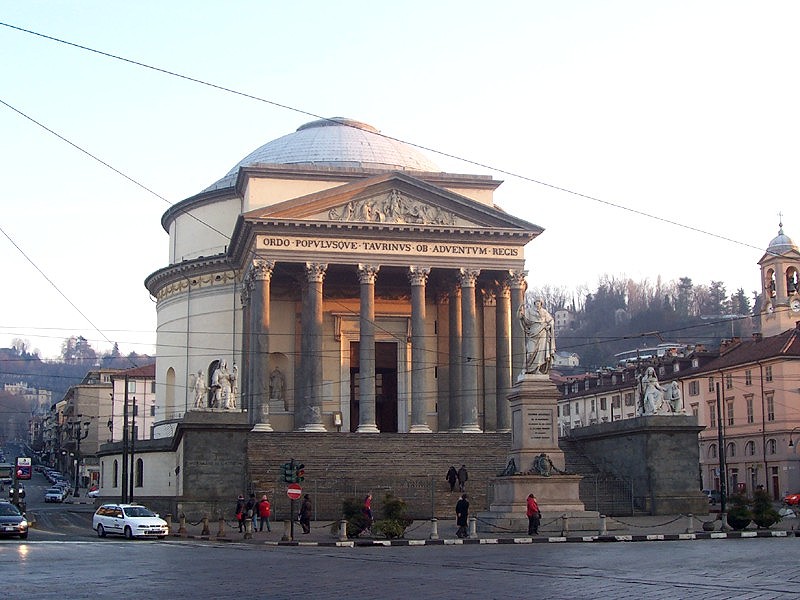
The Chiesa della Gran Madre di Dio is a prominent Neoclassical church located on the right bank of the Po River in Turin, Italy. Commissioned to commemorate the return of King Victor Emmanuel I to the throne in 1814 following the defeat of Napoleon, the structure was designed by architect Ferdinando Bonsignore. Its design was heavily inspired by the Roman Pantheon, featuring a grand portico with Corinthian columns and a circular main hall topped by a dome.
Construction began in 1818 and was completed in 1831, though the interior was not fully finished until later. The church serves as a significant landmark in Turin, positioned at the end of the Vittorio Veneto square and acting as a visual anchor for the city's urban layout. It remains an active place of worship and a notable example of the Neoclassical architectural style in Northern Italy.
Key Facts
- Materials
- Stone, Marble, Brick
- Civilization
- Kingdom of Sardinia
- Accessibility
- Ground level access with steps at the main entrance
- Date(s)
- 1818-1831
- Condition
- Well-preserved, active church
- Original Function
- Votive church commemorating the restoration of the monarchy
- Key Figures
- King Victor Emmanuel I, Ferdinando Bonsignore
Commission and Design
1814-1818Following the fall of Napoleon and the restoration of the House of Savoy, the city of Turin commissioned a church to celebrate the return of King Victor Emmanuel I. Ferdinando Bonsignore won the design competition, proposing a structure that mirrored the grandeur of Roman antiquity.
Construction Phase
1818-1831Work commenced in 1818 under the supervision of Bonsignore. The project faced various delays, but the exterior structure was largely completed by 1831. The church was officially consecrated to the Virgin Mary, reflecting the royal family's devotion.
Modern Era
20th century - presentThe church has undergone several restoration projects to maintain its structural integrity and preserve its Neoclassical facade. It remains a central site for religious and civic events in Turin.
Cultural Significance
The Gran Madre di Dio is a symbol of the restoration of the Savoy monarchy in Piedmont. Its architectural reference to the Roman Pantheon serves to link the 19th-century Kingdom of Sardinia to the prestige of the Roman Empire, reinforcing the legitimacy of the ruling dynasty. It is a focal point of Turin's urban identity, marking the transition from the city center to the hills across the Po River.
Interpretive Notes
Scholarly debates and areas of uncertainty
There is minor academic discussion regarding the extent to which the church's design was intended to serve as a political monument versus a purely religious one, given the specific timing of its commission following the Napoleonic Wars.
Visiting Information
Entry Rules
Open to the public daily. Visitors are expected to maintain a respectful demeanor as it is an active place of worship. Modest dress is recommended.
Best Times to Visit
Morning hours are best for viewing the facade in natural light. The area is particularly scenic during the late afternoon when the sun sets behind the city skyline.
Photography
Personal photography is permitted. Tripods and professional equipment require prior authorization from the parish office.
Preservation Notes
The structure is subject to ongoing maintenance due to its proximity to the river. Visitors should avoid touching the exterior marble surfaces.
Nearby POIs
11 shown- Chiesa di Santa Maria del Monte dei Cappuccini0.3 km
- Villa della Regina0.9 km
- Museo Nazionale del Cinema0.9 km
- Palazzo Carignano1.3 km
- Museo Egizio1.3 km
- Palazzo Madama1.4 km
- Palazzo Reale di Torino1.5 km
- Porta Palatina1.8 km
- Borgo Medioevale1.9 km
- Museo d'Arte Orientale, MAO2 km
- Museo Nazionale dell'Automobile4 km
Sources & Further Reading
- [1]Ferdinando Bonsignore e la Gran Madre di Dio — Vera Comoli Mandracci. Allemandi (1990)
- [2]Torino: Architettura e città — Politecnico di Torino. Umberto Allemandi & C. (2005)
Key Facts
- Materials
- Stone, Marble, Brick
- Civilization
- Kingdom of Sardinia
- Accessibility
- Ground level access with steps at the main entrance
- Date(s)
- 1818-1831
- Condition
- Well-preserved, active church
- Original Function
- Votive church commemorating the restoration of the monarchy
- Key Figures
- King Victor Emmanuel I, Ferdinando Bonsignore
Nearby POIs
11 shown- Chiesa di Santa Maria del Monte dei Cappuccini0.3 km
- Villa della Regina0.9 km
- Museo Nazionale del Cinema0.9 km
- Palazzo Carignano1.3 km
- Museo Egizio1.3 km
- Palazzo Madama1.4 km
- Palazzo Reale di Torino1.5 km
- Porta Palatina1.8 km
- Borgo Medioevale1.9 km
- Museo d'Arte Orientale, MAO2 km
- Museo Nazionale dell'Automobile4 km