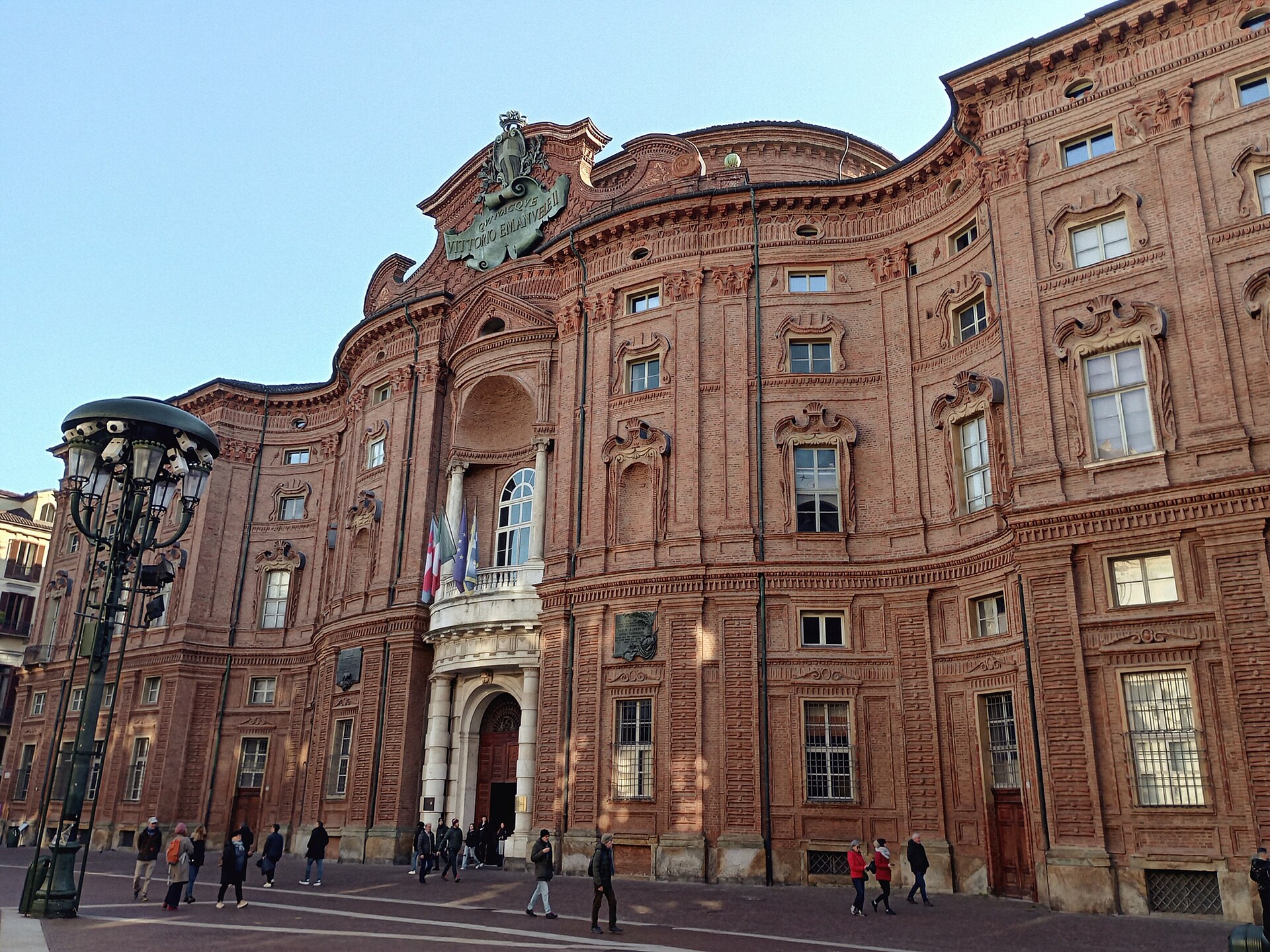
Palazzo Carignano is a historic building in the center of Turin, Italy, widely considered one of the finest examples of Italian Baroque architecture. Designed by Guarino Guarini and commissioned by Prince Emmanuel Philibert of Savoy-Carignano in 1679, the palace is renowned for its distinctive undulating brick façade and its complex, elliptical central staircase.
Beyond its architectural significance, the palace served as the birthplace of King Victor Emmanuel II, the first king of a united Italy. It later gained national importance as the seat of the Chamber of Deputies of the Subalpine Parliament and subsequently the first Parliament of the Kingdom of Italy. Today, it houses the National Museum of the Italian Risorgimento.
Key Facts
- Materials
- Terracotta, Brick, Marble
- Civilization
- Savoyard
- Accessibility
- Wheelchair accessible with elevator access to museum levels
- Date(s)
- 1679–1684
- Condition
- Well-preserved, houses the National Museum of the Italian Risorgimento
- Original Function
- Residential palace for the House of Savoy-Carignano
- Key Figures
- Guarino Guarini, Victor Emmanuel II, Carlo Alberto of Sardinia
Design and Construction
1679–1684Prince Emmanuel Philibert commissioned the architect Guarino Guarini to design a new residence. Guarini utilized a bold, curvilinear design for the main façade, employing exposed brickwork in a manner that was highly innovative for the period.
Political Center
1848–1861The palace became the seat of the Subalpine Parliament in 1848. Following the unification of Italy, the building was expanded to accommodate the first national parliament, which met in the newly constructed hemicycle hall.
Museum Transformation
20th century–presentAfter the capital moved from Turin, the building transitioned into a cultural institution. It underwent extensive restoration in the late 20th century to preserve its Baroque features and modernize the museum facilities.
Cultural Significance
Palazzo Carignano is a cornerstone of Italian national identity, representing the transition from the absolute monarchy of the House of Savoy to the constitutional parliamentary system of the Risorgimento. Its architecture serves as a testament to the technical mastery of the Piedmontese Baroque school.
As the birthplace of the first king of Italy and the site where the unification of the country was debated and formalized, the palace remains a primary site of memory for the Italian state. It is protected as part of the UNESCO World Heritage site 'Residences of the Royal House of Savoy'.
Interpretive Notes
Scholarly debates and areas of uncertainty
There is ongoing academic discussion regarding the extent of Guarini's original design versus the later 19th-century modifications made by Gaetano Ferri to accommodate the parliamentary chamber. Scholars debate how much of the original Baroque spatial logic was compromised by the structural additions required for the legislative hall.
Visiting Information
Entry Rules
The palace is open to the public as part of the National Museum of the Italian Risorgimento. Tickets are required for entry. Visitors are expected to maintain a respectful demeanor as the site is a national monument.
Best Times to Visit
Weekday mornings are generally quieter. The site is particularly significant during national holidays such as Republic Day (June 2) and the Anniversary of Unification (March 17).
Photography
Personal photography is permitted without flash or tripods. Professional photography requires prior authorization from the museum administration.
Preservation Notes
The terracotta façade is subject to ongoing environmental monitoring due to urban pollution. Visitors are requested to refrain from touching the historic masonry and to follow all marked paths within the museum galleries.
Nearby POIs
11 shown- Museo Egizio0.1 km
- Palazzo Madama0.2 km
- Palazzo Reale di Torino0.5 km
- Museo Nazionale del Cinema0.5 km
- Porta Palatina0.7 km
- Museo d'Arte Orientale, MAO0.8 km
- Chiesa della Gran Madre di Dio1.3 km
- Chiesa di Santa Maria del Monte dei Cappuccini1.4 km
- Villa della Regina2.1 km
- Borgo Medioevale2.3 km
- Museo Nazionale dell'Automobile4.2 km
Key Facts
- Materials
- Terracotta, Brick, Marble
- Civilization
- Savoyard
- Accessibility
- Wheelchair accessible with elevator access to museum levels
- Date(s)
- 1679–1684
- Condition
- Well-preserved, houses the National Museum of the Italian Risorgimento
- Original Function
- Residential palace for the House of Savoy-Carignano
- Key Figures
- Guarino Guarini, Victor Emmanuel II, Carlo Alberto of Sardinia
Nearby POIs
11 shown- Museo Egizio0.1 km
- Palazzo Madama0.2 km
- Palazzo Reale di Torino0.5 km
- Museo Nazionale del Cinema0.5 km
- Porta Palatina0.7 km
- Museo d'Arte Orientale, MAO0.8 km
- Chiesa della Gran Madre di Dio1.3 km
- Chiesa di Santa Maria del Monte dei Cappuccini1.4 km
- Villa della Regina2.1 km
- Borgo Medioevale2.3 km
- Museo Nazionale dell'Automobile4.2 km