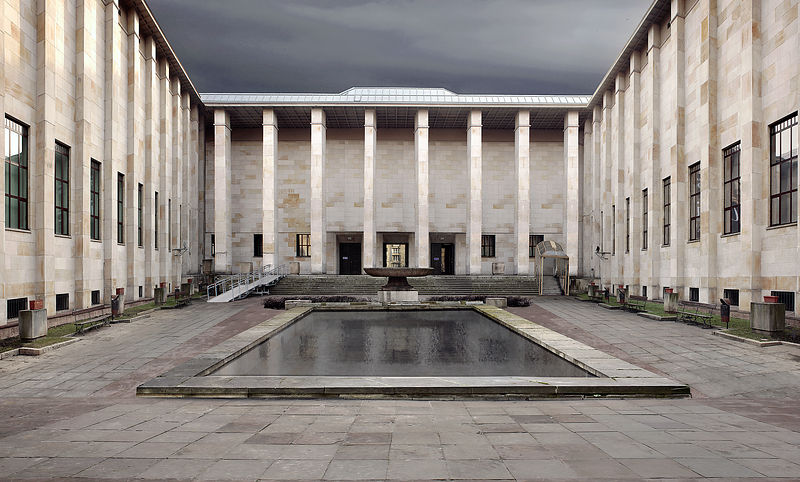
The National Museum in Warsaw is one of the oldest and largest art museums in Poland, housing a vast collection of ancient, medieval, and modern art. Established in 1862 as the Museum of Fine Arts, the institution moved to its current modernist building on Jerusalem Avenue in 1938, designed by architects Tadeusz Tolwiński and Antoni Dygat.
The museum's extensive holdings include over 800,000 works, ranging from Egyptian, Greek, and Roman antiquities to significant collections of Polish painting, sculpture, and decorative arts. It serves as a primary repository for national cultural heritage, documenting the evolution of Polish artistic identity alongside its historical interactions with broader European art movements.
Key Facts
- Materials
- Reinforced concrete, Stone cladding
- Civilization
- Polish
- Accessibility
- Fully wheelchair accessible with elevators
- Date(s)
- 1927-1938
- Condition
- Active, well-maintained
- Original Function
- Art museum
- Key Figures
- Stanisław Lorentz, Tadeusz Tolwiński
Founding and Early Years
1862-1916Originally founded as the Museum of Fine Arts in Warsaw, the institution began with a modest collection of paintings and sculptures. It served as a vital center for preserving Polish art during the period of partitions.
Modernist Expansion
1927-1938Under the leadership of director Stanisław Lorentz, the museum moved to its current purpose-built modernist facility. The building was designed to accommodate a rapidly growing collection and provide modern exhibition spaces.
Wartime Losses and Recovery
1939-1945During World War II, the museum suffered significant looting and damage. Stanisław Lorentz played a heroic role in hiding and documenting works to prevent their destruction or permanent removal by occupying forces.
Post-War Development
1945-PresentFollowing the war, the museum focused on the recovery of looted artifacts and the expansion of its international collections. It has since become a leading research institution and a central hub for Polish art history.
Cultural Significance
The National Museum in Warsaw is a cornerstone of Polish national identity, acting as the primary guardian of the country's visual history. Its collections bridge the gap between local traditions and international artistic trends, reflecting Poland's complex history within the European context.
Beyond its role as a repository, the museum is a site of memory, particularly regarding the preservation of cultural assets during the 20th century. It remains a focal point for scholarly research and public education, shaping the national narrative through its permanent and temporary exhibitions.
Interpretive Notes
Scholarly debates and areas of uncertainty
Ongoing discussions within the museum community focus on the provenance of specific artifacts acquired during the post-war period and the ethics of repatriation for objects displaced during the 20th-century conflicts. Additionally, there is academic debate regarding the balance between displaying nationalistic art versus integrating more global, contemporary perspectives.
Visiting Information
Entry Rules
Open Tuesday through Sunday. Tickets can be purchased online or at the museum box office. Visitors are required to leave large bags in the cloakroom.
Best Times to Visit
Weekday mornings are generally quieter. The museum is particularly busy during temporary exhibition openings and on free-admission days.
Photography
Personal photography is permitted for non-commercial use without flash or tripods. Some temporary exhibitions may prohibit photography entirely.
Preservation Notes
Maintain a respectful distance from all exhibits. Do not touch the artworks or display cases. Flash photography is strictly prohibited to prevent light damage to sensitive pigments.
Nearby POIs
11 shownSources & Further Reading
- [1]
- [2]Art and Identity in Poland — Piotr Piotrowski. Reaktion Books (2011)
Key Facts
- Materials
- Reinforced concrete, Stone cladding
- Civilization
- Polish
- Accessibility
- Fully wheelchair accessible with elevators
- Date(s)
- 1927-1938
- Condition
- Active, well-maintained
- Original Function
- Art museum
- Key Figures
- Stanisław Lorentz, Tadeusz Tolwiński