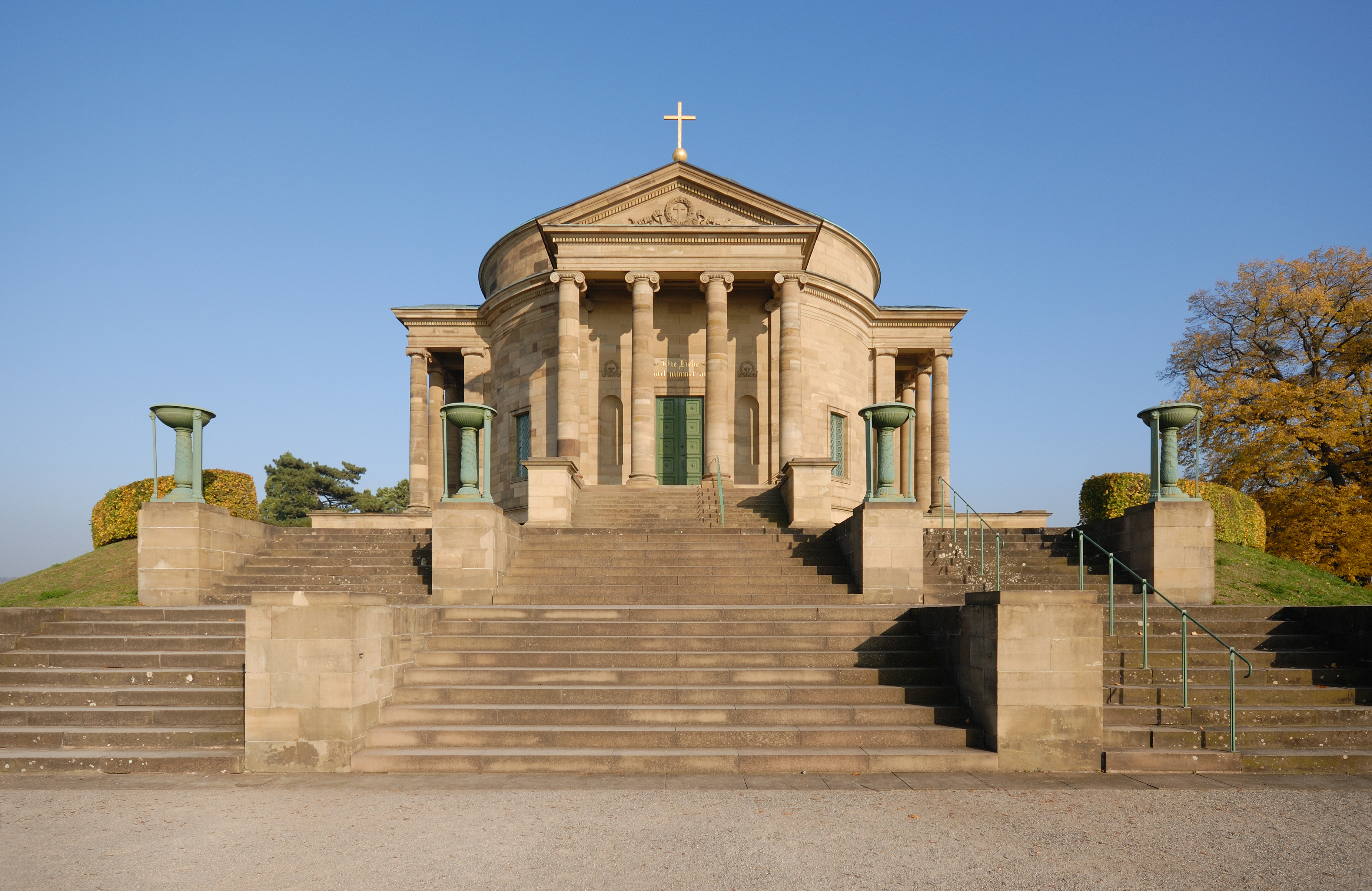
The Württemberg Mausoleum, located on the Württemberg hill in Stuttgart, was commissioned by King Wilhelm I of Württemberg as a final resting place for his wife, Queen Catherine, who died in 1819. Designed by the Italian architect Giovanni Salucci, the structure was completed in 1824 and serves as a prominent example of Neoclassical funerary architecture in Germany.
The mausoleum is built as a rotunda with four identical porticoes, reflecting the influence of Palladian architecture. It houses the sarcophagi of King Wilhelm I, Queen Catherine, and their daughter, Princess Marie. The site is situated on the former location of the ancestral castle of the House of Württemberg, which was demolished to make way for the monument.
Key Facts
- Materials
- Sandstone, Marble
- Civilization
- Kingdom of Württemberg
- Accessibility
- Accessible via walking path from the parking area
- Date(s)
- 1820-1824
- Condition
- Well-preserved, open to the public
- Original Function
- Royal funerary chapel
- Key Figures
- King Wilhelm I, Queen Catherine, Giovanni Salucci
Origins and Commission
1819Following the sudden death of Queen Catherine, King Wilhelm I sought to create a monumental tomb that would serve as a testament to their marriage and a place of perpetual prayer.
Construction
1820-1824Architect Giovanni Salucci was tasked with the design. The medieval ancestral castle of the Württemberg dynasty was demolished to provide a site with commanding views over the Neckar valley.
Consecration and Use
1824-PresentThe mausoleum was consecrated in 1824. It remains a site of historical significance for the region and continues to be maintained as a cultural monument by the state of Baden-Württemberg.
Cultural Significance
The mausoleum is a symbol of the romanticized mourning culture of the 19th century. It represents the transition of the Württemberg dynasty from their medieval origins to their status as a modern kingdom, physically replacing the old castle with a neoclassical monument dedicated to personal grief and royal legacy.
Interpretive Notes
Scholarly debates and areas of uncertainty
Debates exist regarding the extent to which the design was influenced by the King's personal aesthetic preferences versus Salucci's own architectural theories on funerary spaces.
Visiting Information
Entry Rules
Open to the public during seasonal hours, typically from April to November. Admission fee required.
Best Times to Visit
Spring and autumn for clear views of the surrounding vineyards and the Neckar valley.
Photography
Photography is permitted for private use; commercial photography requires prior authorization.
Preservation Notes
The site is a protected monument. Visitors are requested to remain on designated paths and respect the sanctity of the interior space.
Nearby POIs
11 shownSources & Further Reading
- [1]Die Grabkapelle auf dem Württemberg — Staatliche Schlösser und Gärten Baden-Württemberg. Official State Heritage Publication (2020)View
- [2]Giovanni Salucci: Ein italienischer Architekt in Württemberg — Hermann Lenz. Klett-Cotta (1982)
Key Facts
- Materials
- Sandstone, Marble
- Civilization
- Kingdom of Württemberg
- Accessibility
- Accessible via walking path from the parking area
- Date(s)
- 1820-1824
- Condition
- Well-preserved, open to the public
- Original Function
- Royal funerary chapel
- Key Figures
- King Wilhelm I, Queen Catherine, Giovanni Salucci