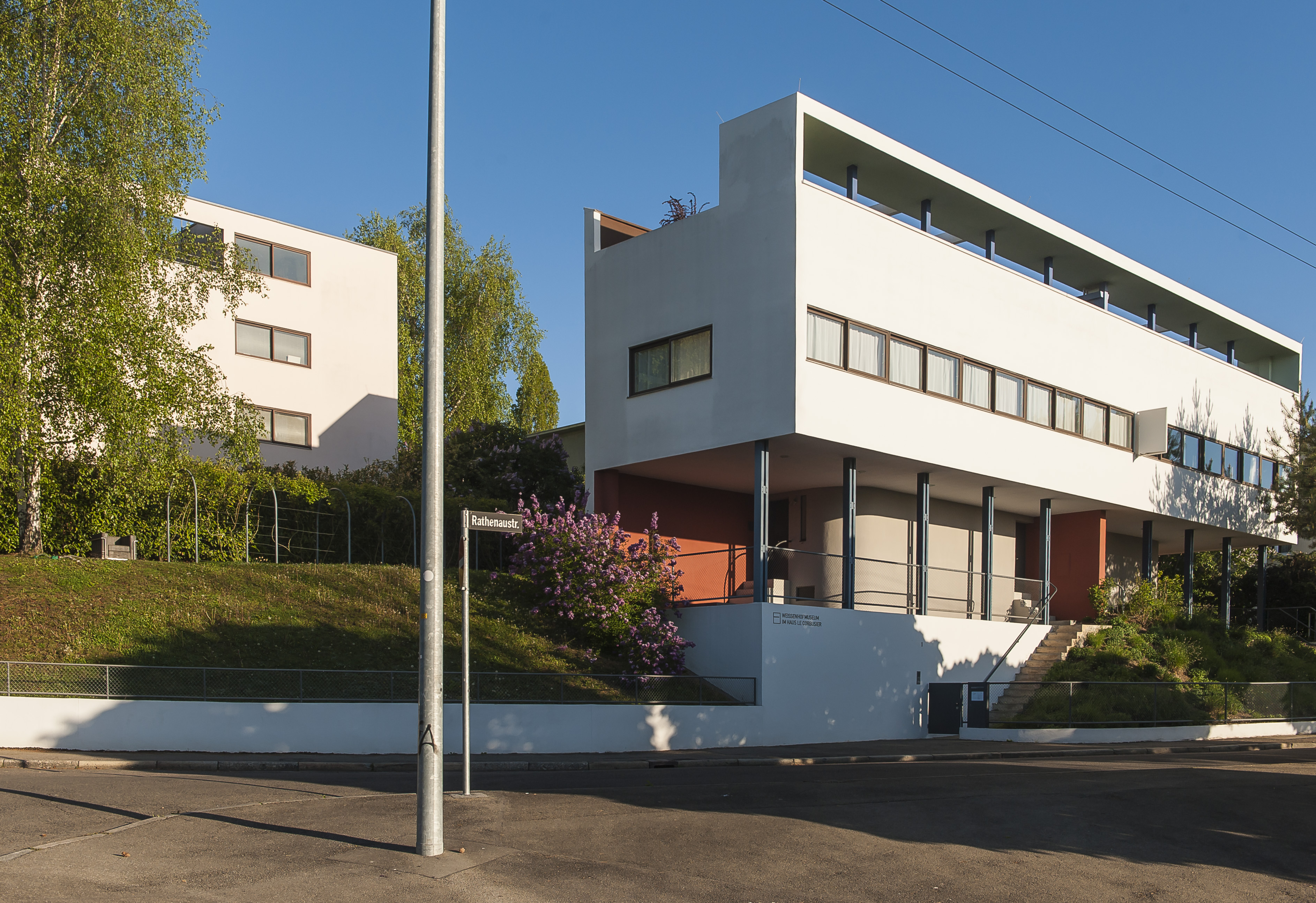
The Weissenhof Estate (Weissenhofsiedlung) in Stuttgart was constructed in 1927 as a model housing project for the Deutscher Werkbund exhibition. Under the artistic direction of Ludwig Mies van der Rohe, seventeen architects from across Europe were invited to design residential buildings that demonstrated the potential of new industrial construction methods and functionalist design principles.
The estate served as a manifesto for the 'Neues Bauen' movement, emphasizing flat roofs, ribbon windows, and open floor plans. Despite initial criticism from conservative circles who labeled the flat-roofed structures as 'un-German,' the project became a cornerstone of 20th-century architectural history, influencing urban planning and residential design globally.
Key Facts
- Materials
- Reinforced concrete, Steel, Glass, Stucco
- Civilization
- Modernist
- Accessibility
- Street-level access, museum interior has stairs
- Date(s)
- 1927
- Condition
- Well-preserved, residential and museum
- Original Function
- Model housing exhibition
- Key Figures
- Ludwig Mies van der Rohe, Le Corbusier, Walter Gropius, J.J.P. Oud
Conception and Exhibition
1927The Deutscher Werkbund commissioned the estate to showcase modern, affordable, and hygienic housing solutions. The project brought together leading avant-garde architects to create a cohesive neighborhood that prioritized functionality over traditional ornamentation.
National Socialist Era
1933-1945During the Third Reich, the estate was disparaged as a 'degenerate' architectural experiment. The flat roofs were modified with pitched roofs to align with nationalist aesthetic ideals, and the site faced significant neglect.
Post-War Restoration
1945-PresentFollowing World War II, the estate underwent several phases of restoration to return the buildings to their original 1927 appearance. In 2016, the Le Corbusier-designed houses were inscribed as part of the UNESCO World Heritage site 'The Architectural Work of Le Corbusier'.
Cultural Significance
The Weissenhof Estate represents the birth of the International Style in residential architecture. It challenged the prevailing bourgeois housing models of the 1920s by proposing standardized, industrial construction as a means to solve urban housing shortages. It remains a primary reference point for architects studying the transition from traditional to modern building techniques.
Today, the estate functions as both a living neighborhood and a site of cultural heritage. The Le Corbusier house, specifically, serves as a museum, allowing the public to engage directly with the spatial innovations of the early modernist period.
Interpretive Notes
Scholarly debates and areas of uncertainty
Debates persist regarding the tension between the estate's original intent as 'affordable housing' and its current status as a high-value, protected heritage site. Scholars also discuss the extent to which the 'international' nature of the project was compromised by the specific socio-political pressures of the Weimar Republic.
Visiting Information
Entry Rules
The estate is a public residential area. The Le Corbusier house (Weissenhof Museum) requires a ticket and has specific operating hours, typically Tuesday through Sunday.
Best Times to Visit
Spring and autumn for walking tours of the exterior. The museum is best visited on weekday mornings to avoid weekend crowds.
Photography
Exterior photography is permitted. Interior photography in the museum is generally allowed for personal use without flash.
Preservation Notes
The estate is a protected monument. Visitors must respect the privacy of residents in non-museum buildings and stay on public walkways.
Nearby POIs
11 shownSources & Further Reading
- [1]The Weissenhofsiedlung: Experimental Housing Built for the Deutscher Werkbund — Karin Kirsch. Rizzoli (1989)
- [2]The Architectural Work of Le Corbusier, an Outstanding Contribution to the Modern Movement — UNESCO World Heritage Centre. UNESCO (2016)View
Key Facts
- Materials
- Reinforced concrete, Steel, Glass, Stucco
- Civilization
- Modernist
- Accessibility
- Street-level access, museum interior has stairs
- Date(s)
- 1927
- Condition
- Well-preserved, residential and museum
- Original Function
- Model housing exhibition
- Key Figures
- Ludwig Mies van der Rohe, Le Corbusier, Walter Gropius, J.J.P. Oud