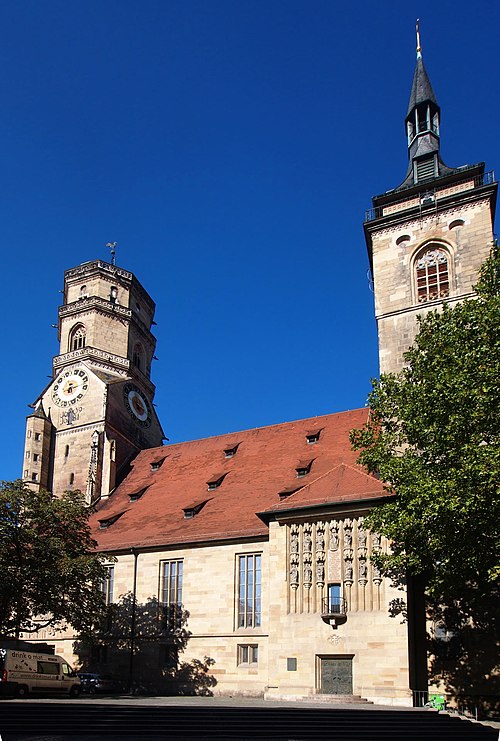
The Stiftskirche in Stuttgart is the city's oldest parish church and the primary place of worship for the Evangelical-Lutheran Church in Württemberg. Originally a Romanesque structure, the current building is largely defined by its 14th and 15th-century Gothic architecture, characterized by a distinctive nave with a complex net vault and two asymmetrical towers that dominate the city skyline.
Following severe destruction during World War II, the church underwent significant reconstruction between 1950 and 1958. This restoration integrated the surviving historical masonry with modern architectural elements, preserving the site's role as a spiritual and cultural landmark in the heart of Stuttgart.
Key Facts
- Materials
- Sandstone, Limestone
- Civilization
- German
- Accessibility
- Wheelchair accessible
- Date(s)
- 10th century - 15th century
- Condition
- Active, fully restored
- Original Function
- Collegiate church
- Key Figures
- Count Ulrich I of Württemberg
Origins and Romanesque Beginnings
10th - 12th centuryThe site originated as a small Romanesque church located outside the early medieval settlement of Stuttgart. It was elevated to a collegiate church in the 14th century by the Counts of Württemberg, who chose the site as their burial place.
Gothic Expansion
14th - 15th centuryThe church underwent major Gothic reconstruction, including the addition of the choir and the nave. The two towers were completed during this period, resulting in their characteristic asymmetrical appearance.
Reformation and War
16th - 20th centuryThe church became a center for the Protestant Reformation in Württemberg in the 16th century. It remained largely intact until the Second World War, when Allied bombing raids in 1944 caused catastrophic damage to the structure.
Post-War Reconstruction
1950 - 1958Under the direction of architect Hans Volkart, the church was rebuilt. The interior was redesigned with a modern aesthetic while retaining the historical footprint and surviving Gothic architectural features.
Cultural Significance
The Stiftskirche serves as the spiritual heart of the Evangelical-Lutheran Church in Württemberg and stands as a symbol of Stuttgart's resilience. Its role as the burial site for the House of Württemberg links the building directly to the political history of the region.
Interpretive Notes
Scholarly debates and areas of uncertainty
There is ongoing discussion regarding the extent to which the post-war reconstruction successfully balanced the preservation of original Gothic elements with the necessity of modern functional requirements.
Visiting Information
Entry Rules
Open daily for visitors and worship. Entry is free. Modest dress is requested.
Best Times to Visit
Weekday mornings for quiet reflection; Sunday mornings for services.
Photography
Personal photography allowed without flash or tripods.
Preservation Notes
The structure is under constant monitoring due to the age of the sandstone masonry. Visitors are asked to remain in designated areas.
Nearby POIs
11 shownSources & Further Reading
- [1]Die Stiftskirche in Stuttgart — Ulrich Zimmermann. Evangelische Landeskirche in Württemberg (2010)View
- [2]Stuttgart: Die Stadt und ihre Kirchen — Hermann Kissling. Theiss Verlag (1998)
Key Facts
- Materials
- Sandstone, Limestone
- Civilization
- German
- Accessibility
- Wheelchair accessible
- Date(s)
- 10th century - 15th century
- Condition
- Active, fully restored
- Original Function
- Collegiate church
- Key Figures
- Count Ulrich I of Württemberg