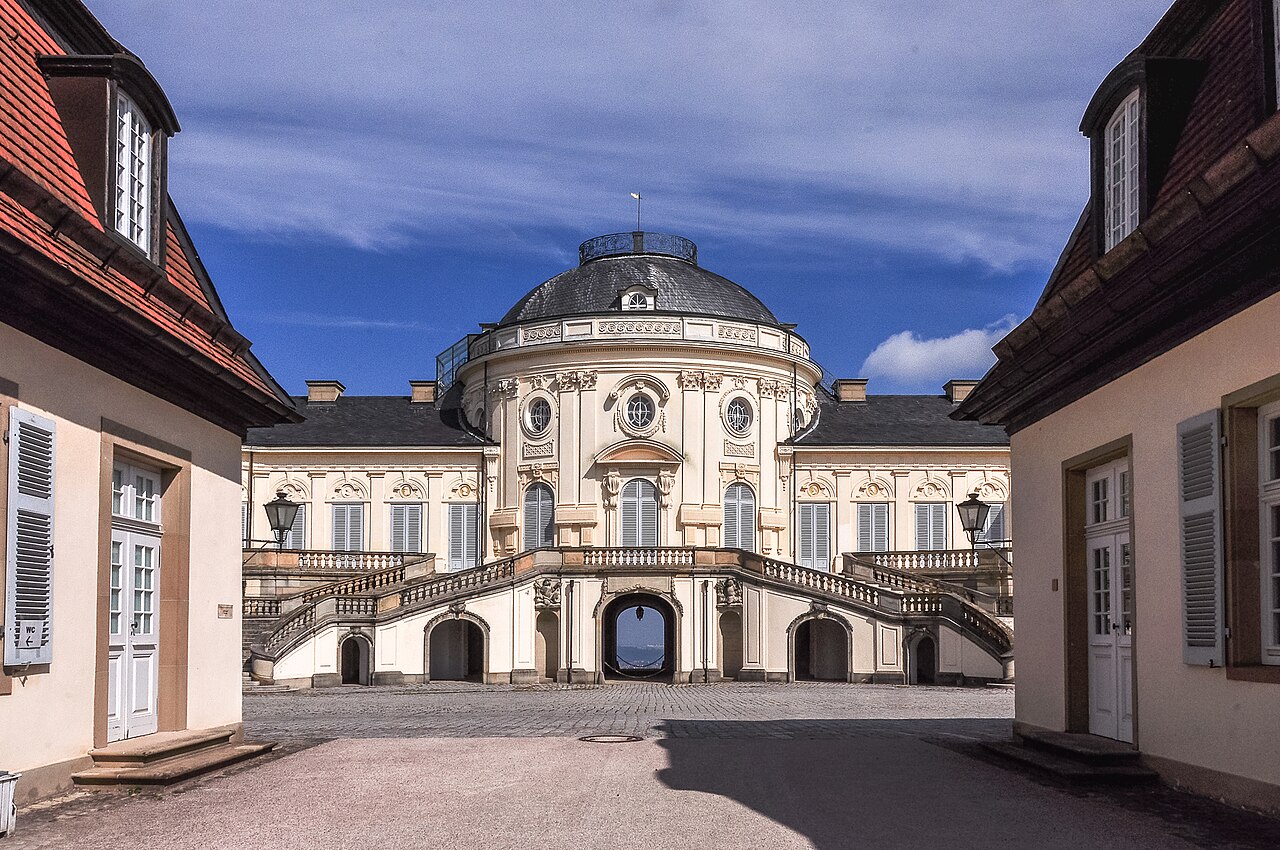
Schloss Solitude is a former hunting lodge and summer residence commissioned by Duke Carl Eugen of Württemberg. Designed by architects Johann Friedrich Weyhing and Philippe de La Guêpière, the palace was constructed between 1763 and 1769. It is situated on a ridge between the cities of Stuttgart, Leonberg, and Gerlingen, offering a commanding view of the surrounding landscape.
The architectural design features a distinct transition from Rococo ornamentation to early Neoclassical forms. The central structure is dominated by a large domed hall, while the palace grounds are famous for the 'Solitudeallee,' a perfectly straight 13-kilometer avenue that connects the palace directly to the Residenzschloss in Ludwigsburg, symbolizing the absolute power of the Duke.
Key Facts
- Materials
- Sandstone, Stucco, Wood
- Civilization
- Duchy of Württemberg
- Accessibility
- Ground floor accessible, upper floors limited
- Date(s)
- 1763-1769
- Condition
- Well-preserved, houses the Akademie Schloss Solitude
- Original Function
- Hunting lodge and summer residence
- Key Figures
- Duke Carl Eugen of Württemberg, Philippe de La Guêpière
Commission and Construction
1763-1769Duke Carl Eugen ordered the construction of the palace to serve as a private retreat for hunting and courtly festivities. The site was chosen for its isolation and scenic beauty, hence the name 'Solitude'.
The Ducal Academy
1770-1794In 1770, the Duke established the 'Hohe Karlsschule' within the palace complex. This elite military academy educated the sons of the nobility and high-ranking officials, with the poet Friedrich Schiller being one of its most famous students.
Decline and Restoration
19th-20th centuryFollowing the death of Duke Carl Eugen, the palace fell into disuse and suffered from neglect. Extensive restoration efforts were undertaken in the 1970s to return the structure to its original 18th-century appearance.
Modern Usage
1990-presentToday, the palace serves as a cultural hub, housing the Akademie Schloss Solitude, an international residency program for artists, writers, and scientists, while maintaining its museum galleries for public visitation.
Cultural Significance
Schloss Solitude represents the height of 18th-century courtly culture in the Duchy of Württemberg. Its unique location and the deliberate alignment of the Solitudeallee reflect the Enlightenment-era obsession with geometric order and the projection of ducal authority over the natural landscape.
Beyond its architectural value, the site is deeply linked to the intellectual history of Germany through the Hohe Karlsschule. The presence of Friedrich Schiller at the academy remains a cornerstone of the site's cultural identity, drawing literary scholars and history enthusiasts alike.
Interpretive Notes
Scholarly debates and areas of uncertainty
There is ongoing academic discussion regarding the extent to which the palace's design was influenced by French versus Italian architectural traditions. While the exterior displays clear French Rococo influences, the interior spatial organization and the dome structure suggest a complex synthesis of European styles intended to showcase the Duke's cosmopolitan tastes.
Visiting Information
Entry Rules
Open Tuesday through Sunday. Guided tours are required to access the interior rooms and the central domed hall. Tickets can be purchased at the visitor center on-site.
Best Times to Visit
Spring and autumn are ideal for viewing the surrounding parkland. Weekdays generally offer a quieter experience for interior tours compared to weekends.
Photography
Personal photography is permitted in the palace gardens. Interior photography is restricted to non-commercial use without flash; tripods are prohibited.
Preservation Notes
The palace is a protected historical monument. Visitors are requested to refrain from touching wall coverings and stuccowork. Please remain on designated paths within the palace grounds to protect the historic landscape.
Nearby POIs
11 shownSources & Further Reading
- [1]Schloss Solitude: Residenz des Herzogs Carl Eugen — Staatliche Schlösser und Gärten Baden-Württemberg. Official State Heritage Publication (2018)View
- [2]The Hohe Karlsschule and the Enlightenment — Hermann Bausinger. Kohlhammer Verlag (1995)
Key Facts
- Materials
- Sandstone, Stucco, Wood
- Civilization
- Duchy of Württemberg
- Accessibility
- Ground floor accessible, upper floors limited
- Date(s)
- 1763-1769
- Condition
- Well-preserved, houses the Akademie Schloss Solitude
- Original Function
- Hunting lodge and summer residence
- Key Figures
- Duke Carl Eugen of Württemberg, Philippe de La Guêpière