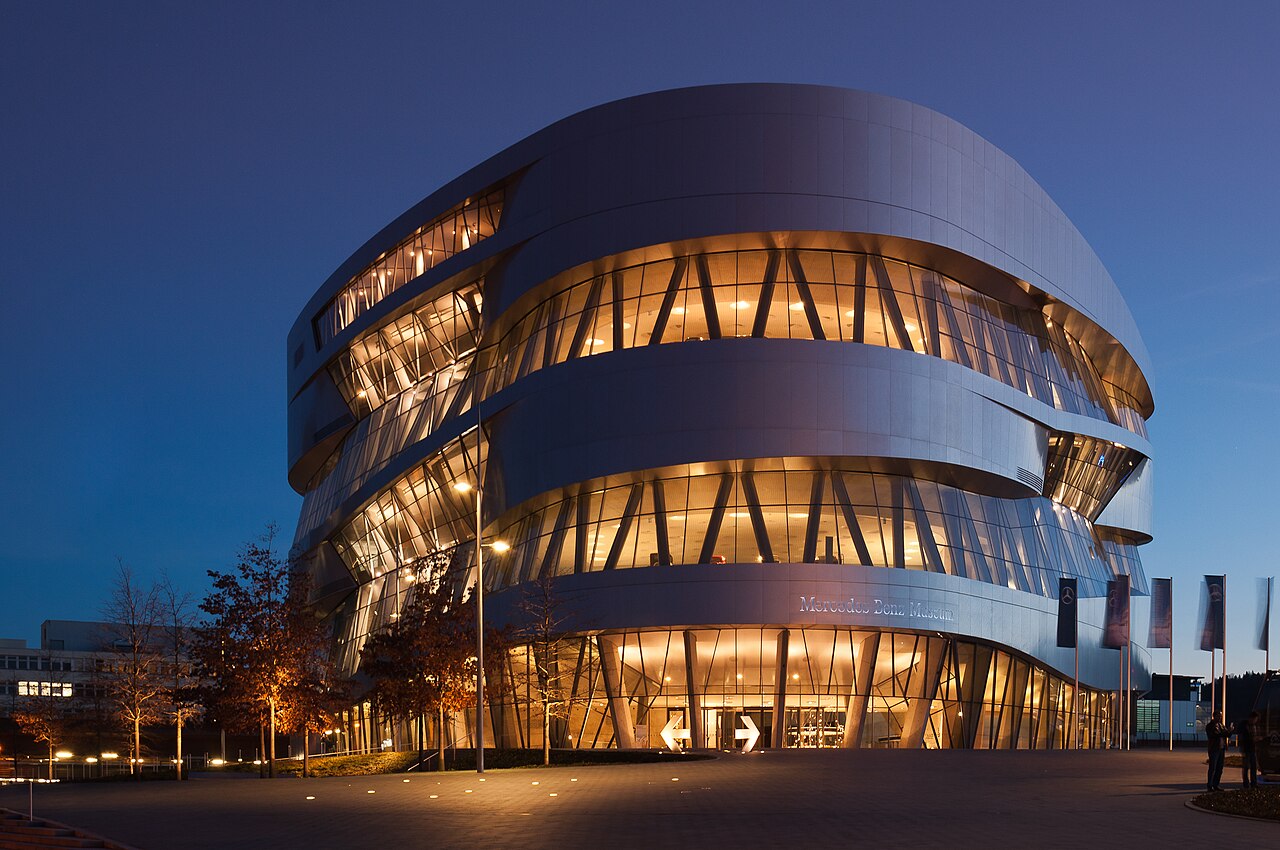
The Mercedes-Benz Museum in Stuttgart, Germany, is a comprehensive automotive museum that chronicles the history of the Mercedes-Benz brand and the evolution of the automobile. Designed by the architectural firm UNStudio, the building features a unique double-helix interior layout that allows visitors to explore the history of the internal combustion engine and the development of the horseless carriage through two distinct chronological paths.
The collection spans over 16,500 square meters and houses approximately 160 vehicles and 1,500 individual exhibits. The museum serves as a technical archive and cultural institution, documenting the legacy of Gottlieb Daimler and Wilhelm Maybach while showcasing the technological advancements that have defined the automotive industry for over 130 years.
Key Facts
- Materials
- Reinforced concrete, Steel, Glass
- Civilization
- German
- Accessibility
- Fully wheelchair accessible with elevators
- Date(s)
- 2003 - 2006
- Condition
- Active, well-maintained
- Original Function
- Automotive Museum
- Key Figures
- Gottlieb Daimler, Wilhelm Maybach, Ben van Berkel
Origins and Legacy
1886 - 1920sThe museum traces its roots to the early inventions of Gottlieb Daimler and Wilhelm Maybach, who developed the first high-speed internal combustion engine. The collection highlights the transition from horse-drawn carriages to motorized vehicles.
Architectural Development
2001 - 2006In 2001, Mercedes-Benz commissioned UNStudio to design a new facility to replace the smaller museum located within the factory. The resulting structure, opened in 2006, utilizes a trefoil floor plan based on the shape of a DNA helix.
Modern Expansion
2006 - PresentSince its opening, the museum has become a landmark of Stuttgart. It continues to update its exhibits to reflect modern innovations in electric mobility, autonomous driving, and sustainable transport technologies.
Cultural Significance
The museum is a central pillar of German industrial heritage, representing the 'cradle of the automobile.' It serves as a site of pilgrimage for automotive enthusiasts and a symbol of the engineering prowess that defines the Stuttgart region's economic identity.
Interpretive Notes
Scholarly debates and areas of uncertainty
Discussions often center on the balance between the museum's role as a corporate marketing tool versus its function as an objective historical archive of industrial technology.
Visiting Information
Entry Rules
Open Tuesday to Sunday. Tickets can be purchased online or at the entrance. Security screening is mandatory for all visitors.
Best Times to Visit
Weekday mornings are generally quieter. The museum is closed on Mondays.
Photography
Personal photography is permitted for non-commercial use. Tripods and professional lighting equipment require prior authorization.
Preservation Notes
Vehicles are maintained in working order by a dedicated team of specialists. Visitors are requested not to touch the exhibits.
Nearby POIs
11 shownKey Facts
- Materials
- Reinforced concrete, Steel, Glass
- Civilization
- German
- Accessibility
- Fully wheelchair accessible with elevators
- Date(s)
- 2003 - 2006
- Condition
- Active, well-maintained
- Original Function
- Automotive Museum
- Key Figures
- Gottlieb Daimler, Wilhelm Maybach, Ben van Berkel