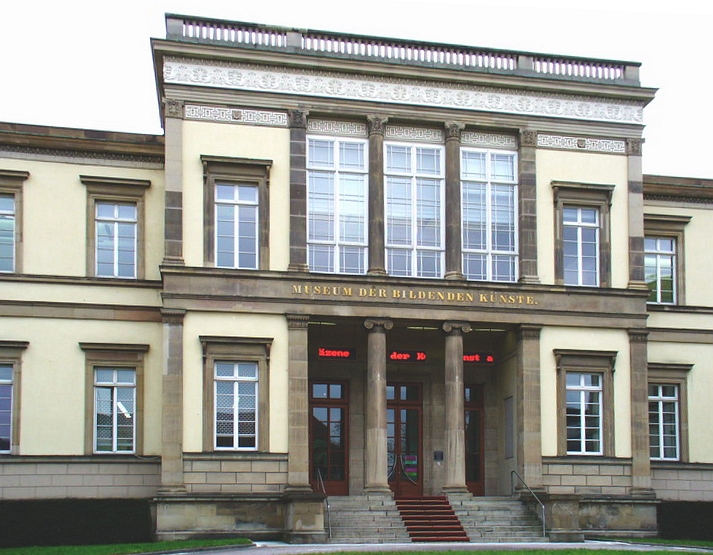
The Staatsgalerie Stuttgart is one of Germany's most visited art museums, renowned for its extensive collection spanning from the 14th century to the present day. The institution is comprised of two distinct architectural phases: the Old Staatsgalerie, a neoclassical building completed in 1843, and the Neue Staatsgalerie, a postmodern landmark designed by James Stirling and opened in 1984.
The museum houses a significant collection of Old Masters, including works by Rembrandt and Rubens, alongside a world-class collection of 20th-century art. It is particularly noted for its holdings of Swabian Impressionism, German Expressionism, and a vast graphic collection that includes thousands of drawings, prints, and photographs.
Key Facts
- Materials
- Sandstone, Steel, Glass, Colored metal
- Civilization
- German
- Accessibility
- Fully wheelchair accessible
- Date(s)
- 1843 (Old); 1984 (New)
- Condition
- Active, well-maintained
- Original Function
- Art Museum
- Key Figures
- James Stirling, Konrad Adenauer, Christian von Holst
Founding and the Old Staatsgalerie
1843The original museum building was commissioned by King Wilhelm I of Württemberg. Designed by Gottlob Georg von Barth in a neoclassical style, it was intended to house the royal art collection and provide a space for public education in the arts.
Expansion and Modernization
1970s-1984Due to the growing collection and the need for modern exhibition spaces, an international competition was held for an extension. The design by British architect James Stirling was selected, resulting in the Neue Staatsgalerie, which became a defining example of postmodern architecture.
Contemporary Status
21st CenturyToday, the museum continues to expand its digital and physical archives. It remains a central hub for international art discourse, hosting major temporary exhibitions while maintaining its permanent collection of European painting and sculpture.
Cultural Significance
The Staatsgalerie Stuttgart serves as a vital cultural institution in the state of Baden-Württemberg, bridging the gap between historical European art and contemporary global movements. The Neue Staatsgalerie building itself is considered a masterpiece of postmodern design, frequently studied for its playful use of classical forms and industrial materials.
Beyond its architectural impact, the museum plays a critical role in the preservation of German graphic arts. Its collection provides a comprehensive look at the evolution of European visual culture, making it a key site for art historical research and public engagement in Southern Germany.
Interpretive Notes
Scholarly debates and areas of uncertainty
The design of the Neue Staatsgalerie by James Stirling sparked significant debate upon its completion in 1984. Critics were divided over its 'collage' aesthetic, which combined high-tech industrial elements with traditional classical references. While some hailed it as a brilliant subversion of modernism, others criticized it as superficial or overly eclectic.
Visiting Information
Entry Rules
Open Tuesday through Sunday. Tickets can be purchased online or at the museum entrance. Concessions are available for students and seniors. Visitors are requested to leave large bags in the provided lockers.
Best Times to Visit
Weekday mornings are generally quieter. The museum is often busier during the opening weeks of major temporary exhibitions.
Photography
Non-commercial photography without flash is permitted in most permanent collection galleries. Photography of temporary exhibitions is often restricted; please check signage at the entrance of each gallery.
Preservation Notes
Do not touch the artworks or display cases. Maintain a safe distance from all exhibits to protect the integrity of the pieces. Flash photography is strictly prohibited to prevent light damage to sensitive pigments and paper works.
Nearby POIs
11 shownSources & Further Reading
- [1]James Stirling: Neue Staatsgalerie Stuttgart — David Jenkins. Phaidon Press (1997)
- [2]Staatsgalerie Stuttgart: The Collection — Christian von Holst. Hatje Cantz (2002)
Key Facts
- Materials
- Sandstone, Steel, Glass, Colored metal
- Civilization
- German
- Accessibility
- Fully wheelchair accessible
- Date(s)
- 1843 (Old); 1984 (New)
- Condition
- Active, well-maintained
- Original Function
- Art Museum
- Key Figures
- James Stirling, Konrad Adenauer, Christian von Holst