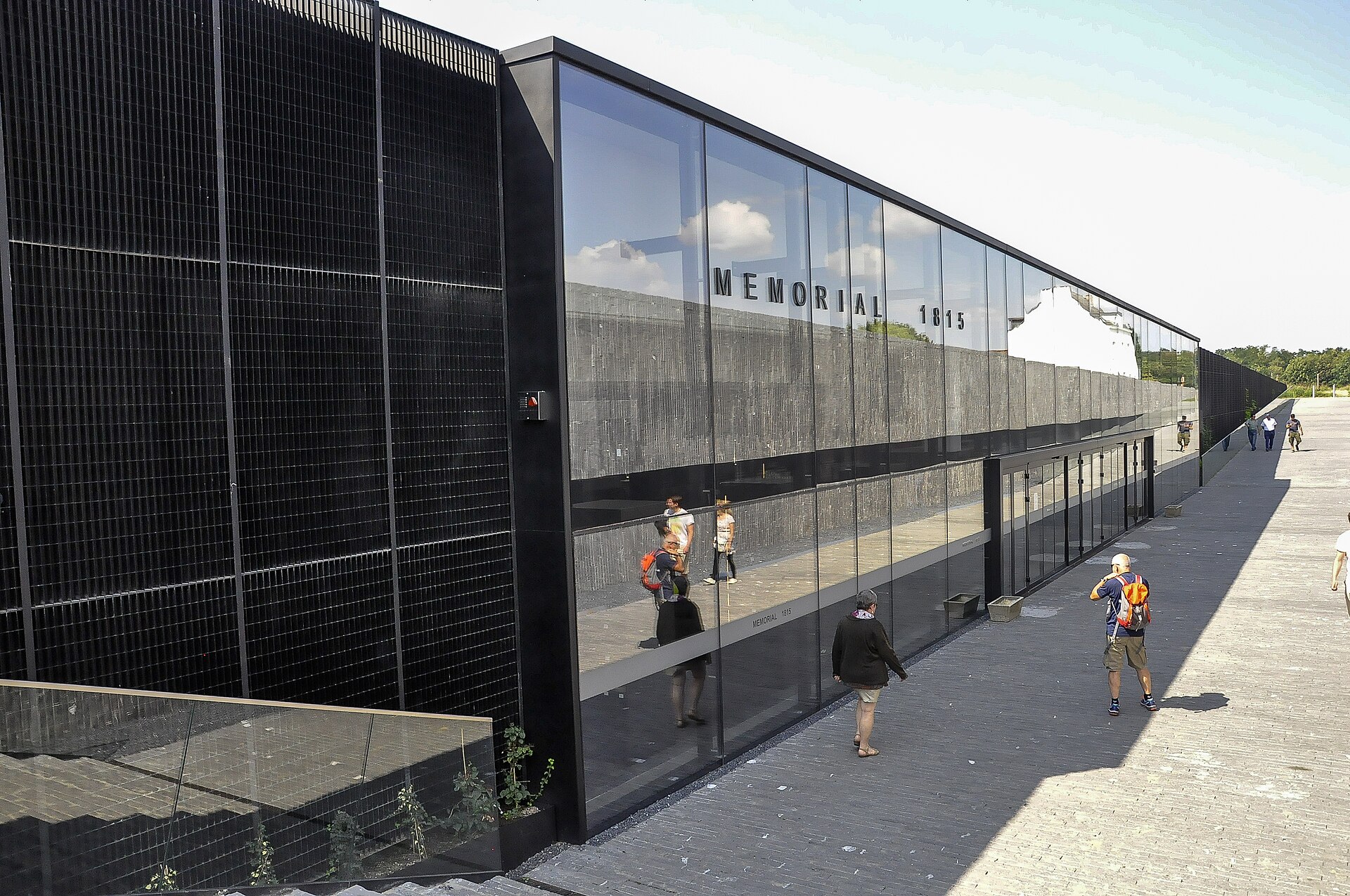
The Waterloo 1815 Memorial is a museum complex situated at the base of the Lion's Mound in Braine-l'Alleud, Belgium. It commemorates the Battle of Waterloo, the decisive conflict that ended the Napoleonic Wars in 1815. The site features an immersive underground museum that utilizes multimedia technology, including a 4D cinema experience, to provide historical context regarding the strategies and events of the battle.
The centerpiece of the memorial is the Lion's Mound, a massive conical hill topped by a cast-iron lion statue, which was constructed between 1823 and 1826 by the order of King William I of the Netherlands. The site also houses a panoramic rotunda featuring a monumental painting by Louis Dumoulin, which depicts the battle in a 360-degree perspective, offering visitors a detailed visual representation of the combat.
Key Facts
- Materials
- Earth, Brick, Cast iron, Concrete
- Civilization
- Belgian
- Accessibility
- Fully accessible with elevators to the museum and panoramic levels
- Date(s)
- 1823-1826 (Mound), 2015 (Museum)
- Condition
- Well-preserved and active
- Original Function
- Commemorative monument
- Key Figures
- Napoleon Bonaparte, Duke of Wellington, Gebhard Leberecht von Blücher, King William I of the Netherlands
The Battle of Waterloo
1815On June 18, 1815, the French army under Napoleon Bonaparte was defeated by the Seventh Coalition, consisting of an Anglo-allied army under the Duke of Wellington and a Prussian army under Gebhard Leberecht von Blücher. This battle marked the end of the Napoleonic Wars and the final exile of Napoleon.
Construction of the Lion's Mound
1823-1826King William I of the Netherlands commissioned the construction of the Lion's Mound to commemorate the site where his son, the Prince of Orange, was wounded. The mound was built using earth taken from the battlefield itself, significantly altering the original topography of the site.
Creation of the Panorama
1912To mark the centenary of the battle, the Panorama of the Battle of Waterloo was commissioned. Painted by Louis Dumoulin, the massive canvas was designed to provide a realistic, immersive view of the fighting, and it remains one of the few surviving examples of 19th-century panoramic art.
Modernization and Memorialization
2015-PresentIn preparation for the bicentenary of the battle, the site underwent a major renovation. A new underground museum was constructed to replace outdated facilities, incorporating modern 4D technology and interactive exhibits to educate visitors on the historical significance of the conflict.
Cultural Significance
The Waterloo 1815 Memorial serves as a primary site for European historical reflection on the Napoleonic era. It represents the shift in power dynamics that defined 19th-century Europe and remains a focal point for military history enthusiasts and researchers studying the transition from the French Empire to the Concert of Europe.
Locally, the site is a significant cultural landmark in Belgium, symbolizing the historical intersection of Dutch, British, Prussian, and French interests. The Lion's Mound itself has become an iconic silhouette in the Belgian landscape, serving as a permanent reminder of the scale of the conflict.
Interpretive Notes
Scholarly debates and areas of uncertainty
There is ongoing academic discussion regarding the historical accuracy of the Panorama painting, particularly concerning the depiction of specific troop movements and the glorification of certain national narratives over others. Additionally, the construction of the Lion's Mound is often criticized by modern archaeologists for destroying significant portions of the original battlefield terrain, which has limited the ability to conduct further forensic analysis of the combat zones.
Visiting Information
Entry Rules
Open daily. Tickets are required for entry to the museum, the panorama, and the ascent of the Lion's Mound. Visitors are advised to check the official website for seasonal hours and potential maintenance closures.
Best Times to Visit
Weekdays during the shoulder seasons (April-May or September-October) offer the best balance of manageable crowds and pleasant weather for climbing the mound.
Photography
Personal photography is permitted in most areas. Flash photography is prohibited inside the panoramic rotunda and the 4D cinema to protect the exhibits and ensure the immersive experience for other visitors.
Preservation Notes
The Lion's Mound is a fragile structure; visitors must remain on the designated staircase. Do not climb on the grassy slopes. The museum environment is climate-controlled to preserve the panoramic canvas and historical artifacts.
Nearby POIs
11 shown- Musee Herge14.8 km
- Stoclet Palace17.3 km
- Brussels Museum of Natural Sciences17.5 km
- Autoworld17.8 km
- Church of Our Lady of Victories at the Sablon18.2 km
- Royal Palace of Brussels18.3 km
- Royal Museums of Fine Arts of Belgium18.3 km
- Palace of Justice of Brussels18.3 km
- BELvue Museum18.4 km
- Musical Instruments Museum18.4 km
- Mont des Arts18.6 km
Sources & Further Reading
- [1]Waterloo: The History of the Battle — Bernard Cornwell. HarperCollins (2014)
- [2]The Battle of Waterloo: A History of the Conflict — Alessandro Barbero. Walker & Company (2005)
Key Facts
- Materials
- Earth, Brick, Cast iron, Concrete
- Civilization
- Belgian
- Accessibility
- Fully accessible with elevators to the museum and panoramic levels
- Date(s)
- 1823-1826 (Mound), 2015 (Museum)
- Condition
- Well-preserved and active
- Original Function
- Commemorative monument
- Key Figures
- Napoleon Bonaparte, Duke of Wellington, Gebhard Leberecht von Blücher, King William I of the Netherlands
Nearby POIs
11 shown- Musee Herge14.8 km
- Stoclet Palace17.3 km
- Brussels Museum of Natural Sciences17.5 km
- Autoworld17.8 km
- Church of Our Lady of Victories at the Sablon18.2 km
- Royal Palace of Brussels18.3 km
- Royal Museums of Fine Arts of Belgium18.3 km
- Palace of Justice of Brussels18.3 km
- BELvue Museum18.4 km
- Musical Instruments Museum18.4 km
- Mont des Arts18.6 km