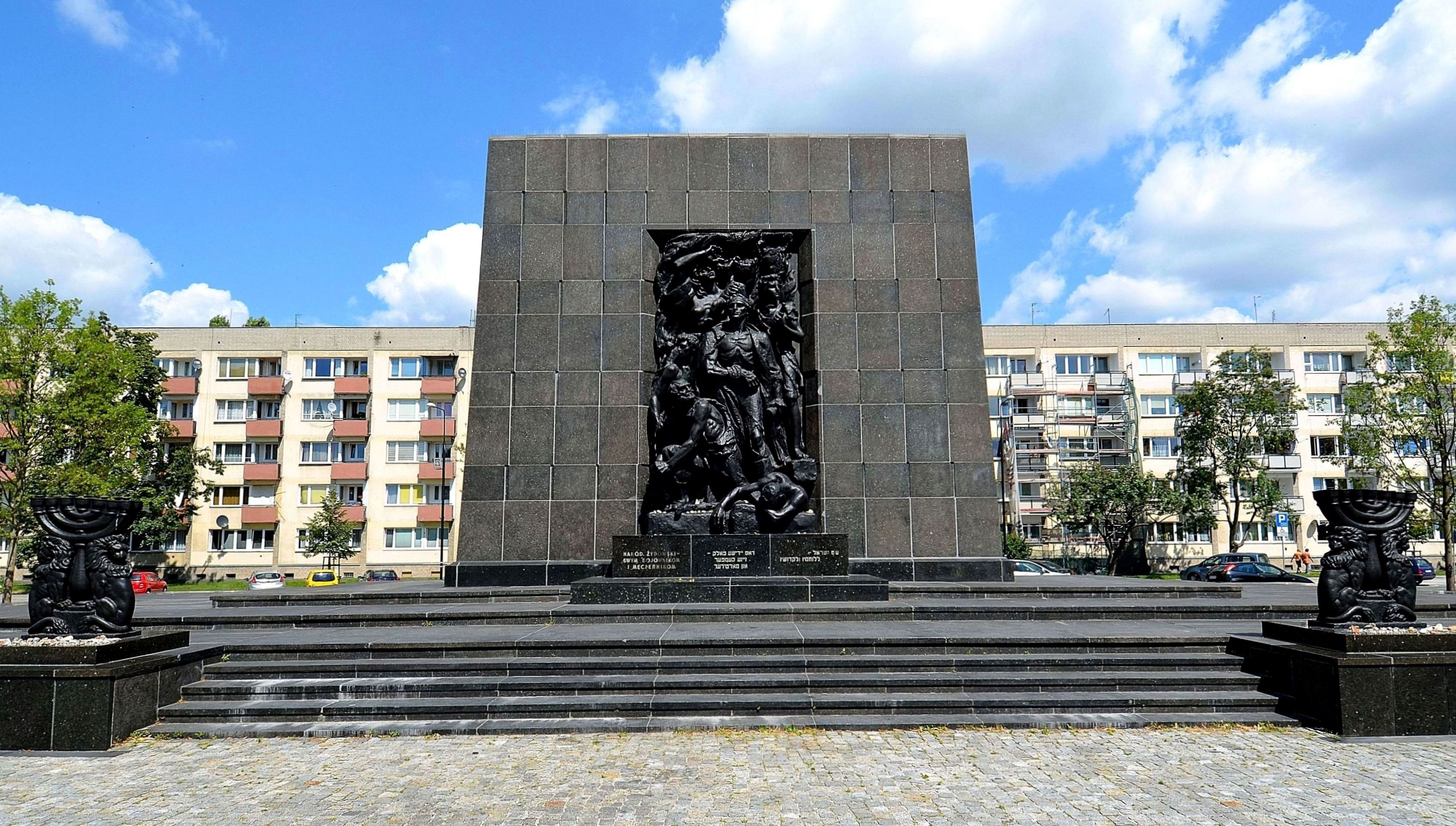
The Monument to the Ghetto Heroes is a memorial in Warsaw, Poland, commemorating the Warsaw Ghetto Uprising of 1943. It is situated on the site of the former ghetto, specifically at the location where the first armed clashes of the uprising occurred between Jewish resistance fighters and German forces.
The monument consists of two primary faces: the western side features a bronze sculptural group depicting the heroic struggle of the fighters, while the eastern side displays a stone relief titled 'The March to the Abyss,' representing the suffering of the Jewish population during the Holocaust. It serves as a central site for remembrance and official state commemorations.
Key Facts
- Materials
- Bronze, Labradorite, Granite
- Civilization
- Polish
- Accessibility
- Ground level, fully accessible
- Date(s)
- 1948
- Condition
- Well-preserved
- Original Function
- Commemoration of the Warsaw Ghetto Uprising
- Key Figures
- Nathan Rapoport, Leon Suzin, Willy Brandt
Conception and Design
1945-1948Following the war, the Central Committee of Polish Jews commissioned a monument to honor the victims and fighters of the ghetto. Sculptor Nathan Rapoport and architect Leon Suzin were selected to design the memorial, which was unveiled on the fifth anniversary of the uprising in 1948.
Symbolic Significance
1948-1970The monument became a focal point for Jewish memory in Poland. In 1970, it gained global attention when West German Chancellor Willy Brandt performed his 'Kniefall von Warschau' (Warsaw Genuflection) here, a gesture of humility and apology for Nazi crimes.
Modern Context
2013-PresentThe monument now stands in front of the POLIN Museum of the History of Polish Jews, which opened in 2013. The integration of the monument into the museum's landscape has created a comprehensive site for historical education and reflection.
Cultural Significance
The monument is a cornerstone of Polish-Jewish historical memory. It represents the transition from the immediate post-war need to memorialize the uprising to the modern, broader institutionalization of Holocaust remembrance in Warsaw. The site is the primary location for annual commemorations of the uprising, attended by international dignitaries and survivors.
Interpretive Notes
Scholarly debates and areas of uncertainty
Debates have historically centered on the artistic representation of the uprising. Some scholars have analyzed the tension between the 'heroic' narrative depicted in the bronze sculptures and the 'victimhood' narrative represented in the stone relief, reflecting the complex layers of memory regarding the Holocaust in Poland.
Visiting Information
Entry Rules
Open to the public 24 hours a day. No entry fees or tickets required.
Best Times to Visit
April 19th, the anniversary of the uprising, is the most significant time for visitation, though it is crowded during official ceremonies.
Photography
None. Personal photography is permitted.
Preservation Notes
The monument is maintained by the City of Warsaw. Visitors are asked to respect the solemn nature of the site.
Nearby POIs
11 shown- POLIN Museum of the History of Polish Jews0.1 km
- Warsaw Uprising Monument0.8 km
- Muzeum Warszawy1.2 km
- St. John's Archcathedral1.3 km
- Sigismund's Column1.3 km
- St. Anne's Church1.4 km
- Royal Castle in Warsaw1.5 km
- Tomb of the Unknown Soldier1.5 km
- Polish Army Museum1.6 km
- Church of the Holy Cross2 km
- Neon Museum2.1 km
Sources & Further Reading
- [1]The Warsaw Ghetto Uprising — Israel Gutman. Yale University Press (1994)
- [2]Memory and Identity in the Shadow of the Holocaust — Jonathan Huener. University of Massachusetts Press (2003)
Key Facts
- Materials
- Bronze, Labradorite, Granite
- Civilization
- Polish
- Accessibility
- Ground level, fully accessible
- Date(s)
- 1948
- Condition
- Well-preserved
- Original Function
- Commemoration of the Warsaw Ghetto Uprising
- Key Figures
- Nathan Rapoport, Leon Suzin, Willy Brandt
Nearby POIs
11 shown- POLIN Museum of the History of Polish Jews0.1 km
- Warsaw Uprising Monument0.8 km
- Muzeum Warszawy1.2 km
- St. John's Archcathedral1.3 km
- Sigismund's Column1.3 km
- St. Anne's Church1.4 km
- Royal Castle in Warsaw1.5 km
- Tomb of the Unknown Soldier1.5 km
- Polish Army Museum1.6 km
- Church of the Holy Cross2 km
- Neon Museum2.1 km