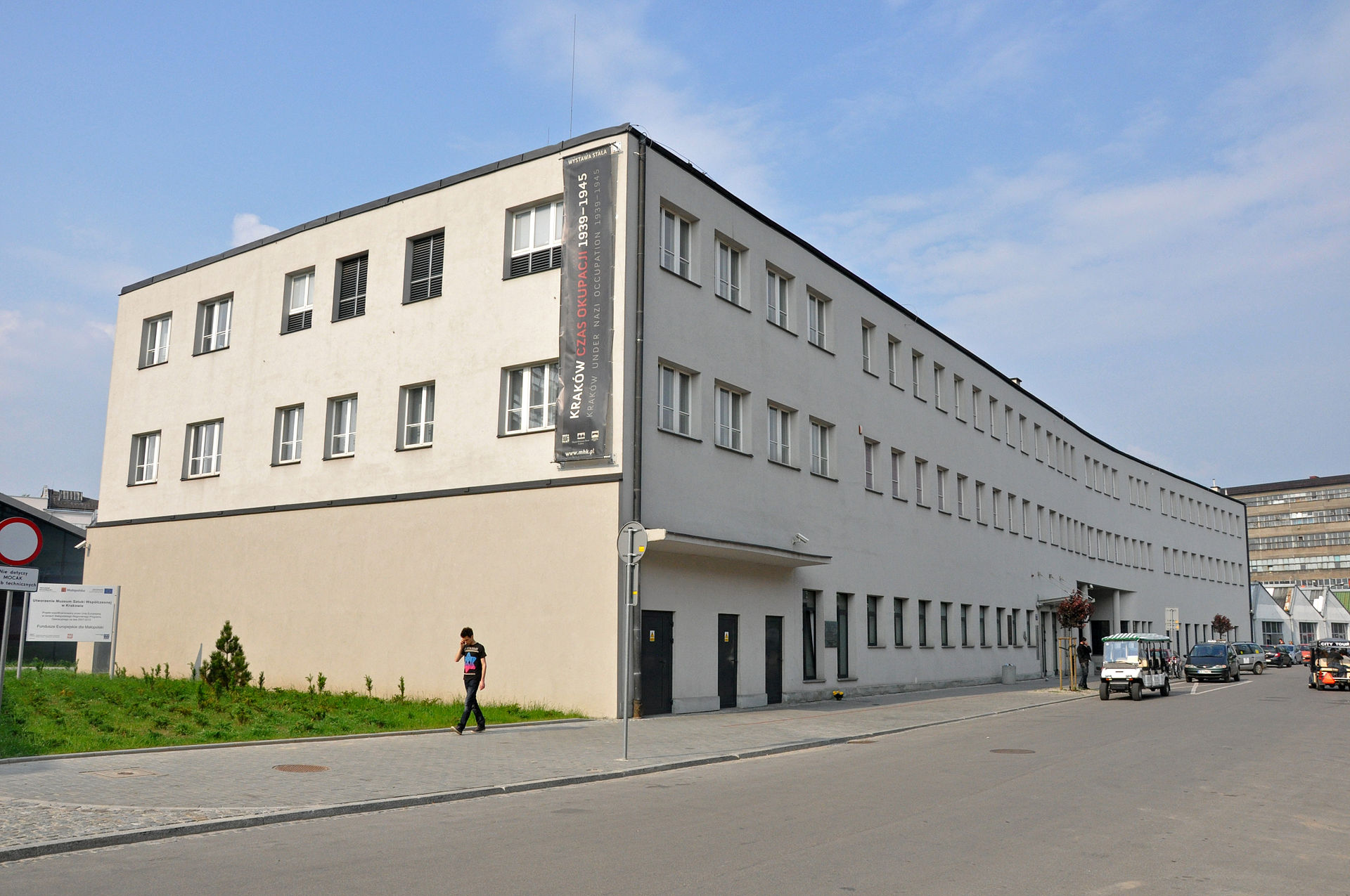
Oskar Schindler's Enamel Factory, known as Deutsche Emailwarenfabrik (DEF), is a former metal item factory in Kraków that now serves as a museum. During the Nazi occupation of Poland, the factory was operated by German industrialist Oskar Schindler, who utilized the facility to employ Jewish workers, effectively shielding them from deportation to concentration camps.
Today, the site houses a permanent exhibition titled 'Kraków under Nazi Occupation 1939–1945.' The museum utilizes multimedia displays, reconstructed streetscapes, and historical artifacts to document the daily lives of Kraków's residents, the persecution of the Jewish population, and the underground resistance movement during the war years.
Key Facts
- Materials
- Concrete, Steel, Glass
- Civilization
- Modern Poland
- Accessibility
- Fully wheelchair accessible
- Date(s)
- 1937
- Condition
- Restored and converted into a museum
- Original Function
- Enamelware factory
- Key Figures
- Oskar Schindler, Itzhak Stern
Establishment and War Years
1939-1945Oskar Schindler took over the factory in 1939. He expanded production to include enamelware and later munitions. By employing Jewish workers from the Kraków Ghetto and the Płaszów concentration camp, Schindler protected approximately 1,200 individuals from the Holocaust.
Post-War Era
1945-2007Following the war, the factory was nationalized by the Polish communist government. It continued to operate as an industrial facility for decades, though the historical significance of Schindler's actions remained largely overshadowed by the state's focus on industrial output.
Museum Transformation
2010-PresentThe site was renovated and opened as a branch of the Museum of Kraków in 2010. It has since become one of the most visited historical sites in Poland, focusing on the broader history of the city during the occupation.
Cultural Significance
The factory serves as a site of memory for the Holocaust in Poland. It bridges the gap between industrial history and the personal narratives of those saved by Schindler, as popularized by Thomas Keneally's book and Steven Spielberg's film, Schindler's List. It is a focal point for education regarding the complexities of survival and resistance under totalitarian rule.
Interpretive Notes
Scholarly debates and areas of uncertainty
Debate persists regarding the balance between the museum's focus on the 'Schindler' narrative versus the broader, more comprehensive history of Kraków's occupation. Some historians argue that the global fame of the Schindler story can sometimes obscure the experiences of the wider population who did not have access to such protection.
Visiting Information
Entry Rules
Tickets are required and should be booked in advance due to high demand. The museum is open daily, with reduced hours on Mondays. Visitors are encouraged to allow at least 90 minutes for the full exhibition.
Best Times to Visit
Weekday mornings are generally less crowded. Avoid weekends and public holidays if possible to ensure a more contemplative experience.
Photography
Personal photography is permitted without flash. Tripods and professional equipment require prior authorization.
Preservation Notes
The site is a protected historical building. Visitors are asked to refrain from touching artifacts and to follow the designated path through the exhibition.
Nearby POIs
11 shown- Museum of Contemporary Art in Krakow0.1 km
- Bricks and Figs0.3 km
- Krakow Old Synagogue1 km
- Krakow Pinball Museum1.7 km
- Zamek Krolewski na Wawelu2 km
- Katedra Wawelska2 km
- Church of the Assumption of the Blessed Virgin Mary2.2 km
- Basilica of St. Francis of Assisi2.3 km
- Sukiennice2.4 km
- Rynek Underground2.4 km
- Town Hall Tower2.4 km
Sources & Further Reading
- [1]
- [2]Schindler's List: The True Story — David M. Crowe. Westview Press (2004)
Key Facts
- Materials
- Concrete, Steel, Glass
- Civilization
- Modern Poland
- Accessibility
- Fully wheelchair accessible
- Date(s)
- 1937
- Condition
- Restored and converted into a museum
- Original Function
- Enamelware factory
- Key Figures
- Oskar Schindler, Itzhak Stern
Nearby POIs
11 shown- Museum of Contemporary Art in Krakow0.1 km
- Bricks and Figs0.3 km
- Krakow Old Synagogue1 km
- Krakow Pinball Museum1.7 km
- Zamek Krolewski na Wawelu2 km
- Katedra Wawelska2 km
- Church of the Assumption of the Blessed Virgin Mary2.2 km
- Basilica of St. Francis of Assisi2.3 km
- Sukiennice2.4 km
- Rynek Underground2.4 km
- Town Hall Tower2.4 km