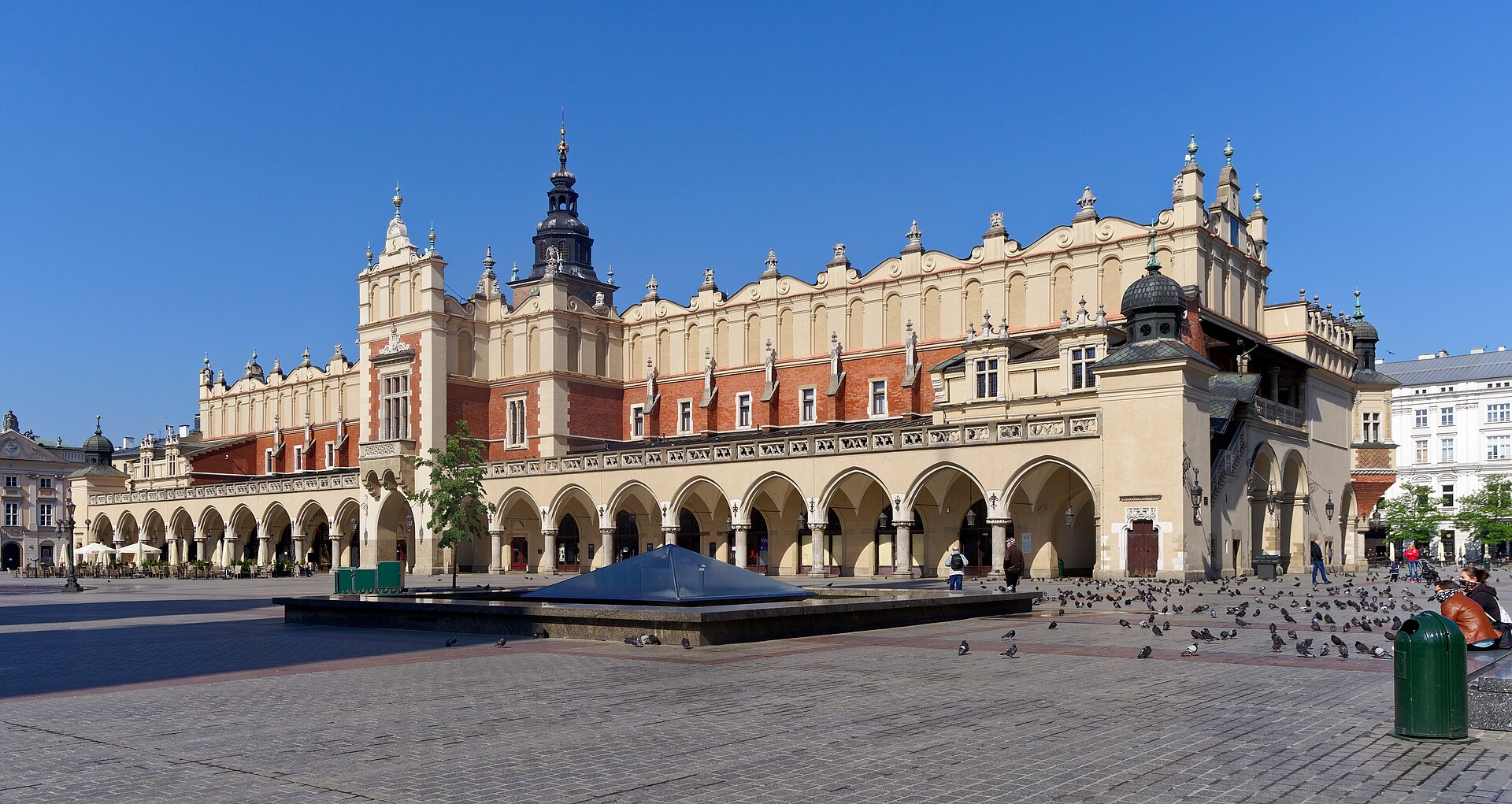
The Sukiennice, or Cloth Hall, is a historic commercial building located in the center of the Main Market Square in Kraków, Poland. Originally established in the 13th century as a series of stalls for textile merchants, the structure evolved into a major hub for international trade, facilitating the exchange of goods such as salt, lead, and exotic spices between the East and the West.
The current Renaissance-style building dates primarily to the 16th century, following a fire that destroyed the earlier Gothic structure. It features a distinctive attic decorated with grotesque masks and a loggia designed by Giovanni Maria Padovano. Today, the ground floor continues its traditional function as a marketplace for local crafts and souvenirs, while the upper floor houses the 19th-Century Polish Art Gallery, a branch of the National Museum in Kraków.
Key Facts
- Materials
- Stone, Brick, Plaster
- Civilization
- Polish
- Accessibility
- Ground floor accessible; museum level accessible via elevator
- Date(s)
- 13th century (original), 1555 (Renaissance reconstruction)
- Condition
- Well-preserved, active commercial and museum space
- Original Function
- Textile trading hall
- Key Figures
- Giovanni Maria Padovano, King Casimir III the Great
Origins and Medieval Growth
13th centuryThe first stone structure was built in the 13th century under the reign of Bolesław V the Chaste. It consisted of two rows of stalls that allowed merchants to trade textiles, leather, and salt, establishing Kraków as a vital node on European trade routes.
Renaissance Reconstruction
1555Following a devastating fire, the building was reconstructed in the Renaissance style. Architect Giovanni Maria Padovano added the iconic attic, decorative masks, and the loggia, which remain the defining features of the building's exterior today.
19th Century Modernization
1875-1879The building underwent a major renovation led by Tomasz Pryliński. This project added the neo-Gothic pointed arches and the external arcades, ensuring the structure remained functional for modern commerce while preserving its historical character.
Modern Era
20th century - presentThe Sukiennice survived the occupation of Poland during World War II largely intact. In the modern era, it serves as a primary cultural landmark, housing the National Museum's collection of 19th-century Polish art and remaining a central site for local commerce.
Cultural Significance
The Sukiennice is a symbol of Kraków's historical status as a wealthy merchant city and a center of European trade. It represents the intersection of Polish architectural heritage and the influence of Italian Renaissance masters, reflecting the city's cosmopolitan history.
Beyond its commercial history, the building is a cornerstone of Polish national identity. The upper-floor gallery holds some of the most significant works of 19th-century Polish painting, making the site a vital repository of the nation's artistic and cultural memory.
Interpretive Notes
Scholarly debates and areas of uncertainty
There is ongoing discussion regarding the extent of the original 13th-century foundations versus the 16th-century additions. Some architectural historians debate the degree to which the 19th-century neo-Gothic modifications by Pryliński altered the authentic Renaissance aesthetic of the building.
Visiting Information
Entry Rules
The ground floor market is open daily. The 19th-Century Polish Art Gallery on the upper floor requires a ticket and operates on a standard museum schedule, typically closed on Mondays.
Best Times to Visit
Early morning or late evening to avoid the heavy foot traffic of the Main Market Square. Visiting during the Christmas market season provides a unique historical atmosphere.
Photography
Personal photography is permitted in the market hall. Flash photography is prohibited within the museum gallery on the upper floor.
Preservation Notes
The building is subject to strict conservation laws. Visitors are asked to respect the historic fabric of the walls and avoid leaning on the stone carvings.
Nearby POIs
11 shown- Rynek Underground
- Town Hall Tower0.1 km
- Church of the Assumption of the Blessed Virgin Mary0.2 km
- Basilica of St. Francis of Assisi0.3 km
- Czartoryski Museum0.4 km
- Saint Florian's Gate0.5 km
- Barbakan0.5 km
- Katedra Wawelska0.8 km
- Zamek Krolewski na Wawelu0.8 km
- Krakow Pinball Museum1 km
- Krakow Old Synagogue1.4 km
Sources & Further Reading
- [1]Kraków: A History — Adam Zamoyski. Hippocrene Books (1993)
- [2]The Cloth Hall in Kraków: History and Architecture — National Museum in Kraków. MNK Publications (2015)
Key Facts
- Materials
- Stone, Brick, Plaster
- Civilization
- Polish
- Accessibility
- Ground floor accessible; museum level accessible via elevator
- Date(s)
- 13th century (original), 1555 (Renaissance reconstruction)
- Condition
- Well-preserved, active commercial and museum space
- Original Function
- Textile trading hall
- Key Figures
- Giovanni Maria Padovano, King Casimir III the Great
Nearby POIs
11 shown- Rynek Underground
- Town Hall Tower0.1 km
- Church of the Assumption of the Blessed Virgin Mary0.2 km
- Basilica of St. Francis of Assisi0.3 km
- Czartoryski Museum0.4 km
- Saint Florian's Gate0.5 km
- Barbakan0.5 km
- Katedra Wawelska0.8 km
- Zamek Krolewski na Wawelu0.8 km
- Krakow Pinball Museum1 km
- Krakow Old Synagogue1.4 km