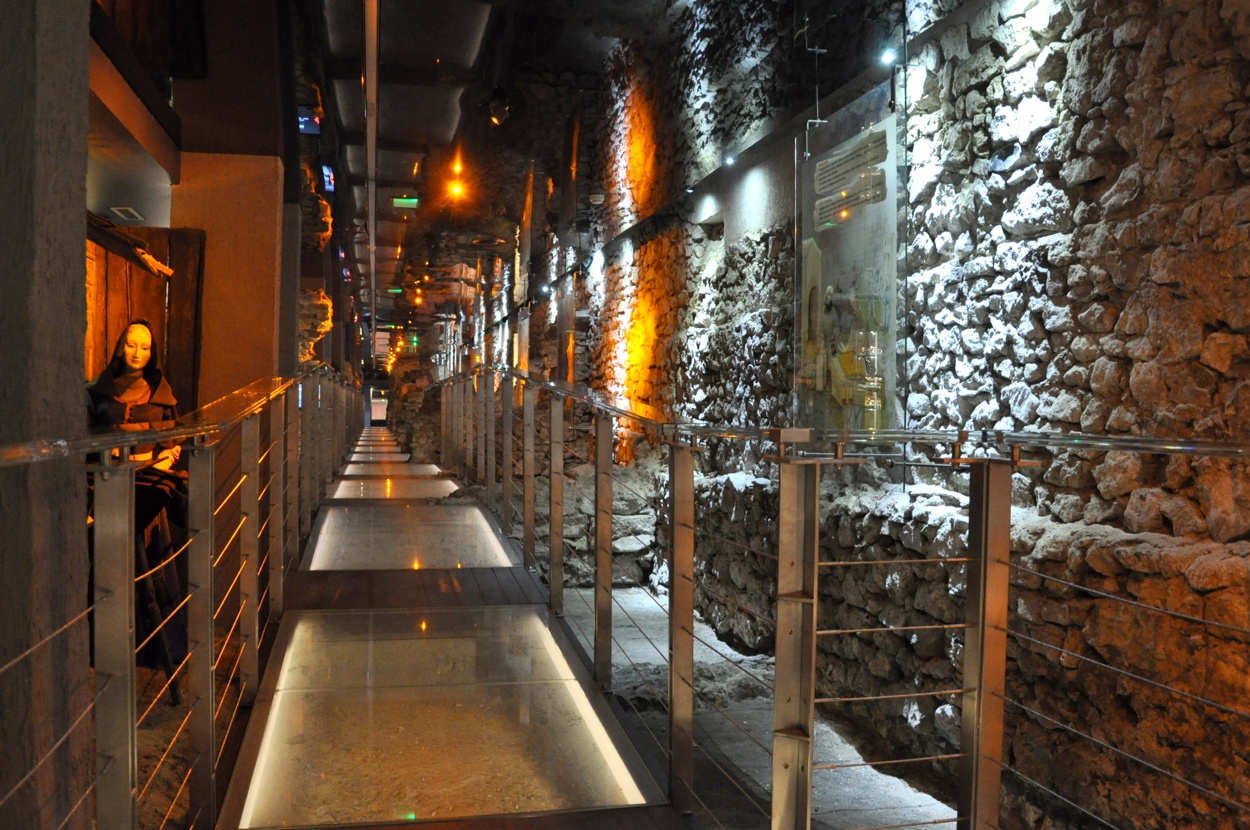
The Rynek Underground is an archaeological museum located beneath the surface of Krakow's Main Market Square. It spans approximately 6,000 square meters, showcasing the medieval layers of the city that were uncovered during extensive excavations between 2005 and 2010. The site provides a subterranean perspective on the urban development of Krakow, revealing the foundations of early trade structures and the original street levels of the medieval city.
The museum features a high-tech exhibition space that integrates original archaeological findings with multimedia displays. Visitors can explore preserved segments of medieval thoroughfares, ancient merchant stalls, and a collection of artifacts including coins, lead seals, and pottery, which illustrate the city's historical role as a significant center of regional commerce.
Key Facts
- Materials
- Stone, Brick, Wood, Glass, Steel
- Civilization
- Polish
- Accessibility
- Fully wheelchair accessible via elevators
- Date(s)
- 2005-2010 (Excavation and Museum construction)
- Condition
- Well-preserved, active museum
- Original Function
- Medieval market and trade infrastructure
- Key Figures
- Krzysztof Wielgus, Cezary Buśko
Medieval Origins
13th-14th centuryThe site served as the commercial heart of Krakow, featuring wooden stalls and stone foundations that supported the city's growing trade network. These structures were eventually buried under successive layers of urban development and paving.
Archaeological Discovery
2005-2010During planned renovations of the Main Market Square, archaeologists discovered extensive remains of the medieval city. The significance of the findings led to the decision to preserve the site in situ rather than reburying it.
Museum Establishment
2010-PresentThe Rynek Underground museum opened in 2010 as a branch of the Historical Museum of the City of Krakow. It utilizes modern technology to contextualize the excavated ruins, allowing visitors to walk through the medieval street layout.
Cultural Significance
The Rynek Underground is a vital site for understanding the urban evolution of Krakow. It bridges the gap between the city's medieval mercantile past and its modern identity, serving as a primary educational resource for the history of the Lesser Poland region.
Interpretive Notes
Scholarly debates and areas of uncertainty
Debates exist regarding the optimal balance between preserving the fragile archaeological layers and the demands of modern tourism, particularly concerning the impact of climate control systems on the ancient wooden and stone structures.
Visiting Information
Entry Rules
Tickets are required and often sell out in advance due to capacity limits. Visitors should check the official website for current opening hours and to book time slots.
Best Times to Visit
Weekday mornings are recommended to avoid large crowds. The site is entirely indoors, making it an ideal destination during inclement weather.
Photography
Personal photography is permitted without flash. Tripods and professional equipment require prior authorization.
Preservation Notes
Visitors must remain on designated walkways to protect the archaeological remains. Touching the ruins is strictly prohibited.
Nearby POIs
11 shownSources & Further Reading
- [1]The Underground of the Main Market Square in Krakow — Cezary Buśko. Historical Museum of the City of Krakow (2010)View
- [2]Archaeological Research in the Main Market Square — Krzysztof Wielgus. Journal of Polish Archaeology (2012)
Key Facts
- Materials
- Stone, Brick, Wood, Glass, Steel
- Civilization
- Polish
- Accessibility
- Fully wheelchair accessible via elevators
- Date(s)
- 2005-2010 (Excavation and Museum construction)
- Condition
- Well-preserved, active museum
- Original Function
- Medieval market and trade infrastructure
- Key Figures
- Krzysztof Wielgus, Cezary Buśko