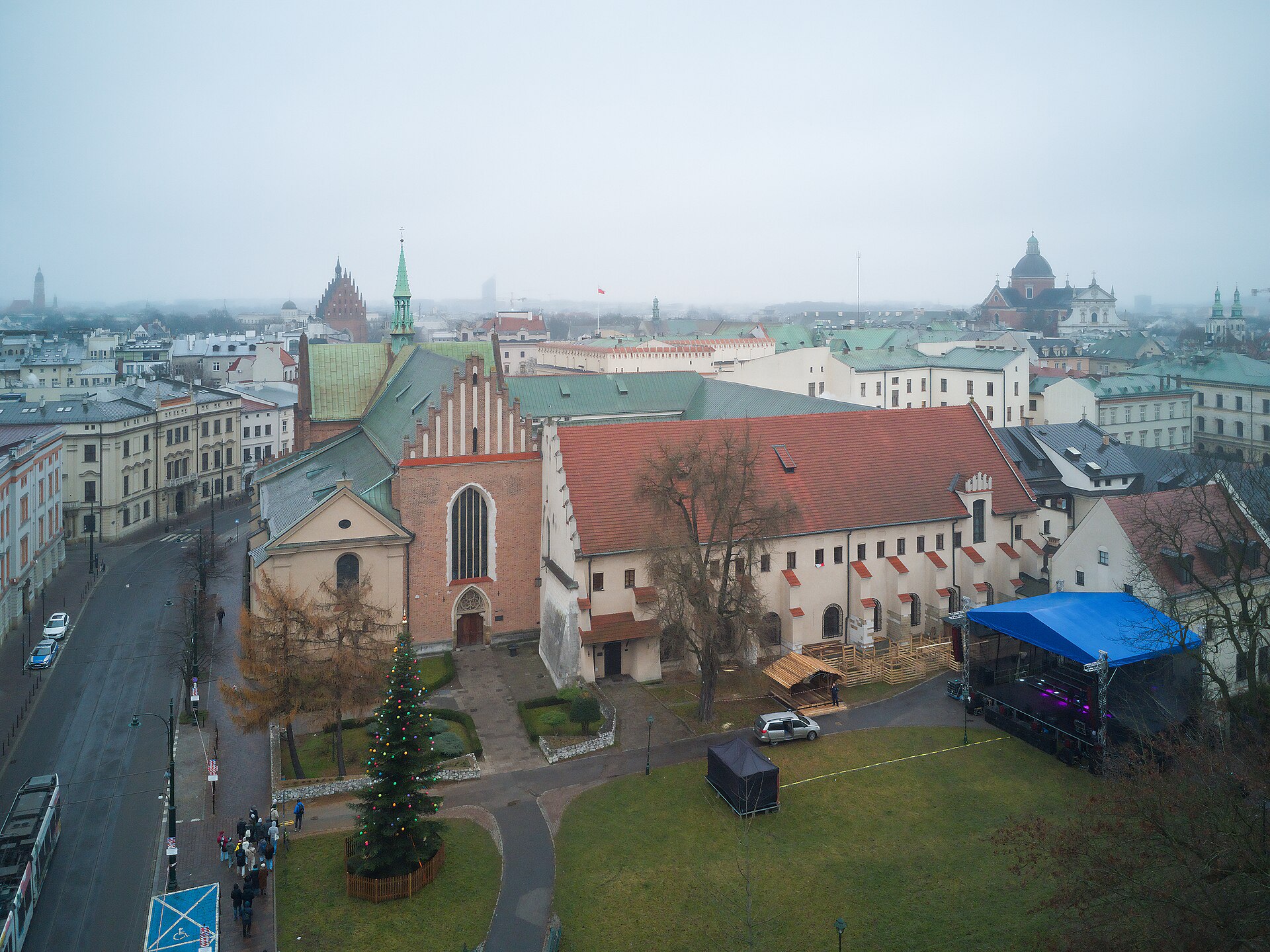
The Basilica of St. Francis of Assisi in Kraków is a historic religious complex serving the Franciscan Order for over seven centuries. Originally founded in the 13th century, the structure has undergone numerous transformations, evolving from its early Gothic origins into a site that blends medieval architecture with significant 19th-century interior renovations.
The basilica is particularly noted for its role as a necropolis for the Piast dynasty, housing the remains of High Duke Bolesław V the Chaste and Blessed Salomea. Its interior is celebrated for its distinctive Art Nouveau polychromy and stained glass windows designed by Stanisław Wyspiański, which represent a unique fusion of religious tradition and modernist artistic expression.
Key Facts
- Materials
- Brick, Sandstone, Stained glass
- Civilization
- Polish
- Accessibility
- Ground level access available
- Date(s)
- 13th century
- Condition
- Active basilica and place of worship
- Original Function
- Monastic church
- Key Figures
- Bolesław V the Chaste, Blessed Salomea, Stanisław Wyspiański
Foundation and Early Years
13th centuryThe church was founded in the mid-13th century, likely with the support of Bolesław V the Chaste. It served as the primary center for the Franciscan Order in Kraków and quickly became a site of royal patronage and burial.
Gothic Development
14th-15th centuryDuring the late medieval period, the basilica was expanded and refined in the Gothic style. The structure served as a focal point for the spiritual life of the city and a repository for the remains of the Piast dynasty.
Modernization and Art Nouveau
19th-20th centuryFollowing a major fire in 1850, the interior underwent extensive restoration. At the turn of the 20th century, the renowned artist Stanisław Wyspiański was commissioned to decorate the interior, resulting in the iconic Art Nouveau frescoes and stained glass that define the basilica's current aesthetic.
Cultural Significance
The basilica stands as a testament to the enduring presence of the Franciscan Order in Poland and the historical intersection of religious and royal life in Kraków. It is a vital site for understanding the evolution of Polish sacred art, particularly the transition from traditional ecclesiastical decoration to the innovative Art Nouveau movement.
Beyond its artistic value, the site remains a place of national memory, preserving the tombs of the Piast dynasty. It continues to function as an active parish and a site of pilgrimage, maintaining its role as a spiritual and cultural landmark within the Old Town of Kraków.
Interpretive Notes
Scholarly debates and areas of uncertainty
Discussions among art historians often focus on the integration of Wyspiański's modernist designs within the medieval architectural framework. Scholars debate the extent to which these 19th-century interventions altered the original Gothic character of the interior versus how they successfully created a new, cohesive aesthetic identity for the basilica.
Visiting Information
Entry Rules
Open daily for visitors. As an active place of worship, please remain quiet and avoid sightseeing during scheduled masses. Modest dress is expected.
Best Times to Visit
Weekday mornings or late afternoons are generally quieter. Avoid visiting during Sunday morning services.
Photography
Photography is permitted for personal use without flash. Tripods and professional equipment require prior authorization.
Preservation Notes
Please refrain from touching the frescoes or historical stonework. Stay within designated visitor areas to protect the delicate interior surfaces.
Nearby POIs
11 shownSources & Further Reading
- [1]Kraków: A History — Adam Zamoyski. Hippocrene Books (1993)
- [2]Stanisław Wyspiański: The Art of the Basilica — Maria Poprzęcka. National Museum in Kraków (2007)
Key Facts
- Materials
- Brick, Sandstone, Stained glass
- Civilization
- Polish
- Accessibility
- Ground level access available
- Date(s)
- 13th century
- Condition
- Active basilica and place of worship
- Original Function
- Monastic church
- Key Figures
- Bolesław V the Chaste, Blessed Salomea, Stanisław Wyspiański