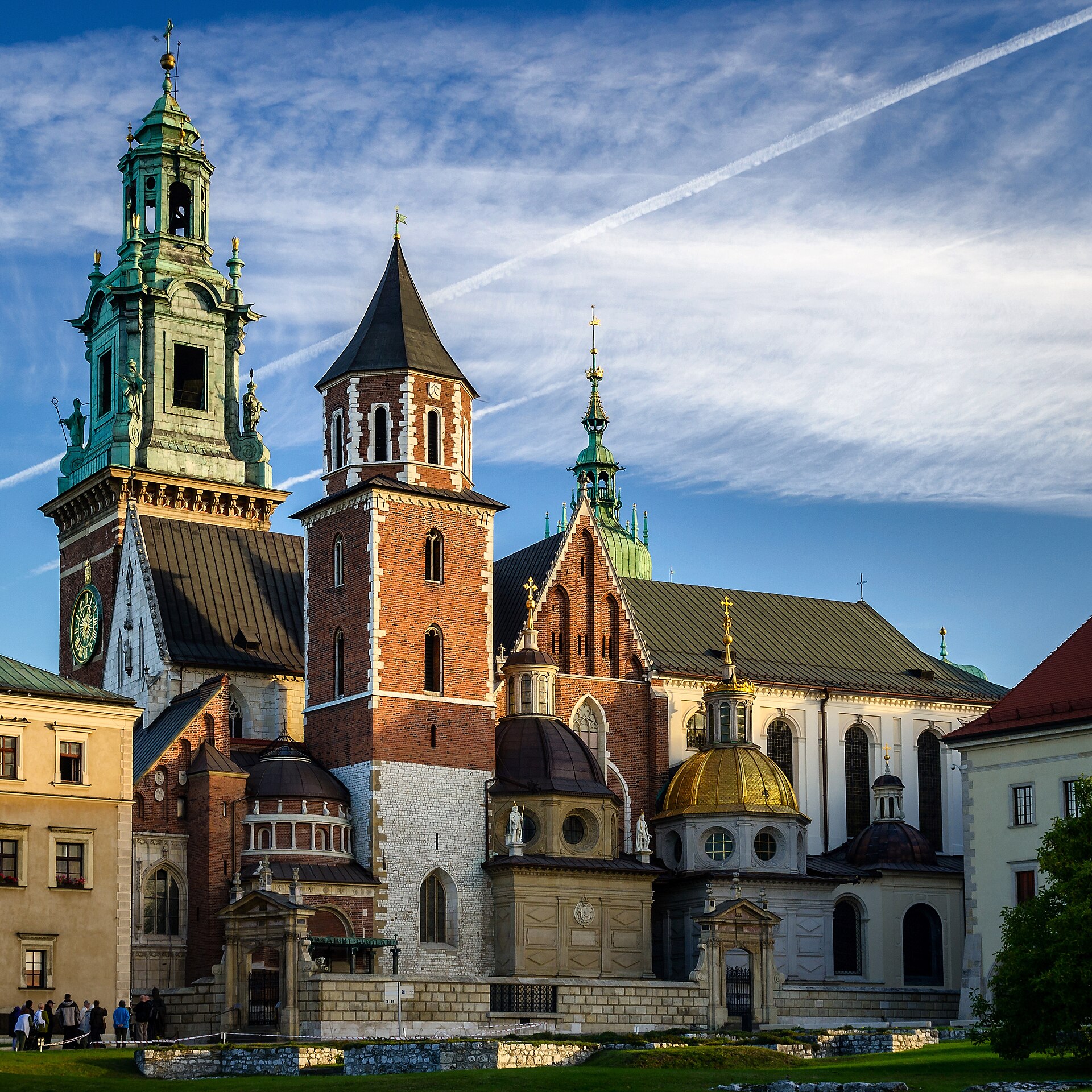
The Wawel Cathedral, formally the Royal Archcathedral Basilica of Saints Stanislaus and Wenceslaus, stands as the most significant religious and national site in Poland. Located on Wawel Hill in Kraków, the current Gothic structure was consecrated in 1364, though it replaced two earlier Romanesque cathedrals dating back to the 11th century. It has served as the traditional coronation site for Polish monarchs and remains the primary necropolis for the nation's kings, national heroes, and poets.
The cathedral is a complex architectural ensemble, featuring a central Gothic nave surrounded by nineteen distinct chapels added across several centuries. Notable additions include the Renaissance-style Sigismund Chapel, commissioned by King Sigismund I the Old, which is widely considered one of the finest examples of Italian Renaissance architecture outside of Italy. The site continues to function as an active Catholic cathedral while serving as a central monument to Polish statehood.
Key Facts
- Materials
- Limestone, Brick, Sandstone, Gilded copper
- Civilization
- Polish
- Accessibility
- Ground level access to main nave; some chapels have limited access
- Date(s)
- 1320-1364
- Condition
- Well-preserved, active cathedral
- Original Function
- Royal coronation church and burial site
- Key Figures
- King Casimir III the Great, King Sigismund I the Old, Saint Stanislaus, Pope John Paul II
Early Foundations
11th-12th centuryThe first cathedral on Wawel Hill was established in the 11th century following the creation of the Kraków diocese. A second Romanesque cathedral, known as the Hermanowska, was consecrated in 1142 but was largely destroyed by fire in 1305.
Gothic Reconstruction
14th centuryBishop Nanker initiated the construction of the current Gothic cathedral in 1320. The structure was consecrated in 1364 and served as the site for the coronation of nearly all Polish monarchs until the capital moved to Warsaw.
Renaissance Expansion
16th centuryUnder the patronage of the Jagiellonian dynasty, the cathedral underwent significant aesthetic changes. The most prominent addition was the Sigismund Chapel, built between 1517 and 1533 by Bartolomeo Berrecci, introducing high Renaissance style to the Polish landscape.
Modern Era and Preservation
19th century-presentDuring the partitions of Poland, the cathedral became a symbol of national identity. In the 20th century, it underwent extensive conservation efforts. It remains a site of major state funerals and religious ceremonies.
Cultural Significance
Wawel Cathedral is the spiritual heart of Poland. Its role as the coronation site and the final resting place of Polish kings, national leaders, and cultural icons like Adam Mickiewicz makes it a primary site of national memory. The cathedral embodies the intersection of religious devotion and political legitimacy in Polish history.
Beyond its political role, the cathedral is a repository of European art history. The architectural diversity of its chapels reflects the shifting cultural influences in Central Europe, from the medieval foundations to the refined Renaissance and Baroque interventions that define its current silhouette.
Interpretive Notes
Scholarly debates and areas of uncertainty
There is ongoing academic discussion regarding the extent of the original Romanesque foundations that remain beneath the current Gothic structure. While archaeological excavations have identified significant remnants, the precise layout of the 11th-century cathedral remains a subject of interpretation among architectural historians.
Visiting Information
Entry Rules
Open daily for visitors. Entry to the cathedral is free, but tickets are required for the Royal Tombs, the Sigismund Bell, and the Cathedral Museum. Modest dress is required as it is an active place of worship.
Best Times to Visit
Early morning or late afternoon on weekdays to avoid large tourist groups. Spring and autumn offer the best conditions for exploring the surrounding Wawel Hill complex.
Photography
Photography is permitted in the main nave without flash. Photography is strictly prohibited in the Royal Tombs and the Cathedral Museum.
Preservation Notes
The cathedral is a fragile historic site. Visitors must remain on designated paths and refrain from touching the sarcophagi or decorative elements. Restoration work is ongoing; some areas may be temporarily restricted.
Nearby POIs
11 shownSources & Further Reading
- [1]Wawel Cathedral: A History — Jerzy Wyrozumski. Kraków Heritage Press (2001)
- [2]The Sigismund Chapel and the Italian Renaissance in Poland — Janusz Bogdanowski. Polish Academy of Sciences (2015)
Key Facts
- Materials
- Limestone, Brick, Sandstone, Gilded copper
- Civilization
- Polish
- Accessibility
- Ground level access to main nave; some chapels have limited access
- Date(s)
- 1320-1364
- Condition
- Well-preserved, active cathedral
- Original Function
- Royal coronation church and burial site
- Key Figures
- King Casimir III the Great, King Sigismund I the Old, Saint Stanislaus, Pope John Paul II