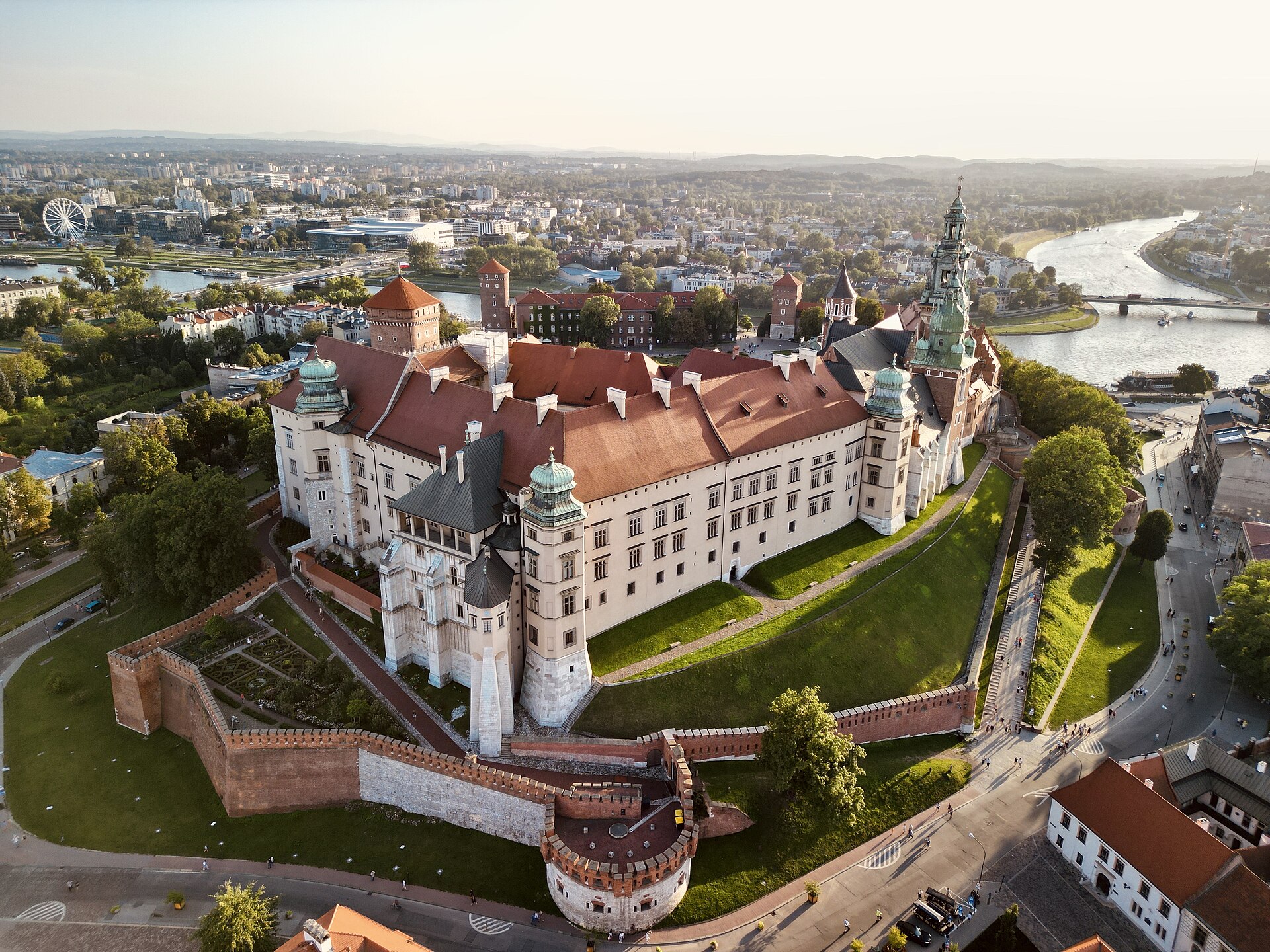
Wawel Castle is a fortified architectural complex situated on Wawel Hill in Kraków, Poland. For centuries, it served as the residence of Polish kings and the symbolic center of the Polish state, reflecting the country's political and cultural evolution from the medieval period through the early modern era.
The site encompasses a diverse range of architectural styles, including Romanesque, Gothic, Renaissance, and Baroque elements. Today, it functions as a national museum, housing extensive collections of royal regalia, weaponry, and the largest assembly of sixteenth-century Flemish tapestries in Europe.
Key Facts
- Materials
- Limestone, Brick, Sandstone
- Civilization
- Polish
- Accessibility
- Partially accessible; some areas involve stairs and uneven historic flooring
- Date(s)
- 10th century - 17th century
- Condition
- Well-preserved, active museum
- Original Function
- Royal residence and administrative center
- Key Figures
- Casimir III the Great, Sigismund I the Old, Bona Sforza
Early Foundations
10th-11th centuryWawel Hill has been a site of human settlement since the Paleolithic era. By the 10th century, it became a primary seat of the Piast dynasty, with the first stone structures, including a pre-Romanesque rotunda, established shortly after Poland's Christianization.
Gothic Expansion
14th centuryUnder the reign of Casimir III the Great, the castle underwent significant expansion. The Gothic royal residence was constructed, solidifying Wawel's role as the primary seat of the Polish monarchy and the site of royal coronations.
Renaissance Zenith
16th centuryKing Sigismund I the Old and his wife, Bona Sforza, commissioned a major reconstruction of the castle in the Renaissance style. The iconic arcaded courtyard was added during this period, transforming the medieval fortress into a grand royal palace.
Decline and Restoration
17th-20th centuryFollowing the transfer of the capital to Warsaw and subsequent partitions of Poland, the castle suffered periods of neglect and military occupation. Extensive restoration efforts began in the early 20th century to return the complex to its former state as a national symbol.
Cultural Significance
Wawel Castle is considered the heart of Polish national identity. It served as the coronation site and burial place for Polish monarchs, and its architecture represents the intersection of Central European and Italian Renaissance influences. The castle remains a potent symbol of Polish sovereignty and historical continuity.
Beyond its political history, the site is a repository of national heritage, housing artifacts that survived the turbulent history of the Polish-Lithuanian Commonwealth. It is a focal point for national celebrations and historical commemoration.
Interpretive Notes
Scholarly debates and areas of uncertainty
The extent of the original Romanesque structures on the hill remains a subject of archaeological investigation. Additionally, debates persist regarding the optimal balance between preserving the castle's various historical layers versus restoring specific sections to their Renaissance appearance.
Visiting Information
Entry Rules
Open daily. Tickets are required for individual exhibitions and the royal apartments. Visitors are advised to book tickets online in advance, as daily entry limits apply to specific halls.
Best Times to Visit
Early morning or late afternoon on weekdays to avoid peak tourist crowds. Spring and autumn offer the most comfortable weather for exploring the castle grounds.
Photography
Personal photography is permitted in most areas without flash or tripods. Professional photography requires prior authorization from the museum administration.
Preservation Notes
Visitors are required to follow marked paths and refrain from touching historical tapestries or architectural surfaces. Large bags must be left in the cloakroom.
Nearby POIs
11 shownSources & Further Reading
- [1]Wawel Royal Castle: The History of the Residence — Janusz Bogdanowski. Wawel Royal Castle Press (2010)View
- [2]The Renaissance in Poland: Architecture and Culture — Maria Bogucka. Polish Academy of Sciences (2005)
Key Facts
- Materials
- Limestone, Brick, Sandstone
- Civilization
- Polish
- Accessibility
- Partially accessible; some areas involve stairs and uneven historic flooring
- Date(s)
- 10th century - 17th century
- Condition
- Well-preserved, active museum
- Original Function
- Royal residence and administrative center
- Key Figures
- Casimir III the Great, Sigismund I the Old, Bona Sforza