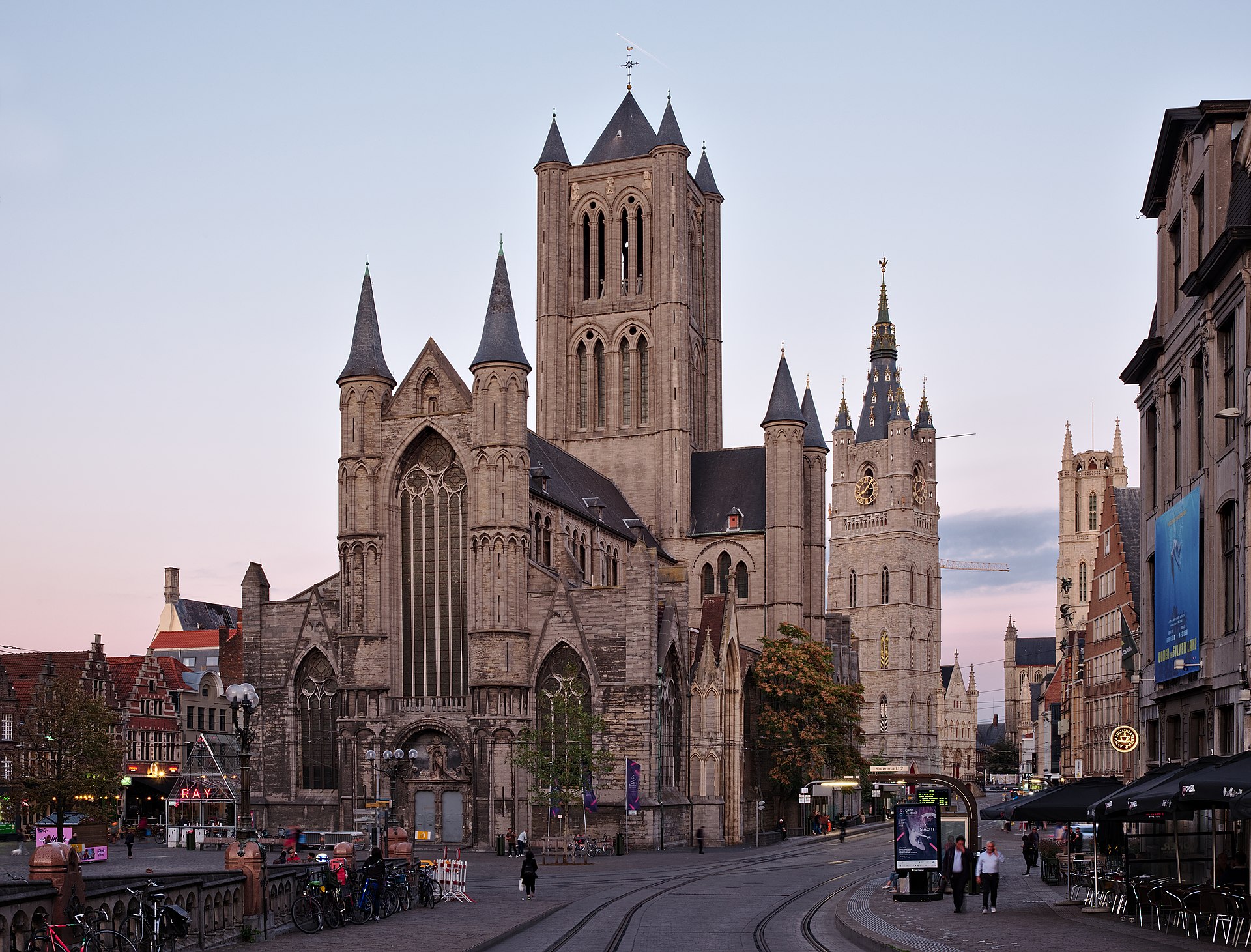
Saint Nicholas Church is one of the oldest and most prominent landmarks in Ghent, Belgium. Constructed primarily during the 13th century, it serves as a quintessential example of the Scheldt Gothic style, characterized by the use of blue-gray stone sourced from the Tournai region.
The church is architecturally distinguished by its central lantern tower, which was strategically designed to allow natural light to illuminate the transept. This feature, combined with its location near the historic Korenmarkt, solidified the church's status as a symbol of the prosperity of the local merchant guilds during the Middle Ages.
Key Facts
- Materials
- Tournai stone, Blue-gray limestone
- Civilization
- Medieval Flemish
- Accessibility
- Ground level access available
- Date(s)
- 13th century
- Condition
- Restored and active
- Original Function
- Parish church
- Key Figures
- Ghent merchant guilds
Origins and Construction
13th centuryThe current structure replaced an earlier Romanesque church. Construction began in the early 13th century, funded largely by the wealth of the local merchant guilds who favored Saint Nicholas as their patron saint.
Architectural Evolution
14th-15th centuryDuring the late Middle Ages, the church underwent several expansions. The distinctive central lantern tower was added to provide light to the crossing, a hallmark of the Scheldt Gothic architectural tradition.
Restoration and Modern Era
20th-21st centuryAfter centuries of wear and structural challenges, the church underwent extensive restoration projects in the 20th century to stabilize the masonry and preserve the integrity of the Tournai stone facade.
Cultural Significance
Saint Nicholas Church stands as a testament to the economic power of the medieval merchant class in Ghent. Its proximity to the Korenmarkt, the city's historic grain market, highlights the deep integration between religious life and commercial activity in the Flemish city-states.
Today, the church remains a focal point of the Ghent skyline alongside the Belfry and Saint Bavo's Cathedral. It is frequently used for cultural events and exhibitions, maintaining its role as a central community space in the heart of the city.
Interpretive Notes
Scholarly debates and areas of uncertainty
There is ongoing academic discussion regarding the structural stability of the central tower and the extent to which the original 13th-century design was modified during the 14th-century expansion phases.
Visiting Information
Entry Rules
Open to the public daily. Entry is free, though donations are encouraged for maintenance. Visitors are expected to maintain a quiet demeanor as it is a place of worship.
Best Times to Visit
Morning hours are best for observing the light effects in the transept. Weekdays are generally quieter than weekends.
Photography
Personal photography is permitted without flash. Tripods and commercial equipment require prior authorization.
Preservation Notes
The Tournai stone is sensitive to environmental pollutants; visitors are asked not to touch the exterior masonry.
Nearby POIs
11 shownSources & Further Reading
- [1]Gothic Architecture in Belgium — Luc Delporte. Flemish Heritage Institute (2015)
- [2]The Churches of Ghent: A Historical Guide — Jan Van der Stock. Ghent University Press (2018)
Key Facts
- Materials
- Tournai stone, Blue-gray limestone
- Civilization
- Medieval Flemish
- Accessibility
- Ground level access available
- Date(s)
- 13th century
- Condition
- Restored and active
- Original Function
- Parish church
- Key Figures
- Ghent merchant guilds